We know this to be true: getting a signature Hermès bag requires monumental patience. There’s a procurement dance of sorts that one needs to be prepared for in order to even be in the running to purchase a coveted quota bag the likes of an Hermès Kelly or Birkin. There are a few good reasons for this, but mainly, it’s a case of demand far outstripping supply—a fortunate problem to have for any business.
It was evident on my visit to 24 rue du Faubourg Saint-Honoré in Paris. The famed address has been home to both the Hermès flagship boutique as well as its leather saddlery workshop since 1880. Like any boutique, the interior is decorated with displays of Hermès’ latest creations spanning its many universes from ready-to-wear to equestrian paraphernalia. The leather bags section on the second floor is no different, with pieces in varying hues and materials filling up clear display cases. The difference: every single piece is purely for display as shown by a small metallic sign that accompanies almost every bag.
Online enquiries for bags directed to the Faubourg boutique alone reaches about 15,000 per day. Even if a specific model is available, its colour and type of leather are hardly considerable options. I walked behind a lady seated at a desk in a corner of the boutique. A sales staff attending to her shared apologetically, “Unfortunately, this is the only design I have for this model,” when a different colour was requested.
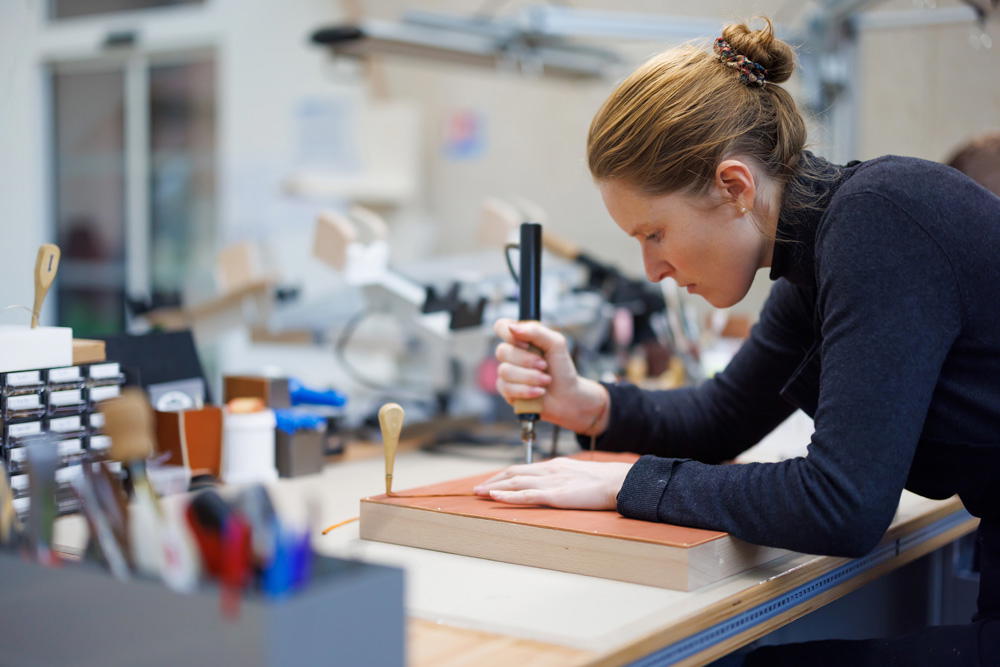
It’s understandable to suspect that Hermès may be using the scarcity tactic, intentionally limiting supply such that owning a piece becomes even more coveted. The truth is simpler. An Hermès leather good is crafted entirely by hand. A bag typically takes about 20 hours to complete, and with standard French labour laws dictating a 35-hour workweek, that’s equivalent to just a bag per artisan per week.
Plans are already in place to ramp up production while still retaining Hermès’ emphasis on meticulous handcraft. Since 2020, the house has made several announcements of a total of five new leather workshops to be opened by 2026 in various parts of France. They will be partnered up with French employment agencies and educational institutions as part of the house’s recruiting and training strategy.
The first of the five—and the twenty-first to date—was officially inaugurated on 7 April 2023. The Maroquinerie de Louviers also marks the second site in Normandy, and together with the Maroquinerie de Val-de-Reuil (established in 2017) form Hermès’ Normandy hub.
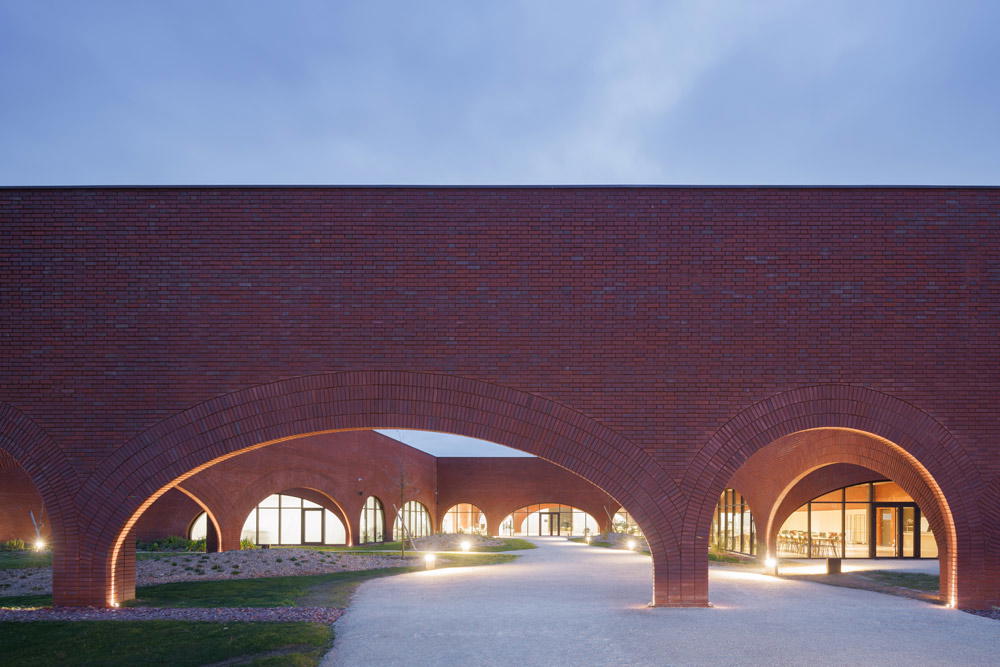
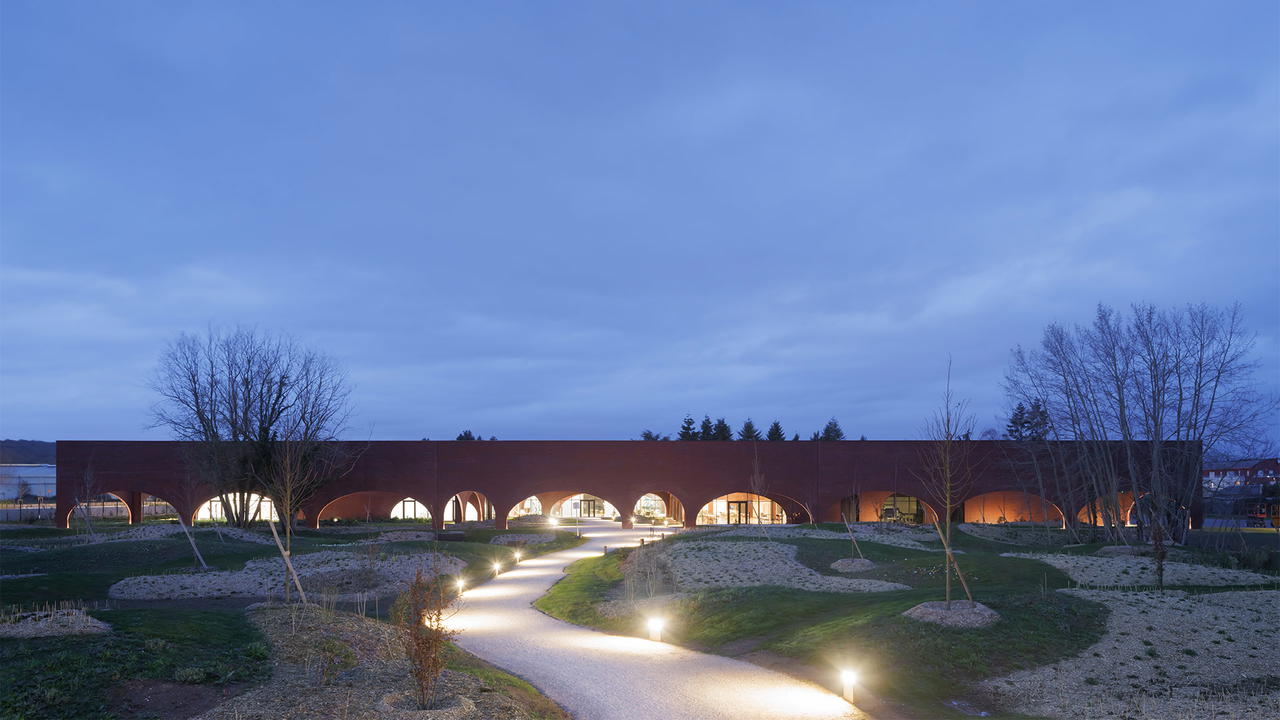
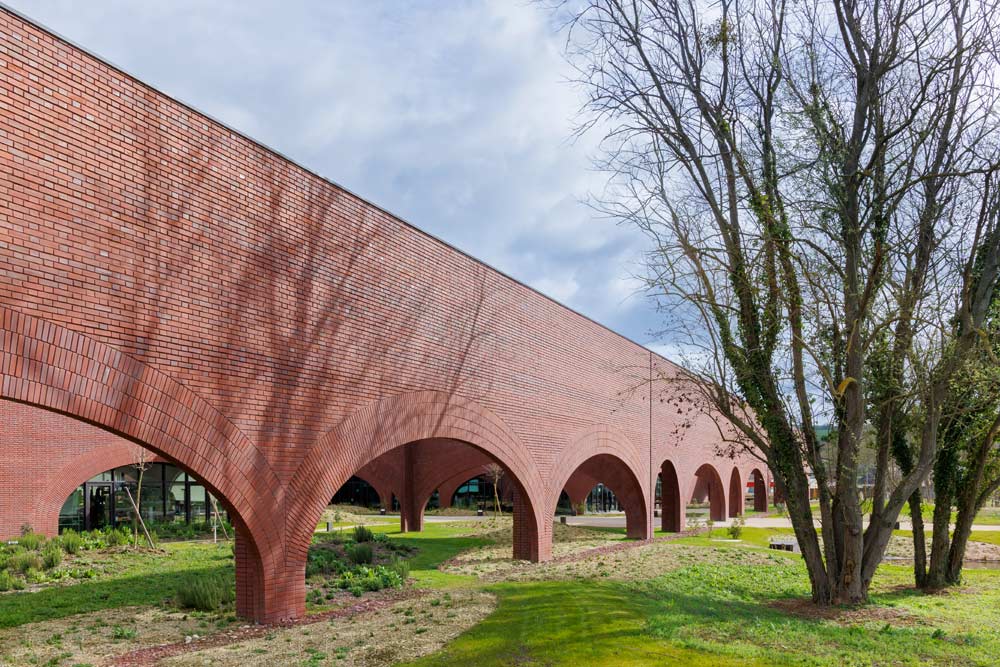
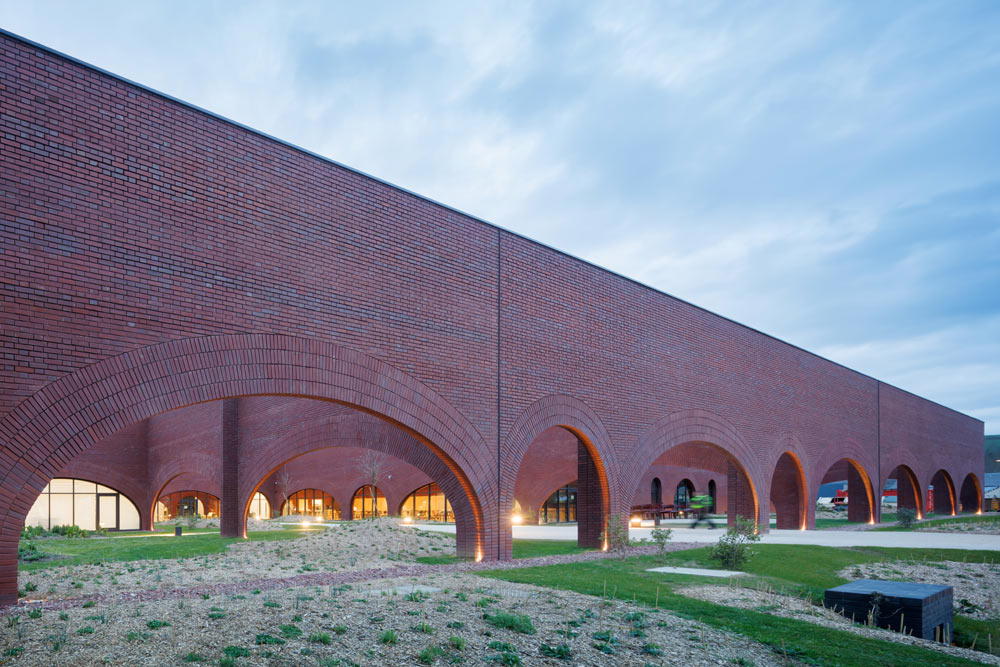
From a distance, the Maroquinerie de Louviers looks nothing like what one would expect of a leather workshop. The architecture is anything but industrial—no cold, almost clinical façade, and it most definitely doesn’t fade into any of the surrounding buildings in the area. The design concept is the work of French-Lebanese architect Lina Ghotmeh, who’s known for her humanist approach to architecture. The first distinctive feature of the Maroquinerie de Louviers are arches that follow through the perimeter of the building. Together, they echo the continuous trajectory of a jumping horse—a key insignia of Hermès. And while it’s not apparent from ground level, the 6,200m2 workshop is shaped like a square, again reminiscent of another Hermès icon: the silk carré.

Photo: Gilbert Hage.
Those are the only somewhat literal connections to Hermès; the rest are more nuanced. In line with the vision of the house, Ghotmeh’s design took into account as many eco-conscious aspects as possible, both during the construction phase as well as the day-to-day operations of the completed building.
“One of the ambitions was to do this very ecological building, and push even further this relationship to nature into a complete symbiosis,” Ghotmeh tells me. “Something that is very dear to me is how we can really make architecture work in synchronicity with nature. Here, it’s not only about the form of the building that contributes to that, but all the technicality of it. If you go to the roof, you’d see the guts of the building, how it works and optimised using clean energies.”
For starters, it was a considered decision to constrain production as locally as possible. The entire façade of Maroquinerie de Louviers comprises bricks produced about 70 kilometres from Louviers in order to minimise environmental impact as well as to root the entire project within the Normandy region. More than 500,000 bricks in total were laid by hand to construct the wooden-framed workshop.
Lighting was an important aspect especially given how Hermès artisans require sufficient light to ensure precision while crafting. Large panelled windows echo the shape of the exterior arches and run along all sides of Maroquinerie de Louviers. They’re supplemented by skylights slanted at an angle to direct sunlight in to fill the interiors of the workspaces—all to help limit the need for artificial lighting. To power the entire complex, energy needed comes in the form of geothermal energy and the rooftop’s excess of 2,300m2 of solar panels. A combination of both ensures an energy autonomy.
“They wanted to build the first workshop that was ambitious environmentally, but it fit very nicely with values that I hold so it was very much a privilege for me as an architect to be able to also achieve my personal ambitions with Hermès. Because you have to push things and it really takes teamwork to arrive at such a result,” expresses Ghotmeh.
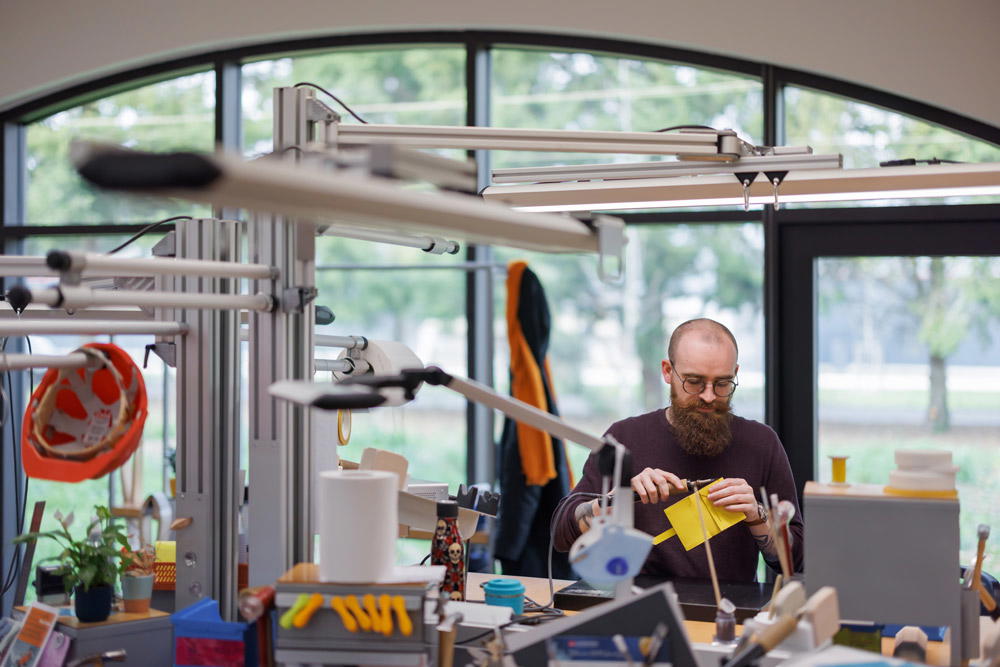
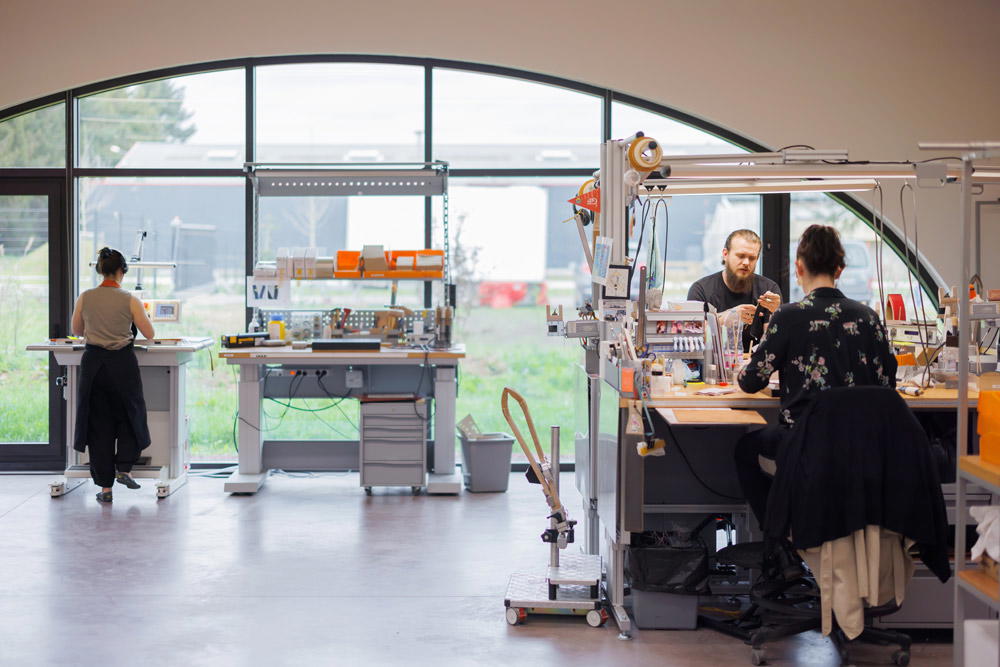
That’s all to say that Maroquinerie de Louviers is a feat of sustainable industrial architecture. It’s the first industrial building to date to earn the French E4C2 label. The assessment certifies that the workshop satisfies both the energy- and carbon-efficiency criteria at the highest achievable levels of the label.
“The care of the well-being of the artisans was also really primordial in the brief for this project. This for me was very touching because what I like to do is really have a place where people feel good,” shares Ghotmeh. “It’s not just an industrial place of, you know, doing work. More than that, every artisan is very much linked to the object that they’re producing and there is a kind of sense of continuity. I was wondering, ‘How can I actually reflect on that precision and on that well-being through architecture, and allow it to be like a medium for people to enhance—even the artisans—the relationship to the work.’”
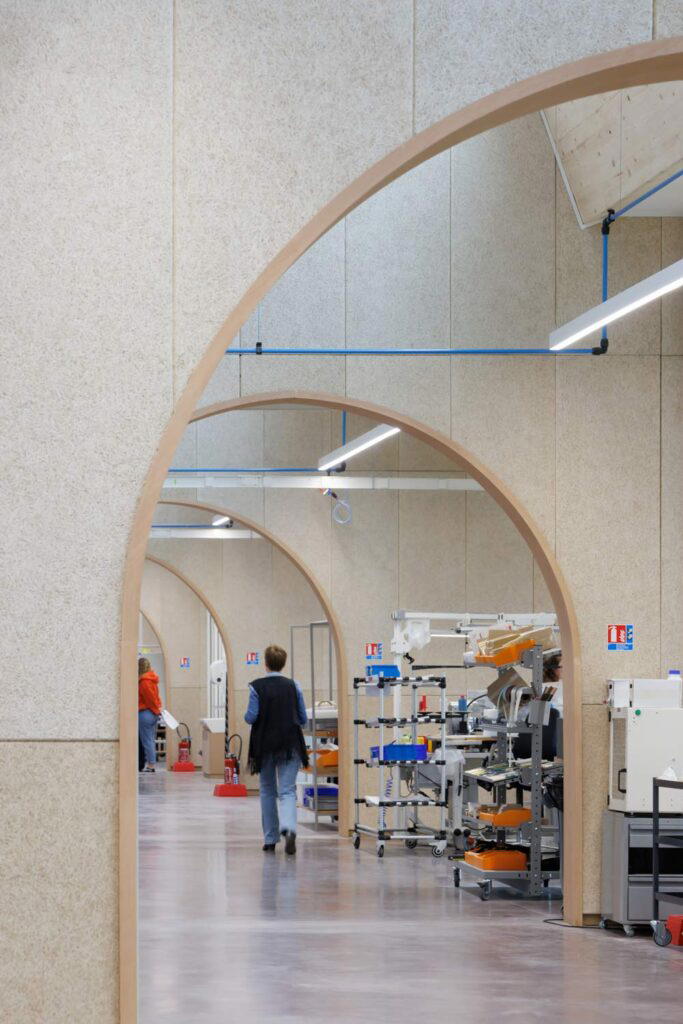
Photo: Iwan Baan.
The moment one enters the main entrance of Maroquinerie de Louviers, the saddlery workshops are located to the left. This is the second Hermès saddlery workshop in existence as all things equestrian had only been crafted from the workshop right above the Faubourg flagship from the very beginning. It is here where artisans supplement the crafting of Hermès’ four saddle designs as well as bridles. The assembly workshop sits right next to the leather-cutting workshop with an open arch separating the two spaces so that both departments can communicate freely.
The same thought went into organising the bags and small leather goods workshops. The cutting and assembly areas are similarly connected in seamless fashion. At Maroquinerie de Louviers, artisans specialise in making the Hermès Kelly, the Kelly To Go series as well as a number of small leather goods.
The art of the hand is Hermès’ raison d’être. An artisan—whether one who specialises in saddlery or leather goods—individually works on an entire piece from start to finish. Saddlers develop a close relationship with horse riders as each saddle is crafted unique to both the horse as well as its rider. Leather goods artisans take care and precision to ensure that each creation is crafted to upmost perfection, but like any other form of handmade practice, there are bound to be nuanced differences. These are individual to each artisan, so much so that they’re able to distinguish a piece that they had personally worked on—a testament to the number of hours spent with one.
Hermès has come up with a strategy to promote its own brand of artisanal craftsmanship. In 2022, the Louviers École Hermès des savoir-faire was opened to train aspiring artisans in support of the Normandy hub. Each of Hermès’ nine production hubs consists of an École Hermès des savoir-faire to assist in the transmission of know-how within the region. Each course—leatherworking, cutting, and stitching—spans a year and three months and is completely free; apprentices are also paid a salary. There is, however, no obligation for qualified graduates to join Hermès at the end of their training.
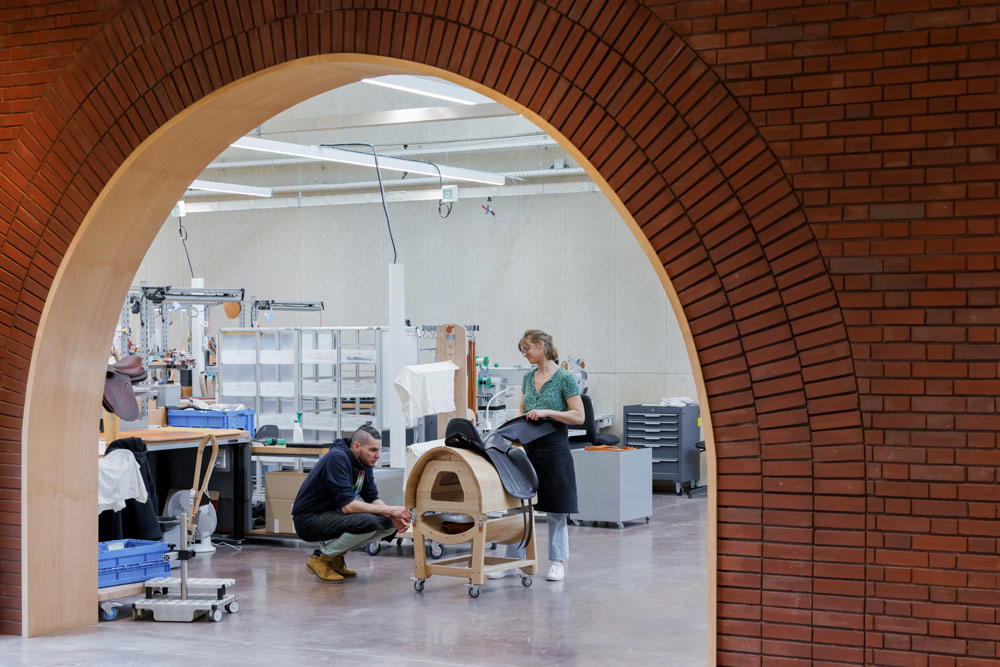
Photo: Iwan Baan.
Echoing the commitment to craft and the environment is Fondation d’entreprise Hermès that was set up in 2008. The foundation has been holding a Skills Academy programme every two years since 2014, where professionals are invited to participate and bring together their collective expertise and know-how to explore innovative approaches to a given material. The latest edition is dedicated to stone and is being overseen by Ghotmeh.
“It’s about trying to really understand the material and its history, the resources that we can find in France, what we can do with stone and how to actually bring it back as a contemporary material, which is happening today. We need to use more natural materials to be able to be more carbon neutral and energy positive. Stone is one of these materials that is geo-sourced, and that you can reuse,” explains Ghotmeh.
She refers to the foundation as independent from what Hermès is universally famed for. But as a whole, Hermès is all about time-honoured craftsmanship and their applications in ways that are conscious of the well-being of self and of everything around. For example, the building of Maroquinerie de Louviers required soil excavation and as a way of preserving the local diversity, it’s then used to create three hectares of undulating gardens within the compound as conceptualised by Belgian landscape architect Erik Dhont. Most of the site’s original trees have been kept too.
It was hard to not notice that the artisans at Maroquinerie de Louviers have such passion for their work and seem to enjoy it. They’re each allocated a permanent workstation and as I moved randomly from one to another, I could spot personal photographs and knick-knacks that add their own individual stamp to the space—quite like what happens to their covetable creations.
Four more workshops are in the works for now. It’s by no means a huge number, especially in today’s context of high-production capabilities. But it makes little sense to shorten production times in order to chase sales, only for the quality of craftsmanship to suffer. It’s definitely not the Hermès way. It takes time to pass down skills and knowledge, and even more to achieve the level of experience that’s needed to craft an Hermès creation.
So you may still have to continue waiting for an Hermès Kelly (or a number of other models). But know that it’s being looked after by a single artisan somewhere in France; perhaps even from within the brick walls of the Maroquinerie de Louviers.