It’s one of the world’s fastest-growing sports, with over 25 million people enjoying it globally. According to Google, interest in padel has grown 385 percent in the past five years, based on search trends. Now, it has reached our part of the world.
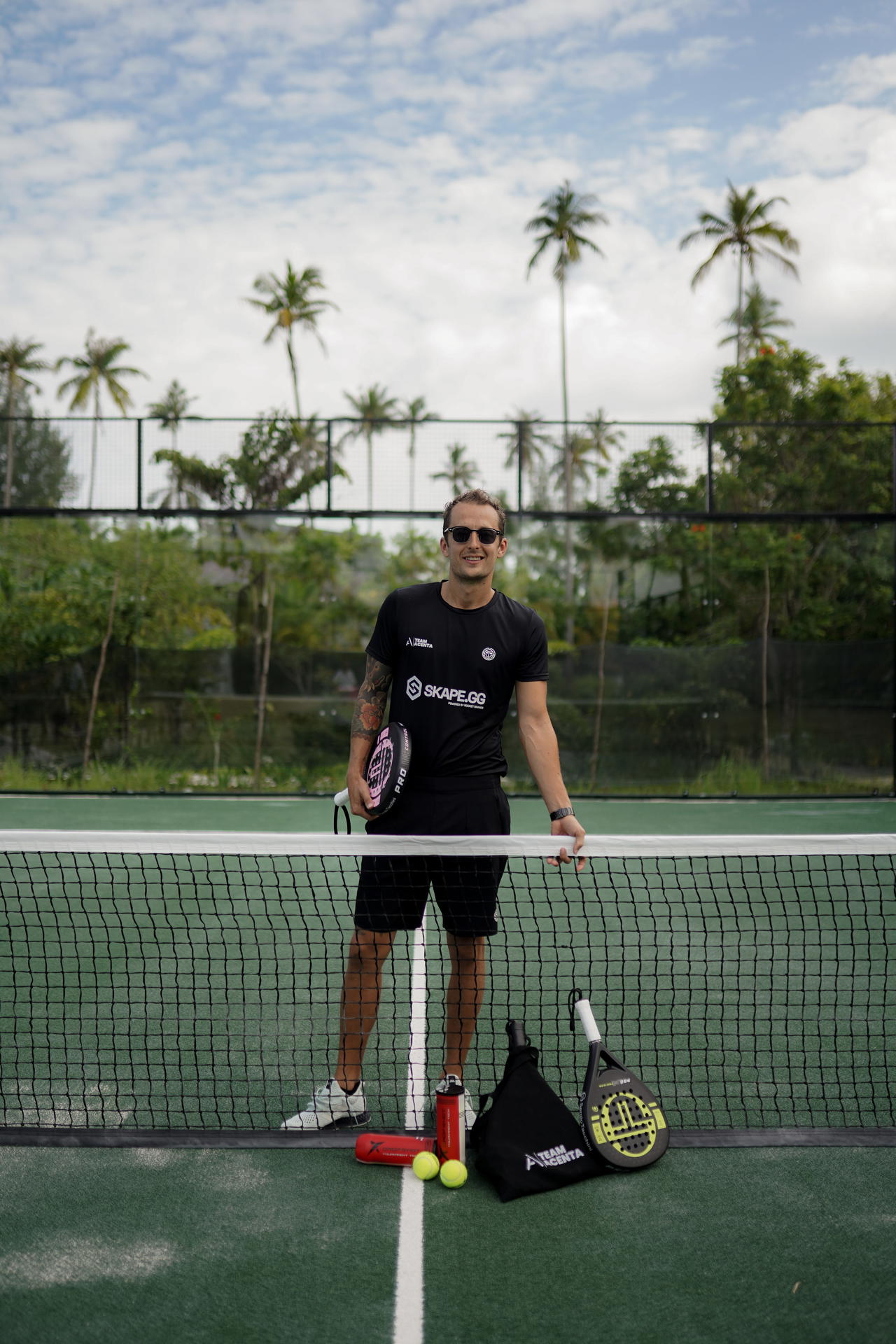
Felix Kaldal builds padel courts. The co-owner of Acenta Asia travels the world to assemble the glass walls, metal mesh, and green turf, and notes that he’s been to South-east Asia a lot more in the past year.
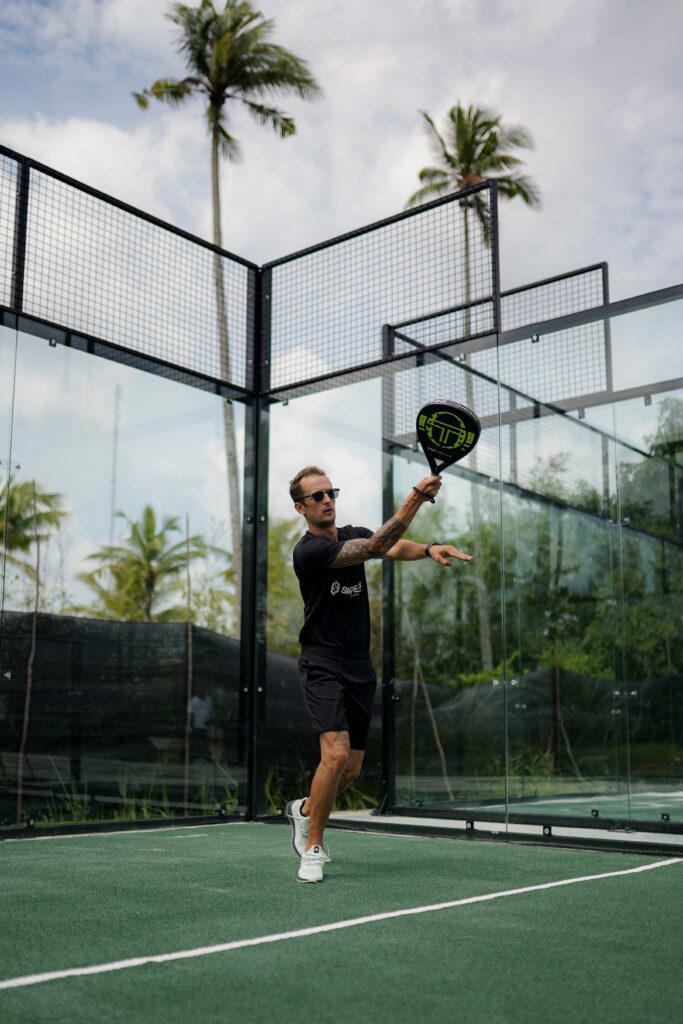
“I put together a court in Indonesia, some in Singapore, and a few in Phuket. Hotels and resorts are getting more visitors asking if they have padel courts, so there’s an increased interest in it,” says Kaldal.
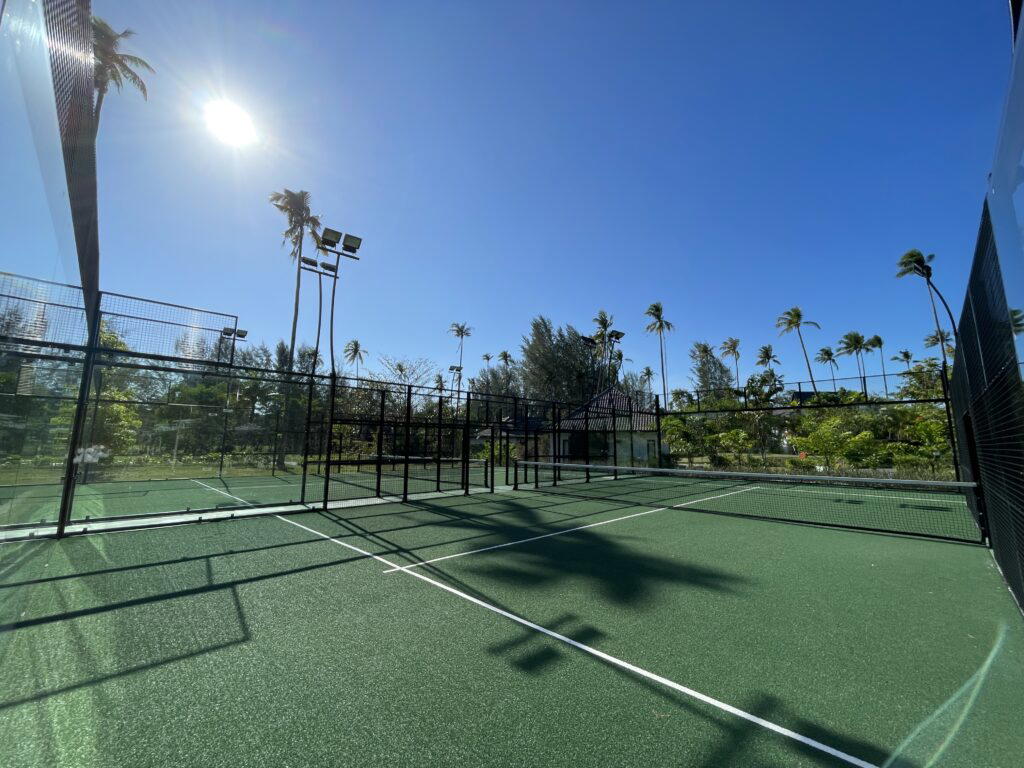
His latest completed project can be found at The Sanchaya in Bintan. It’s a magnificent piece of work, with gorgeous see-through tempered glass, solid turf grass, and floodlights that illuminate the two doubles courts when the sun sets. The resort’s owner first played the sport in Singapore and fell in love with it. So, she approached Kaldal.
Padel’s appeal is simple. It’s incredibly easy to pick up. Children and adults with no knowledge of the game will be hitting balls across the net after an hour’s worth of instructions. Also, it doesn’t require an extraordinary level of fitness, unlike tennis, which can leave people with sedentary lifestyles gasping for air.
More importantly, it promotes social interaction. Padel is best played in a doubles format, and the smaller court size means players can chat without resorting to shouting. This also means there are more communities centred on the bonds formed, and less of the competition prevalent in some of the other sports.
From a business perspective, Kaldal points out that one tennis court can accommodate three padel arenas. The space is used more efficiently and has a higher potential hourly yield. So, the return on investment is significantly better than tennis. The initial capital expenditure, however, can be daunting. A court costs upwards of US$50,000 (S$68,234) to build.
First, you need to import the glass, which is specially made to withstand the abuse it will endure, from balls hitting it to rackets and even humans crashing into it. Kaldal usually recommends a 12mm thickness. “They can absorb a lot of shock. I’ve seen heavier players smashing the glass walls and there is barely a scratch. Standard courts can resist strong, constant winds of up to 110kph. I’ve even built hurricane-proof courts, which stay strong even when the winds reach 230kph. The glass remains the same, but the weight of the columns are doubled to make sure everything stays in place,” says Kaldal.
Second, laying concrete, turf, glass, metal, and more requires labour and special equipment. While it may take only five days to craft a padel court from scratch, evaluating the location and importing the necessary equipment and materials takes many more days. It’s one reason why padel courts remain largely the domain of the well-heeled. In America, padel courts are mostly located in affluent areas, such as country clubs and gated communities, where it is popular among the deep-pocketed. Similarly, starting the sport in Europe can be expensive.
Entry-level rackets are priced in the hundreds and need to be replaced regularly due to wear and tear—and the occasional accidental smack of the glass. Kaldal estimates that someone who plays a few times a week will need a new racket every couple of months. They’re also made from carbon, a pricey material.
Despite this, padel in South-east Asia seems to be growing more sustainably. Professional padel player and veteran coach Luis Ruiz has been teaching the game in Thailand for a couple of years and has seen it grow rapidly. From one court in the country, there are now over 15. Several locals have also started playing it more professionally, including Ruiz’s Thai partner, who is the top-ranked female player in the country.
The Spaniard first started playing tennis but switched to padel because he saw its explosive popularity. “Tennis has been the same for many years in Thailand. Padel, however, has been expanding, so I saw an opportunity to pick it up,” says Ruiz.
Similarly, Kaldal has been busy with the deluge of inquiries. For 2024, he will be building 30 new courts around the world. “But I suspect there will be more,” he says, laughing. “I can get a phone call a day from a hotel asking if I can build a court within four weeks.”
With the one at The Sanchaya done, Kaldal is jetting off to another part of the world to oversee another project. He’ll miss the sun, he tells me, and suspects he’ll be back in Bintan again, if only to play padel.