Every meaningful, well-designed space begins with the people who live or work there. Design shaped by human experience has, over time, expanded to factor in the environment. As it stands, buildings account for nearly 40 percent of global carbon emissions. Rising temperatures and storms are increasingly becoming a part of our daily life in Southeast Asia. In architecture, this has raised questions such as how does the built environment affect climate change, and how can it evolve to meet the challenges ahead?
Sustainable design is no longer about causing less harm. It now balances environmental responsibility with human well-being and long-term value. Both function and circularity play a role when selecting materials, and waste is considered a design problem, not an afterthought. Nature is also drawn in—not shut out—by air, light, and living systems that restore.
Today’s buildings are expected to evolve with their environment, endure climate shifts, and respond to changing needs. In Singapore, this philosophy is becoming policy, with a national goal to “green” 80 percent of our buildings by 2030.
ENVIRONMENTAL VALUE
This evolution is also reshaping how architecture studios define purpose. When TA.LE Architects was founded in 2014, our goal was clear: to design spaces that connect with people. Over time, that vision has expanded to respond to a rapidly-changing world where design must balance how a space feels with how it performs.
This has led to a deeper commitment to circular design, in which materials are reused, refurbished, recycled, and used in other regenerative ways. Sustainability is no longer an add-on to a process, but shapes it from the ground up. By working with upcycled or responsibly sourced materials, each of our projects is designed to reduce waste and generate long-term environmental value.
Sustainable design begins by rethinking the everyday. At City Square Mall, Singapore’s first eco-mall, we bring this approach to life through unexpected materials that reduce embodied carbon and enrich the visual experience. The ceilings are textured with bamboo chopsticks, the insulation is bubble wrap, and the bricks are PET bottles. In addition, the flooring consists of carpet offcuts and worn tennis balls are embedded into rubber surfaces. Every element reflects a design philosophy that values resourcefulness, turning discarded objects into purposeful, tactile spaces.
While sustainable design is not solely about aesthetics, it often includes biophilic design, the practice of incorporating natural elements into built spaces to strengthen our connection with nature. This approach is especially relevant as urbanisation continues to limit access to green spaces.

Photo: Rendy Aryanto.
In the redesign of Changi Airport Terminal 1, our team embraced biophilic principles to reflect Singapore’s long-term “Garden in the City” vision, integrating lush greenery into everyday city life. The result is an environment that is not only functionally sustainable but also supports well-being by bringing light, greenery, and organic forms into daily spaces.
BUILDING THOUGHTFULLY
Likewise, sustainability now also demands practical solutions, such as reusing materials and installing energy-efficient systems, to address the growing carbon footprint of the built environment. One way this takes shape is through the adaptive transformation of existing structures into low-impact, purposedriven spaces.
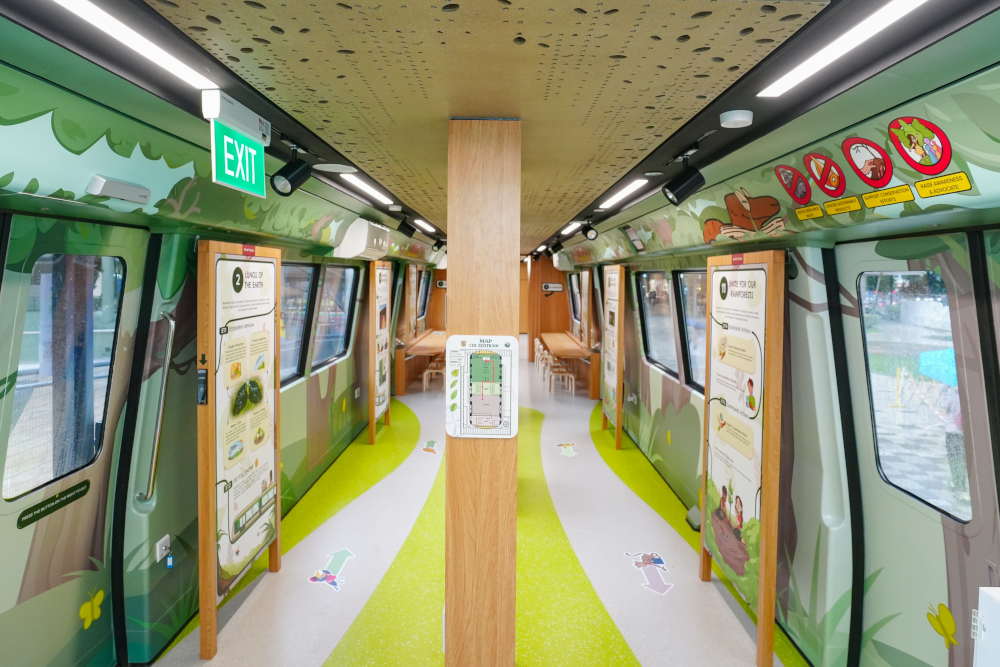
For example, The CDL Ecotrain, part of our larger City Square Mall renovation project, is a decommissioned MRT cabin reimagined as a zero-energy learning gallery. Rather than demolish it, we applied solar reflective paint, energy monitoring systems, and passive cooling strategies to reduce its environmental impact. In other areas of the mall, we’re re-adapting some of the existing materials and structures as well, including the wooden railings and long balustrades.
Projects like this show that sustainable design doesn’t always require a complete overhaul. Sometimes, it’s about building thoughtfully on what already exists. As such, designing for sustainability in Southeast Asia requires a local mindset. Our climate is hot, humid, and intense, so buildings here need to respond accordingly.
That’s why many of our strategies are tailored to this climate, including high ceilings for better airflow and rooftop solar panels that harness the sunny weather, as seen in our Singapore Sustainability Academy Annex as part of the City Square Mall revamp.
Some features are even drawn from traditional practices, such as bamboo screens for shading. The result is a nostalgic nod to the past that fits our present context, a reminder that sustainability can elevate both function and form.
Architecture must become more climate responsive, flexible, and rooted in the needs of its communities. With homes serving as offices and malls as lifestyle centres, comfort, health, and resilience are becoming increasingly important for our surroundings. Buildings of today must be adaptable to the uncertainties of tomorrow, be it rising temperatures or shifting lifestyles.
As Singapore works towards the Green Plan 2030, I’m hopeful that sustainable architecture will no longer be a luxury but the norm. TA.LE Architects is committed to driving this change, designing spaces that are both environmentally responsible and accessible. I hope others—architects, developers, and individuals—will join us in reimagining the future of our built environment.