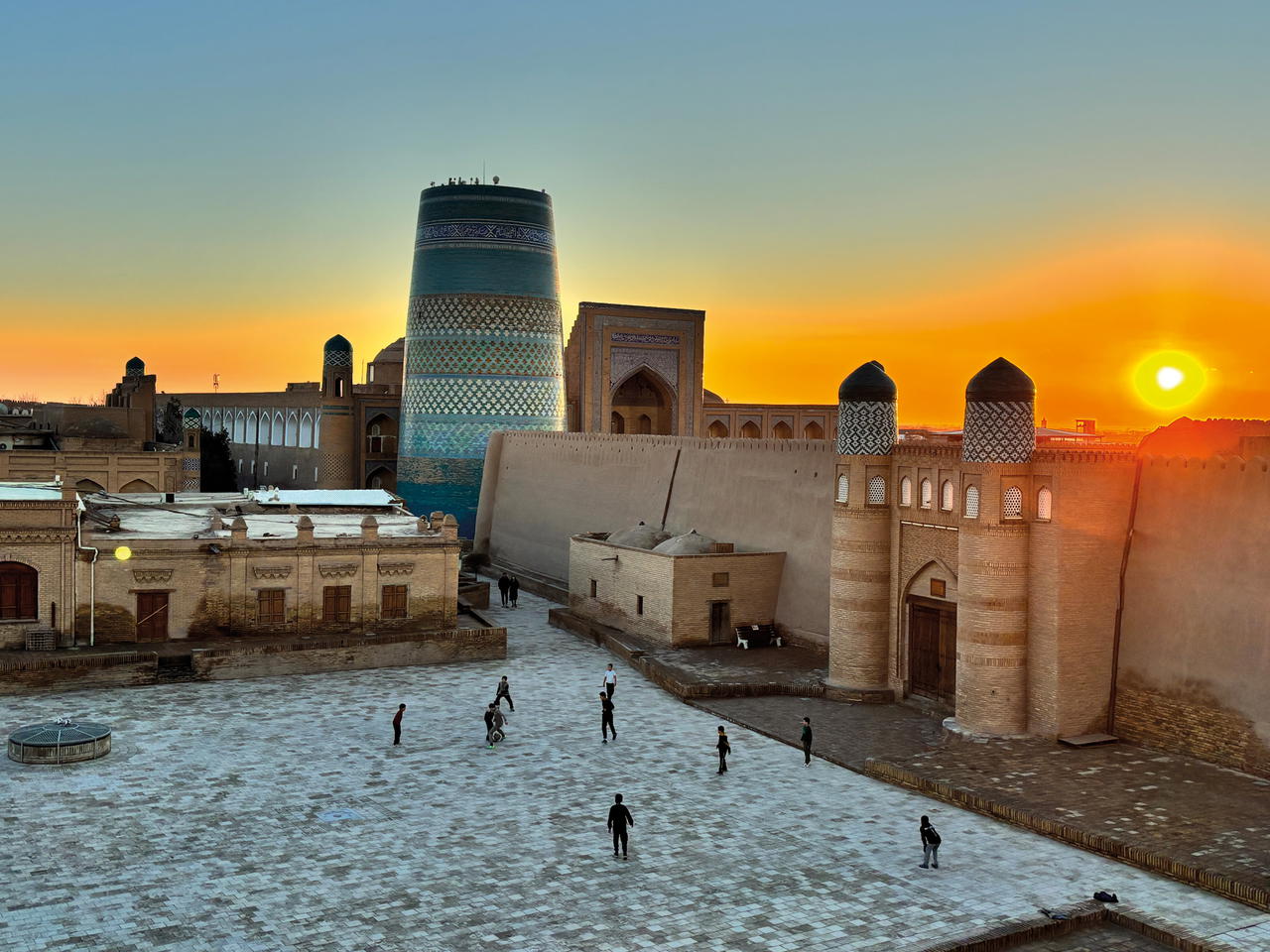
Sun-baked ramparts, turquoise domes, and slender minarets come into view as we approach Khiva, emerging from the vast sweep of the Kyzylkum Desert. After hours of sand and sky, the mediaeval walls of adobe and brick rise like mirages the colour of warm bread freshly pulled from a tandoor once used to keep marauders at away.
Located in Western Uzbekistan, between desert sands and the fertile valley of the Amu Darya, Khiva was founded as a powerful Silk Road stronghold more than 2,500 years ago. Its first inhabitants came from Iran, and it served as the final resting place for caravans on the ancient Great Silk Road before they crossed the desert towards Iran.
Khiva also had a dark past of brutal slave trade until the 19th century, yet during the reign of the Khans, the city flourished as a centre of art, culture, and learning. At its heart lies Itchan Kala, the inner walled city and Central Asia’s first Unesco World Heritage Site.
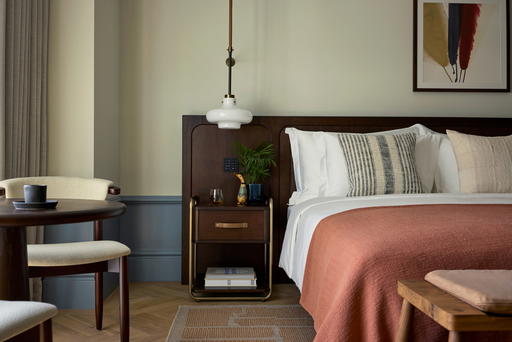
From a distance, Khiva appears almost self-contained, its crenellated walls concealing centuries of trade and art. We check into the Hotel Farovon Khiva, whose walls are adorned with paintings and craftwork. At the reception area, old vessels with inscriptions stand in glass cases. Our first evening begins with a tour of Itchan Kala, very much the home of one of the country’s most cohesive artistic traditions, led by Madiyar Rakhimov, our guide from Orient Star Group, one of the country’s largest tour operators.
Just like the other guides in the other Uzbek cities, he speaks good English, is passionate about his country, and is eager to share it with us. According to Madiyar, Khorezm, the ancient region that once thrived here, was a crossroads of civilisations. Silk Road caravans brought more than silk and spices; they brought mathematics, astronomy, theology, poetry, and ideas.
Though the historic monuments have closed for the day, he reminds us that this is not an open-air museum. More than 3,000 residents still live within these ancient walls. Children chase footballs across the cobbled lanes while mothers push prams in the fading light, their conversations echoing softly against the mud-brick facades.
Living Tapestry Of Craft & Culture
Metallic statues punctuate the streets, capturing intimate vignettes of daily life—two men conversing over a steaming samovar and children savouring juicy watermelon slices. Each August, the region honours its famous fruit with an annual Watermelon Festival featuring exhibitions, tastings, traditional folk performances, and cultural workshops.
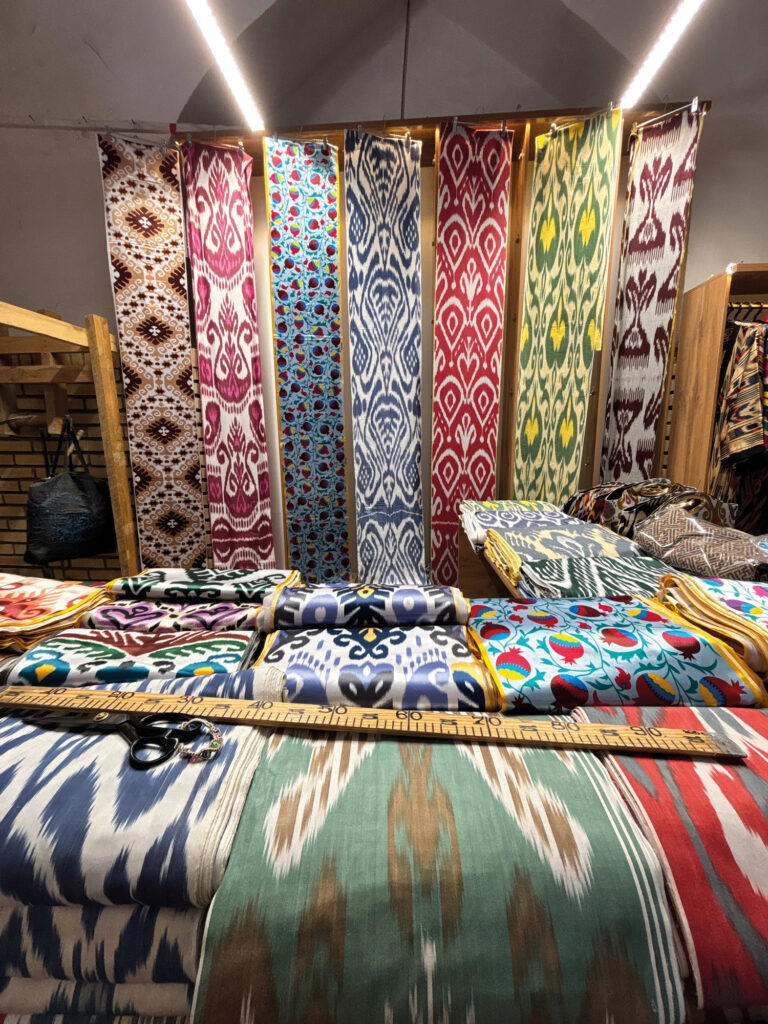
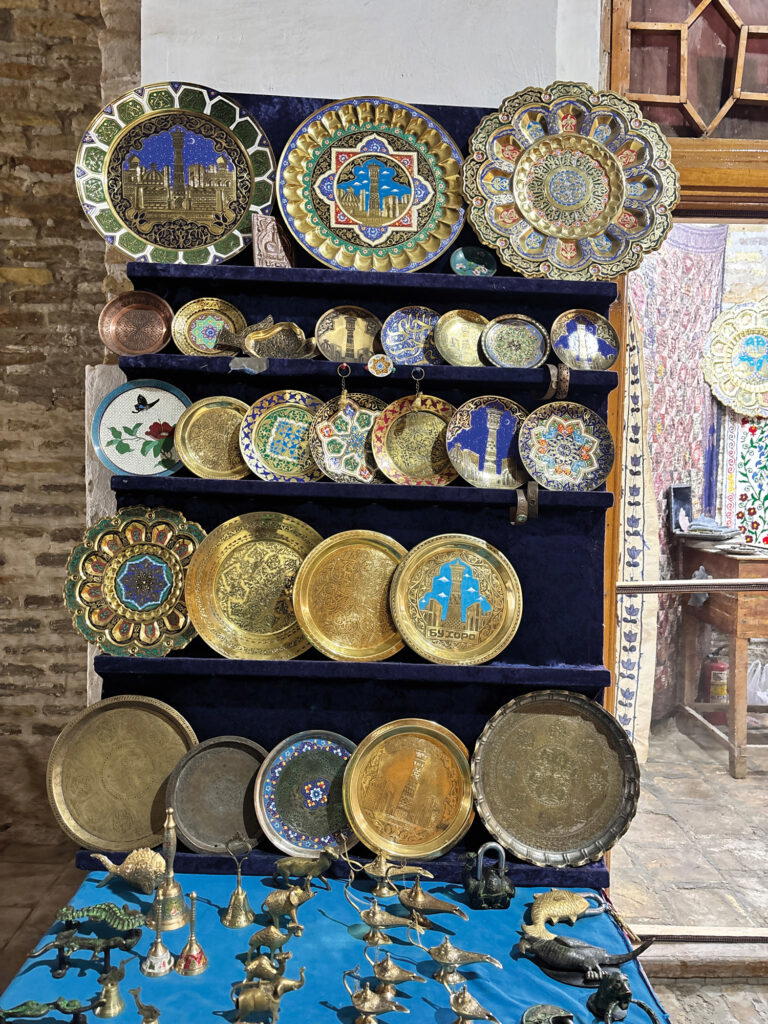
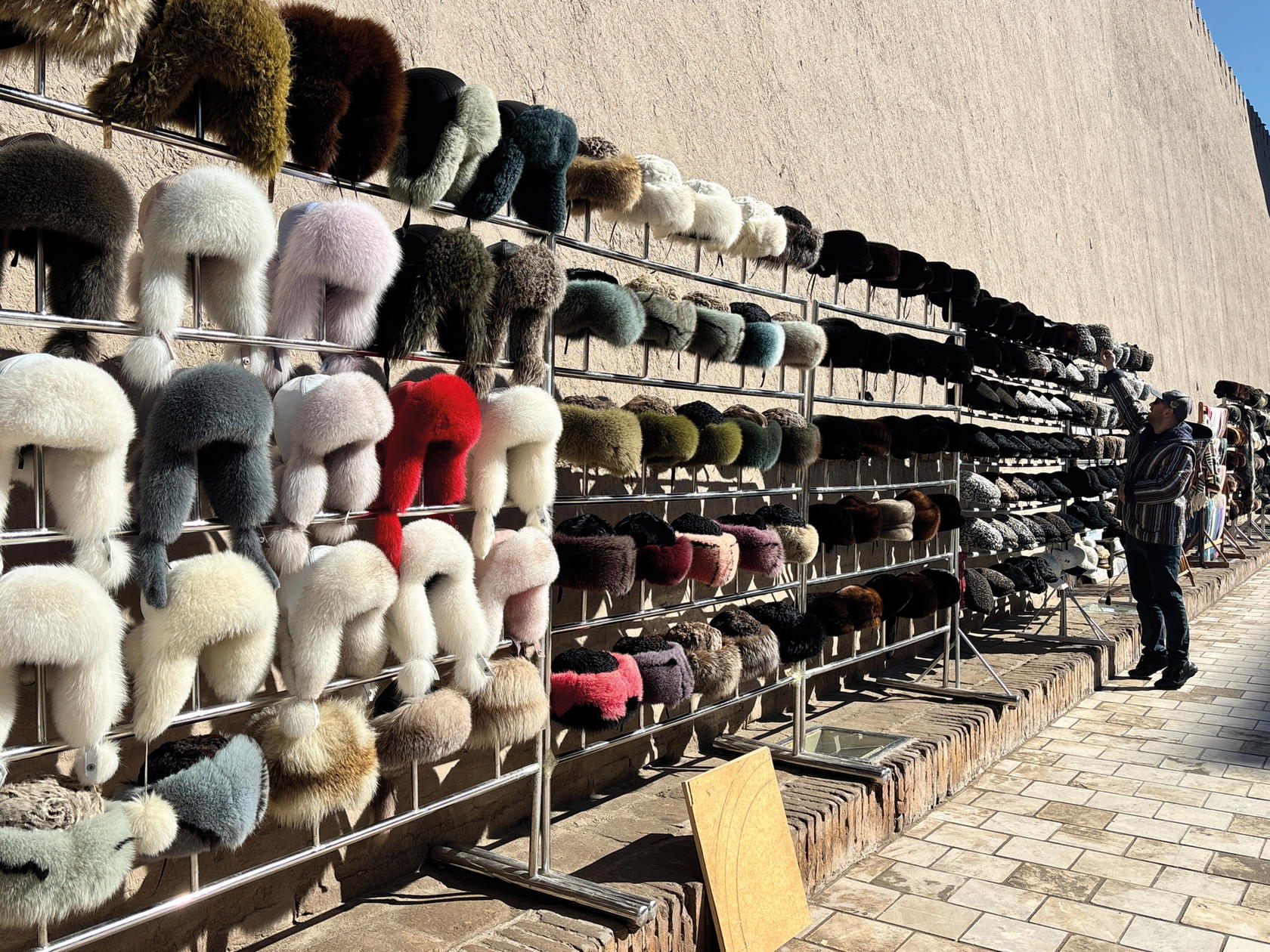
Stalls spill colour onto the pathways. They display traditional clothing, handwoven carpets, intricately carved wooden pen boxes, vibrant ceramics, quilted chapans (traditional long-sleeved robes worn by Central Asians, particularly Uzbeks), and telepecs, the shaggy sheep’s wool hats Turkmen wear.
Craft and culture are woven into the rhythm of everyday life in this living tapestry. Madrassahs, mosques, minarets, and caravanserais, where travellers could stay in the desert area, stand shoulder to shoulder, their facades adorned with a distinctive Khorezmian aesthetic that sets them apart from the grandiose monuments of Samarkand, or the refined symmetry of Bukhara. “Khiva’s beauty is also practical—this was art built to withstand desert winds and the merciless glare of summer,” explains Madiyar.
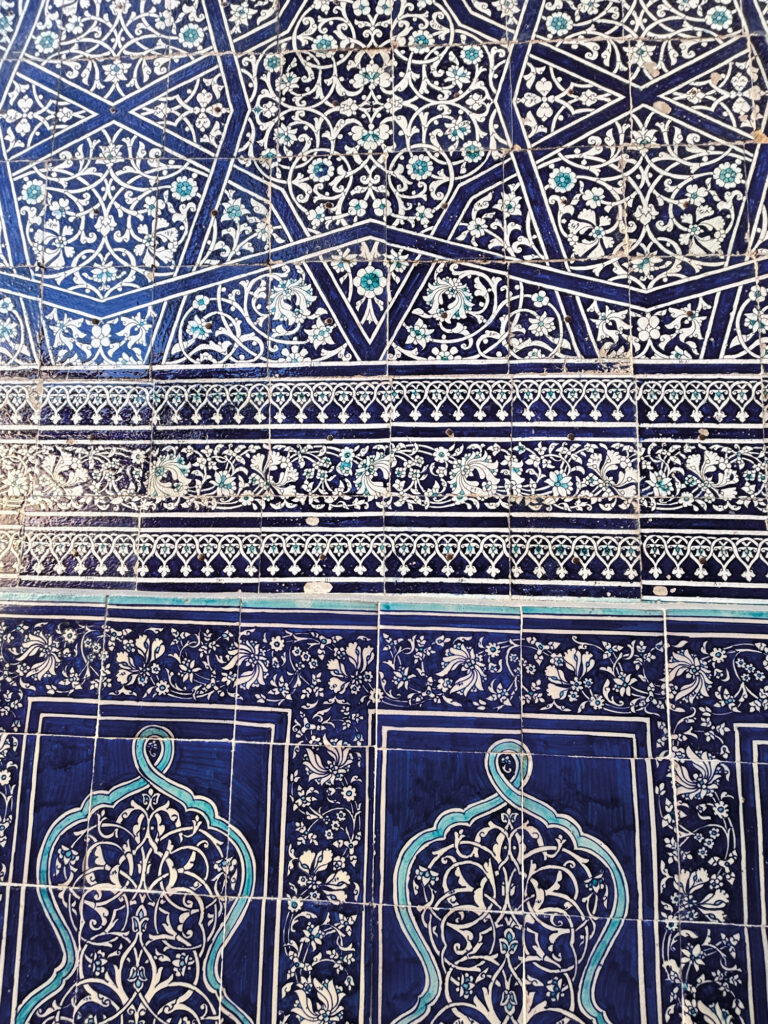
I love the striking palette of the city. Deep cobalt blues and luminous turquoise tiles shimmer against the muted clay of surrounding buildings. Geometric patterns repeat in precision, interrupted by restrained floral motifs. This is tilework shaped by the climate, with glazes chosen to endure and patterns designed to dazzle even under a white-hot desert sky.
Kuhna Ark, with its mud crenellations that lord over the town, was the fortress and residence of Khiva rulers, built in the 12th century with a mosque, arsenal, mint, harem, and stables. The Summer Mosque inside is stunning with an orange gold ceiling.
Many of the madrassahs have been repurposed as museums. The grand Mohammad Amin Khan Madrassah, once a hub of Islamic learning, now functions as a hotel, while the Allakuli Khan Madrassah is a museum dedicated to the history of medicine.
At 57m high, the Islam Hoja mosque is Uzbekistan’s tallest. If you can manage the vertiginous climb through a narrow staircase, you will be rewarded with panoramic views of the old city.
Despite this showstopper, it is the stout Kalta Minor Minaret, with its truncated form wrapped in bands of geometrically patterned blue ceramic, that stands out. Though unfinished because ruler Muhammad Amin Khan was killed before it was completed, it remains a symbol of ambition and artistry in brick.
In the Pahlavan Mahmud Mausoleum, dedicated to the patron saint of the city, who was also a 13th-century Sufi poet and wrestler, the majolica tiles with swirling leaves and stalks glisten in shades of green, blue, and turquoise under the chandeliers, while newlyweds seek his blessing in his tomb.
Necessity, Not Luxury
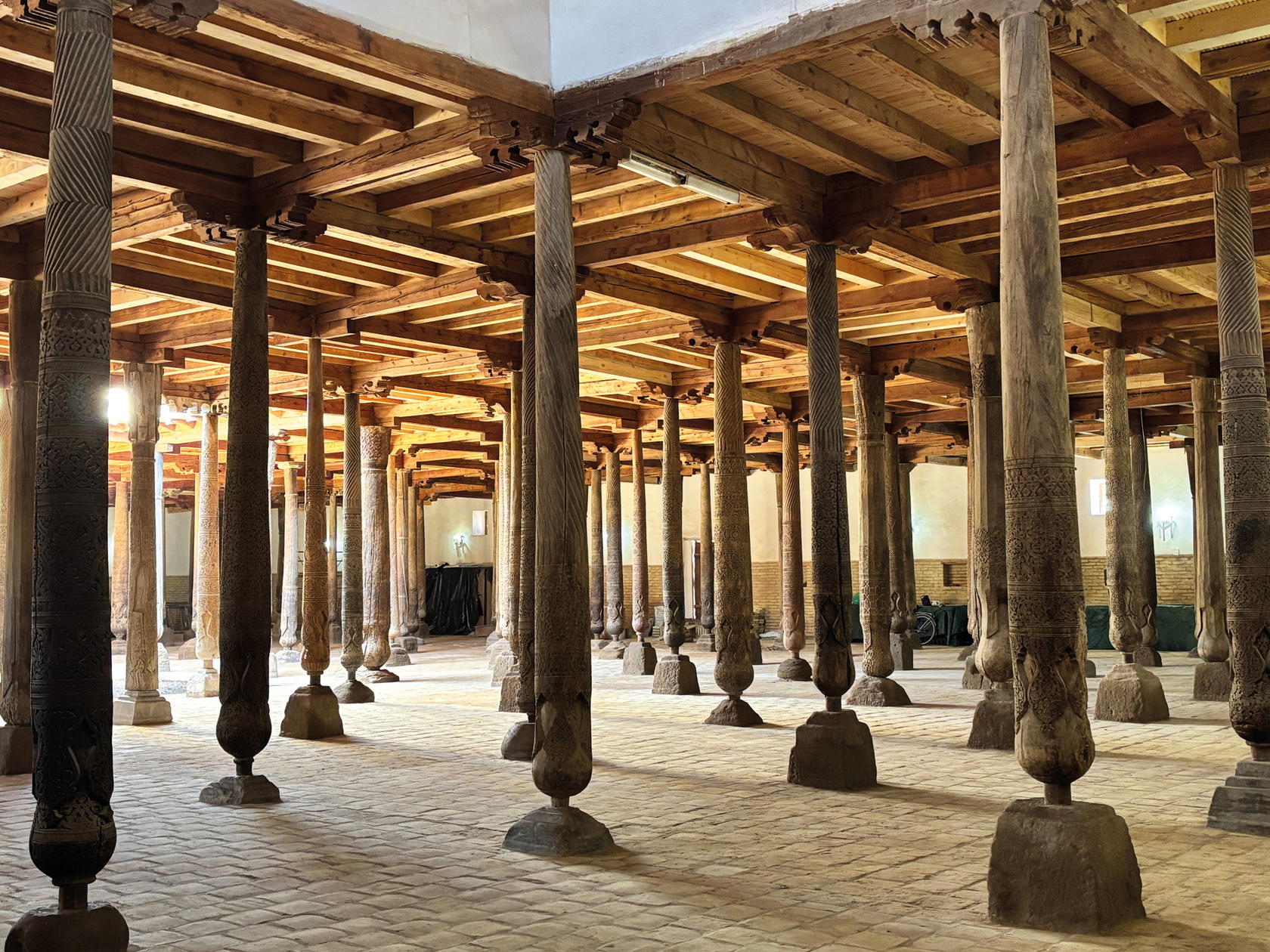
The city’s woodcarving tradition is among the finest in Central Asia, and it is not typified by isolated masterpieces but by structural necessity. In the cool, shadowy interior of the Juma Mosque, where the scent of aged wood lingers, this tradition reaches its peak.
The mosque is unlike others in the Islamic world. Instead of grand domes or glittering chandeliers, the hall is dominated by more than 200 carved wooden columns supported by carved stone blocks that rise from the stone floor, each one distinct. Several dating back to the 10th century have been salvaged and preserved for generations. Their surfaces are layered with patterns. from spirals to vegetal motifs and interlacing lines, each symbolising protection, eternity, and faith.
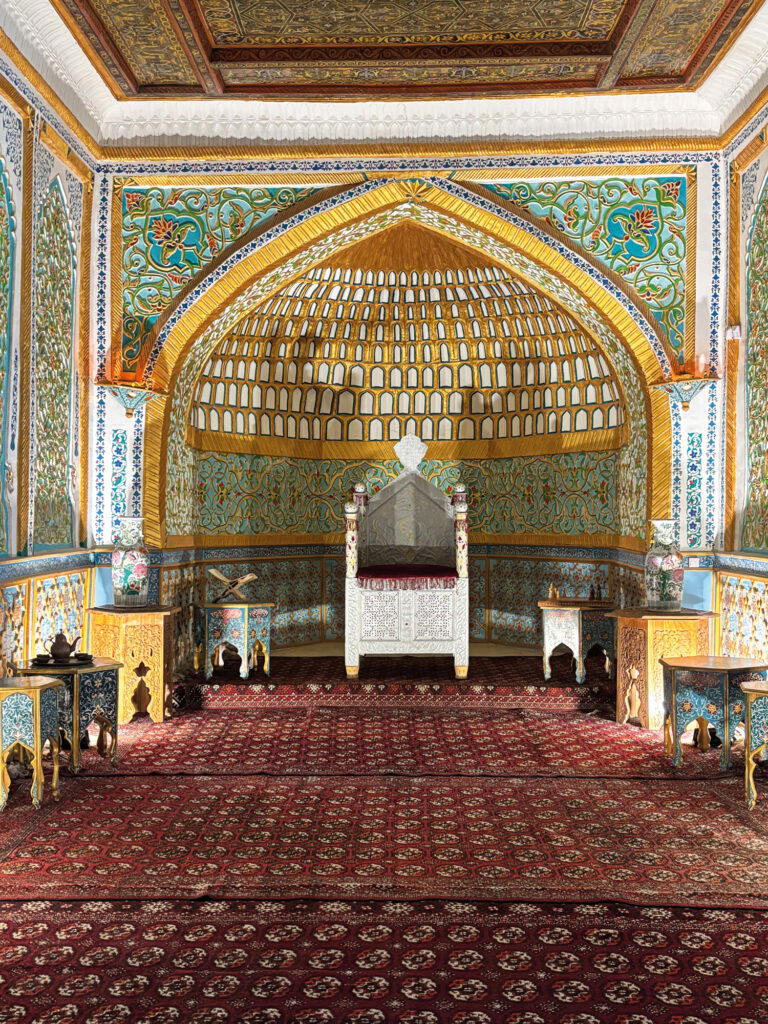
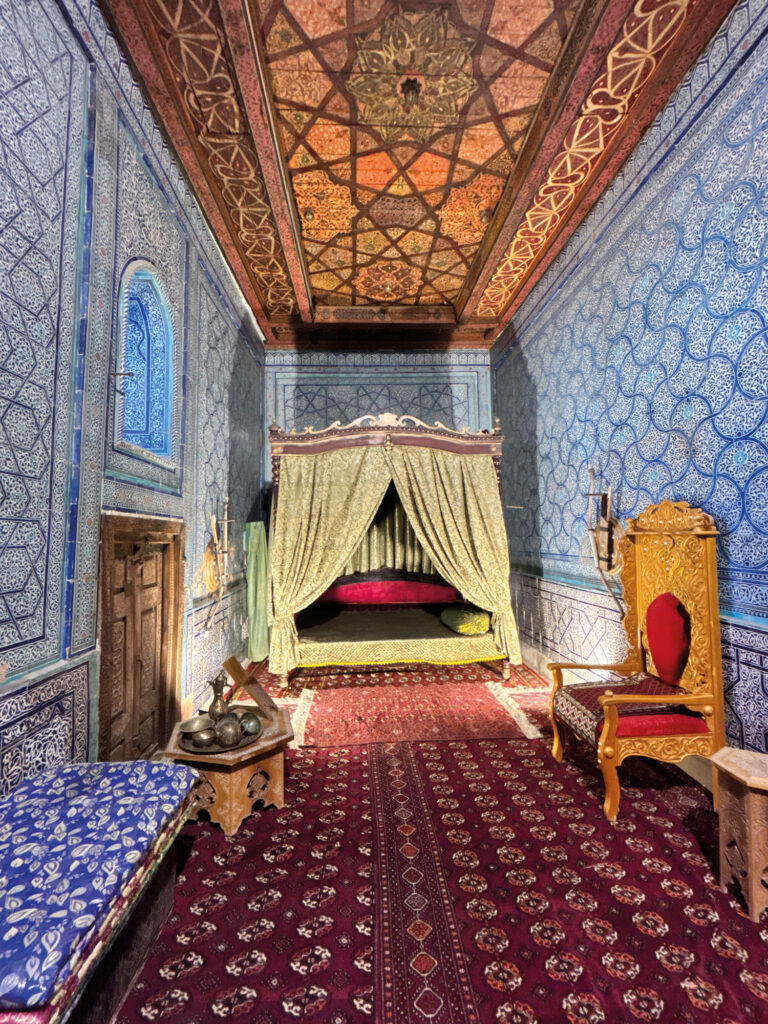
Some of Khiva’s most beautiful interiors can be found in the Tosh Hovli Palace in the old city, built in 1841. Featuring midnight-blue ceramic tiles with Arabic numerals, carved wooden pillars, nine courtyards, and 150 rooms, it resembles a giant jigsaw puzzle.
In the cool, shadowy interior of the Juma Mosque, where the scent of aged wood lingers, Khiva’s woodcarving tradition reaches its peak.
The rooms and loggias, known as aywans, facing north and surrounding the courtyards, are adorned with shimmering turquoise tiles, intricate plasterwork, and stunning painted muqarnas or wooden cornices. The Tosh Hovli accommodated the ruler Allah Kuli Bahadur Khan, his four wives, and a labyrinthine harem for his 40 concubines. Madiyar points out the jade green elements on the walls, echoing an ancient Zoroastrian symbol as the Zoroastrian religion thrived here before Islam.
Many tourists overlook the exquisite Nurullabai Palace, built in 1912 outside the walls. It is a glorious fusion of Russian and local architecture with German influences, reflecting the once present German community. Meissen tiles and cherubs on ceilings, ceramics produced in St Petersburg, and sprawling courtyards make this Islamic structure of baked bricks and tiles uniquely captivating.
Art That Speaks Volumes
In the winding lanes of Itchan Kala, the tradition of craftsmanship continues to this day. A weaver sits before a loom strung with luminous threads, her hands moving with practised grace. Through her fingers, silk is transformed into ikat patterns that mirror the geometry of the city’s tiles. In another corner, a master embroiderer bends over a suzani textile (derived from the Persian word suzan, meaning needle), stitching bold medallions and curling vines in crimson, indigo, and saffron.
Madiyar explains that each motif tells a story of fertility, prosperity, and protection from misfortune. These richly embroidered textiles were once part of dowries. Today, they are considered symbols of protection and good fortune.
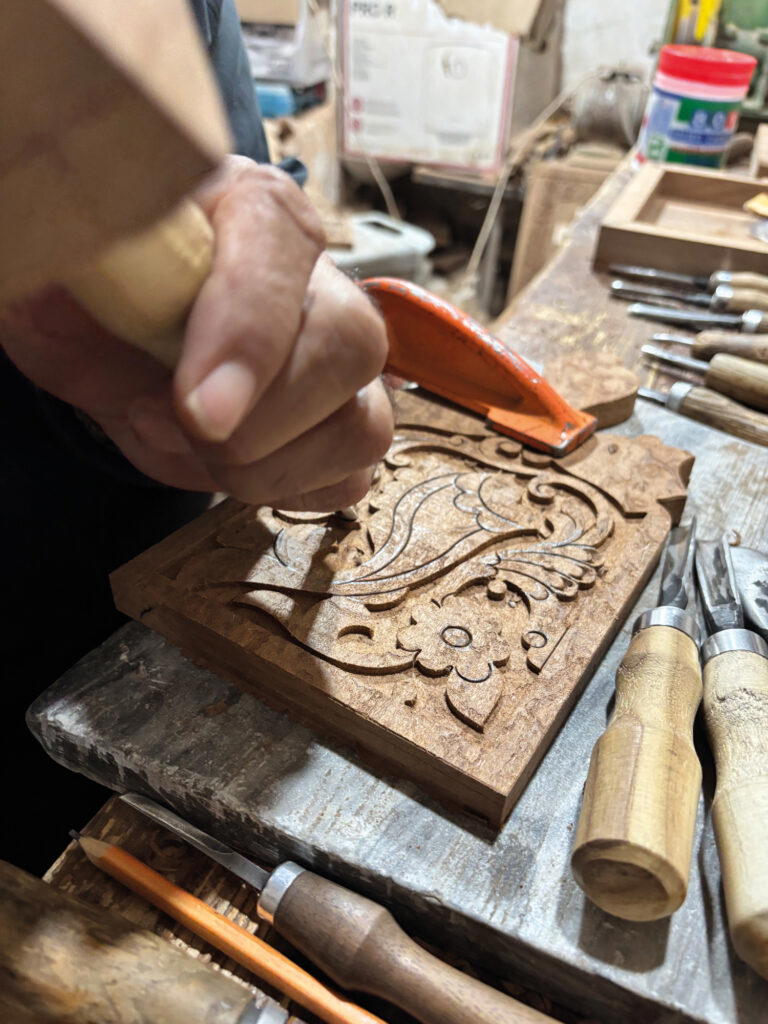
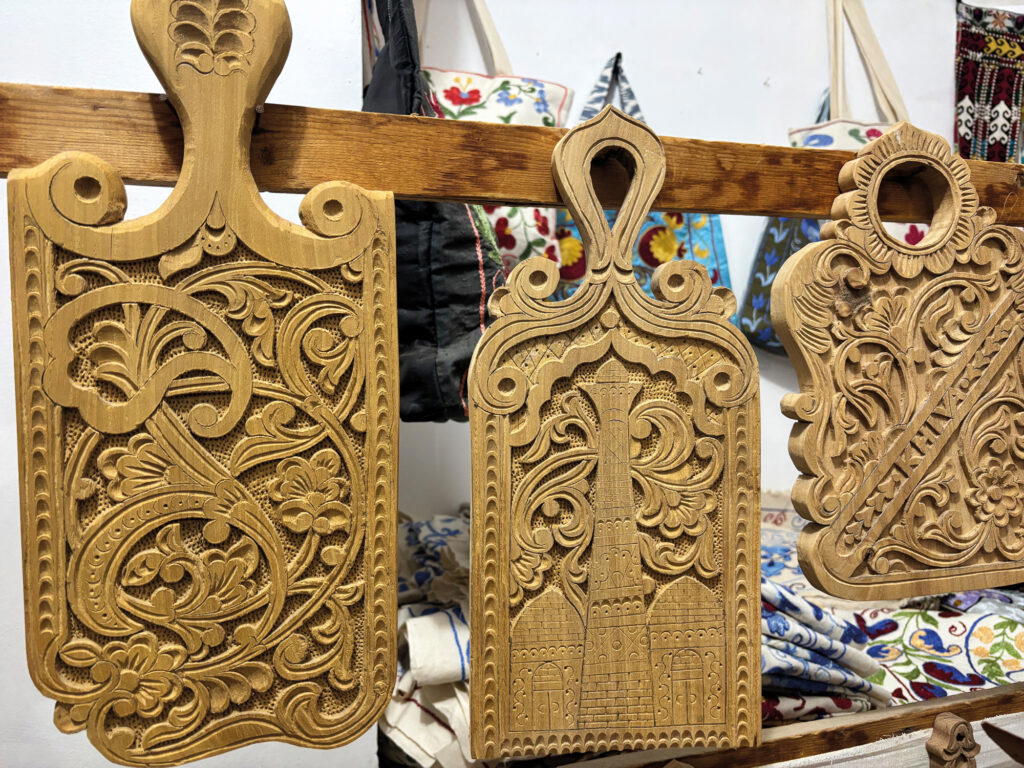
I enter a woodcarver’s workshop inside an old madrasa and watch him etch and carve delicate arabesques into a chopping board. His tools are worn smooth by decades of use. The patterns are similar to those on madrassah walls but scaled down to fit the palm of your hand. Among the items he shows me are tall elm wood pillars he carved over months, and collapsible book rests called lauh, which are constructed without nails or hinges from single pieces of wood and used to hold the Quran or other manuscripts.
As the afternoon light softens, the sun’s descent towards the horizon lights up the tiles. Long shadows cast by minarets stretch across sandy courtyards. From the top of the city walls, the panorama unfolds: domes clustered like turquoise beads, alleyways threading between earthen facades, and the desert stretching beyond in quiet permanence.
As we watch the sunset from the terrace of the Terrassa Cafe & Restaurant over a cup of green tea, I imagine the caravans that once approached from afar, their silhouettes wavering in heat haze. In the days of those merchants and travellers, Khiva must have appeared as a sanctuary of refuge with water, rest, and cultural exchange.
Khiva reminds me that art does not have to shout to be heard. It speaks most powerfully when it is woven into the very fabric of life, when every surface tells a story, and every story is carved, glazed, woven, or etched by hand.