
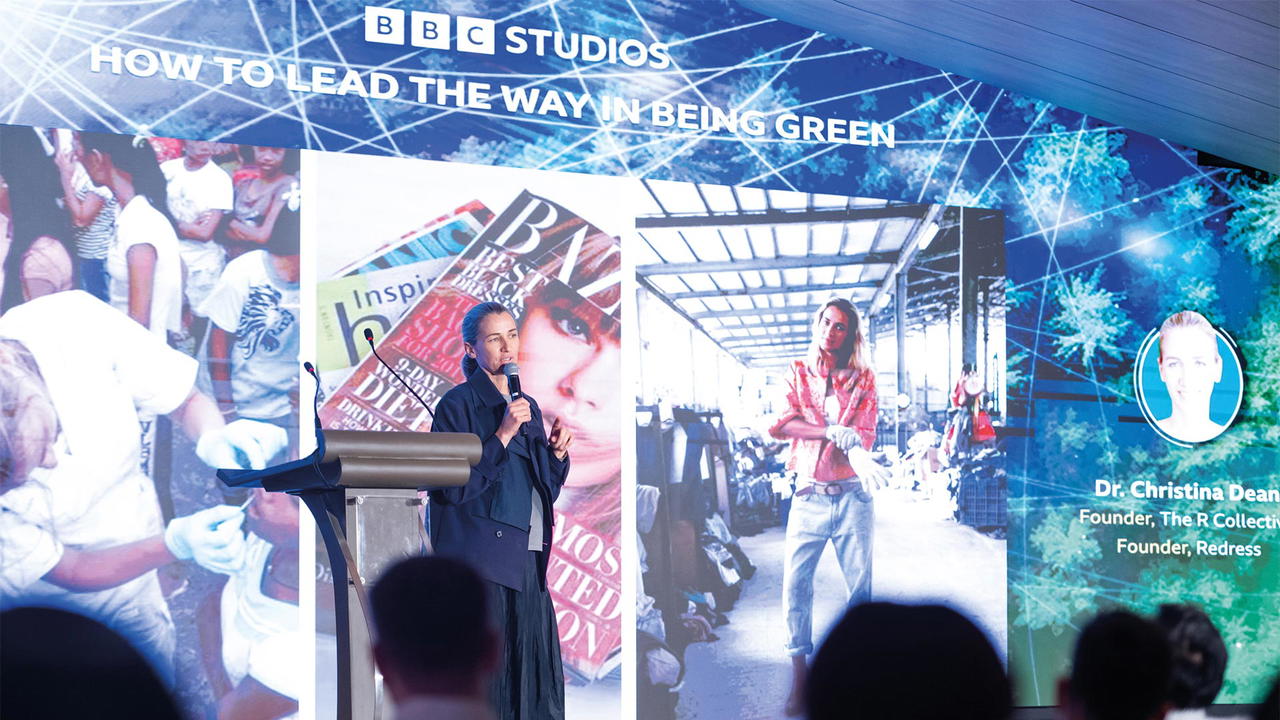
Having founded these two entities—Redress and The R Collective—that focus on different target groups, should the responsibility of fashion waste fall largely on consumers or fashion businesses, in your opinion?
If you look at the data on environmental impact, basically—depends on which study you look at—you can argue that the majority of the impact comes from the consumer in how they wash, dry and dry clean a garment repeatedly before chucking away. You could then say that the lion’s share of negative impact comes from the consumer after they walk out that shop with that garment. And that’s kind of quite a good thing because it means that that’s their responsibility. The issue with that is that if we believe it to be true, then the other percentage comes from the garment—the way it’s designed and produced. Therefore, I’m going to simplify it by saying that consumers and the industry have got almost an equal role to play.
That said, for many years, I thought—and I suspect many kinds of advocates thought—“Power to the consumer; vote with your dollar.” The problem with that assumption is that it takes too long to educate consumers and for them to change. And should consumers be responsible for urging one of the most polluting industries in the world to have better practices? They should, but they don’t really understand how to do that. They don’t understand their choices; they’re very confused about what’s in the market.
Ultimately, the challenge of being a consumer today, is that people really love clothes. It’s a very emotional product that we use in order to portray who we are. And so there’s a very deep emotional connection that consumers have with clothing, that makes it very difficult for them not to shop. So unless we really understand that from a from a deep emotional psychological perspective, we’re not going to overcome the problem.
Is there a way then to drive a sort of mindset shift at the layperson’s level when it comes to buying clothes?
The most important thing is to understand that there are many types of consumers and they have the right to enjoy fashion, and also we need them to consume from an economic perspective. The one solution that fits all is buy less, buy better, which basically means buying more durable clothes. But then within each customer segment, you’ve got different solutions for the luxury consumer versus the ultra fast fashion consumer. Although that is true, the urgency that we have in order to reduce waste and other negative environmental issues is so much greater than the consumers’ point-of-views. And that’s really where the industry has changed more recently. What’s needed is legislation to really quickly make it change, because we don’t have time for Peter and Susie to get their act together.
Price is always a factor with fashion. How then do you educate consumers on buying less but buying better.
Price was always a problem because no one wants to spend more for anything—we know that that is true. I understand that and I respect it, particularly if people have got a small disposable income. The argument is that buying something durable, and wearing and keeping it for longer is as cheap, if not cheaper, than buying multiple things that fall apart. The problem is that people just don’t like it because they want to buy lots of things. It’s very difficult to educate buying less but buying better because you’re actually asking them to do something less.
However, buying secondhand clothes is cheap. It’s the coolest thing that Gen Z could possibly do because no one will look like them and they won’t look like they’re dressed in, you know, plastic cheap rags. At the ultra fast price point, the clothes don’t last a couple of washes so for that same amount of money, buying secondhand gives you much better quality.
To answer your question: it’s about making people fall in love with secondhand because then there’s no argument around the price.
Circularity is the best case scenario for the fashion industry. Do you think as an industry, fashion can truly be sustainable?
Philosophically, if we could capture all of the waste materials and really go 100 percent circular, the beauty of that would be that we would be creating new products. And jobs—incredibly important. We’d be allowing this beautiful industry to be creative and innovative, but it will only happen if the raw materials can become circular. So philosophically, yes; practically, no.
Clearly now is no longer the time for talk without any action. Would you say there’s a timeline for the industry to accelerate such moves to become even more sustainable?
We’ve been hearing a lot about Net Zero 2030 and 2050. How much time have we got? Very little because 2030 is pretty much tomorrow in terms of industry transformation. And the fashion industry works really slowly. We often talk about how juggernaut businesses take a long time to turn but the good news is we’ve got good billions of startups with solutions that obviously if we could scale that up…
What are the positives that you’ve seen so far that’s encouraging?
There are millions of those, otherwise it would be a very depressing job. The beauty of fashion is that it reinvents itself and the creators have this desire to ultimately do better. I was on a panel with Paul Dillinger from Levi’s and he said that at the heart of any good designer, is the desire to design better and to design a product that’s better than all the other products that are out there. So that is why it’s encouraging because whether you’re a designer of clothes, textiles, yarns, trims, dyes or whatever, the designers need to create better really quickly in order to do that. Also, they need the finance to support their great ideas, because they’re out there. I’m also really excited about how an increased in digital accessibility will help more consumers buy secondhand, to share and to sell their own pre-existing clothes.
Considering that there’s quite a lot of doom and gloom out there, what keeps you going?
For me, the fact that I really enjoy it, I feel very, very passionate about it because I believe in hope and I believe it can be better. And I also think our lives are really short. It just makes me want to stay at it and get more done and derive more impact even though my impact is absolutely minuscule compared to the problem.