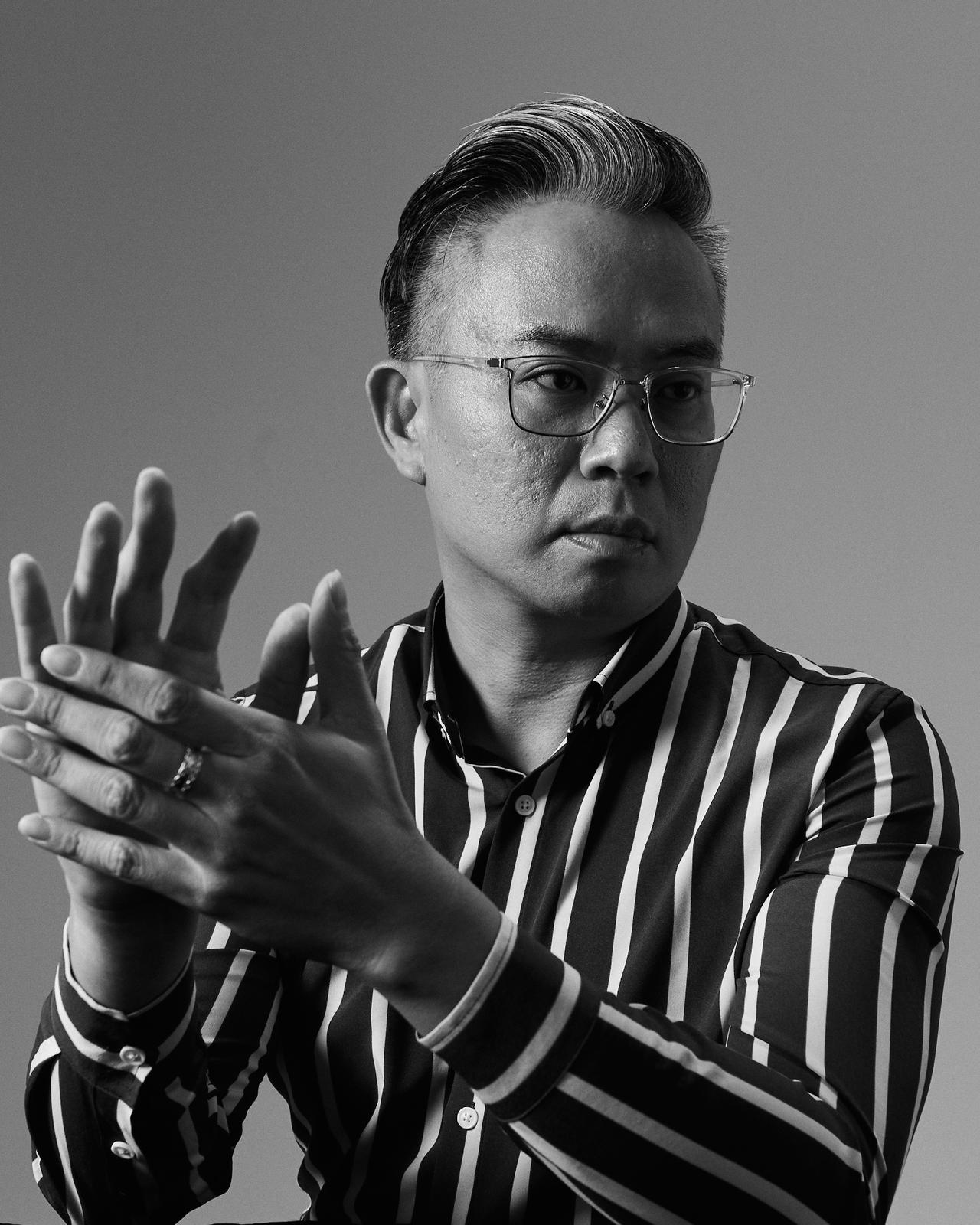
Bryan Choong sat encamped at The Projector during the live broadcast of Prime Minister Lee Hsien Loong’s historic National Day Rally 2022, listening stolidly as the announcement of Section 377A’s repeal was delivered. The message was emphatic, unequivocal: sex between men would henceforth cease to be a criminal offence in Singapore.
Amid the ensuing paroxysm of jubilation (happy tears were shed) that gripped the room, the LGBTQI activist’s reaction to the news was comparatively subdued.
“I felt relieved and quite honestly, exhausted. Because we have spent enough resources and energy on the repeal and we need to move this energy to address other practical issues affecting the LGBTQI community,” he shares.
His sense of lassitude is understandable. You see, Choong is among the caravan of lionhearted gentlemen who’d repeatedly squared up to the proverbial Goliath that is Singapore’s legal system in challenging Section 377A. He’d initially helped canvass for more than US$100,000 to launch the first unsuccessful challenge against the constitution, before quietly filing his own case in 2019.
This came on the back of attaining his Master’s in public health at Scotland’s University of Edinburgh on the prestigious Chevening scholarship.
“I was slightly reluctant to return to Singapore because once you are exposed to people being free to be who they are without having to grapple with legal issues, you realise how liberating it is to focus on things that make people better — including equal access to health and mental services — rather than a piece of law that gets everyone stuck,” he recounts.
I don’t think the government system is monolithic; it’s made up of individuals who are passionate and compassionate. People want change but as long as the overarching law itself prevents them from moving forward, their hands are tied.
Bryan Choong
If Singapore’s public discourse around inclusivity was bogged in inertia, the former executive director of non-profit LGBTQ+ organisation Oogachaga attributes this to systemic issues stemming from a lack of social acceptance of LGBTQ individuals.
“A lot of public agencies don’t want to talk about those issues with 377A in place. I don’t think the government system is monolithic; it’s made up of individuals who are passionate and compassionate. People want change but as long as the overarching law itself prevents them from moving forward, their hands are tied,” asserts the 45-year-old, who credits his mother for his resolve to lock horns with the constitution — an endeavour some labelled a non-starter.
“Both of us are very independent individuals and I share her philosophy that if you want something changed, don’t wait for somebody to do it.”
Understated and deliberate in his manner of interlocution, Choong subverts the tired stereotype of the bolshie activist. Having served eight years in the Singapore Armed Forces, the self-professed introvert recalls comical attempts to blend in with heterosexual colleagues at seamy nightclubs.
“I don’t know what the heck I was doing spending so much money and doing things I didn’t like. At some point this guest relationship officer sat next to me and said, you shouldn’t come to this place as it is a waste of your money,” he recalls mirthfully.
The army regular eventually came out to a supportive cohort, an experience he says shaped his subsequent interactions with mainstream society. “I realised a lot of times people may not be well-informed or come from a place of unacceptance. They may not have been exposed (to LGBTQ individuals) and lack the right language and approach to use.”
He employs the same sanguine attitude when confronted with the million-dollar question: with the repeal hedged with the caveat that it is the Parliament’s prerogative to define marriage as being between a man and a woman, how exactly are things better for Singapore’s LGBTQ community?
For Choong and his contemporaries who for years had beavered away at overturning the law, it was a major step forward — a coda to a more buttoned-up chapter in Singapore’s narrative, if you will. Granted, he’s mindful that younger LGBTQ individuals may have other pressing priorities, such as same-sex marriage.
“The younger generation sees Singapore as a diverse and economically developed country and if you start comparing us with other places that already allow same-sex marriage it is understandable for them to question why we are progressing so slowly.”
“But I think the government is pragmatic enough not to seal the door to same-sex marriage because nobody knows what will happen in future,” he argues. The move to safeguard marriage stops short of enshrining its definition in the highest law of the land, which staunchly conservative Singaporeans have exhorted for.
“To a certain extent I do agree that sometimes things may not necessarily have to happen in the courts system as there may be negative consequences, like how we have seen the US supreme court throw out abortion rights,” he qualifies, though he hopes society will one day develop enough maturity to have a conversation about marriage beyond conventional norms.
Arguably, the rallying points of the LGBTQ community have evolved in step with more liberal sentiment. For one, Choong feels that the “coming out crucible” trope of generations past may have atrophied, with a shift towards angling for greater societal acceptance and support.
Those are issues the seasoned activist is personally invested in, which he suggests can be addressed through greater representation in mainstream media, as well as inclusive workplace policies.
“It is the first important step for us to understand that Singapore is a diverse society and there are many people who are different from us. How can we understand their needs? We may not support them completely, but we have the opportunity to have a mature conversation around their differences and stop othering people.”
It’s the same reason why he wants to see frameworks for addressing LGBTQ students developed in schools. “How you relate to the world is often learnt in the formative school settings; we want people to feel safe to be different and for younger Singaporeans to know there are people who are different from them.”
Though he may have ceded his steering role at Oogachaga to a successor, the linchpin of the organisation — who helped establish the country’s first LGBTQ helpline — still chairs its board. He’s been involved in HIV research, and now works as a principal consultant at a social enterprise that builds capacity for impact-led organisations.
Apropos to the upsurge of social media activists championing his cause, Choong explains that he has mixed feelings. “To a certain extent, raising visibility and discussing issues on social media have their impact but sometimes real change must happen on the ground. It still requires you to be directly involved with stakeholders because often in social media you are just talking over one another — unfortunately in Singapore this can sometimes be extracted into an article.”
Ultimately, he “would like to think that the repeal of 377A is a signal from the government that it is ready to deal with other types of social issues together as a society.”
Already, signs of a cautious, albeit potentially tectonic shift are showing.
Choong cites a hot-button case in July, whereby a teacher from Hwa Chong Institution was suspended for propagating homophobic rhetoric, following a rash of student complaints.
“For the longest time it has always been the policymakers interfacing with LGBT organisations that are intermediaries, but I think society is moving fast enough that if at some point the public can take issues directly to the policymakers.”
Videography: Marcus Lin
Photography: Mun Kong
Producer: Cara Yap
Styling: Chia Wei Choong
Hair: Peter Lee using Goldwell
Makeup: Keith Bryant Lee using Shiseido