


Since the dawn of civilisation, humanity has chased the illusion of mastering time. We tracked shadows, built mechanisms, and devised calendars to keep life in sync with the cosmos. Nature, however, has never been one for tidy arithmetic—months stretch unevenly, leap years throw the count off, and celestial rhythms remain stubbornly unpredictable.
Enter the perpetual calendar. First conceived by London watchmaker Thomas Mudge in the late 18th century, this mechanical marvel does what nature cannot: impose order.
It automatically adjusts for shifting month lengths and leap years, requiring manual corrections only once every century. Now, 250 years later, Audemars Piguet (AP) has reimagined this historical complication for its 150th anniversary—engineering it for today’s lifestyle by prioritising clarity, ease and adaptability.

Keeping it simple
For all their brilliance, perpetual calendars are notoriously high maintenance. If you wind one too far forward, you might have to cycle through an entire year to fix it. If you adjust it at the wrong time, you could damage the movement.
Many models also rely on pushers and pins for corrections, further complicating an already complex mechanism. As a result, it’s not uncommon to see a perpetual calendar being worn despite displaying incorrect information, which is unfortunate.
With the new calibre 7138, AP redefines the rules of perpetual calendars. Developed over five years and protected by five patents, this next-generation movement simplifies one of the most complex complications in horology in two ways. It allows the date indications to be adjusted without requiring additional correctors, and it is easier to read.


While traditional perpetual calendar watches rely on correctors located at the side of the case, the calibre 7138 operates via a new crown system that eliminates the need for tools and reduces the risk of damage.
The crown now has four positions: in the first, winding is done clockwise while pulling the crown out to the second position lets you adjust the date forward and the month or leap year backwards. In the third, you can set the time in either direction, and in the fourth, you can adjust the day, week, and moon phases. As the correction sequence follows a logical pattern (date, month, day and moon phase), setting the time becomes intuitive.
This innovative system is powered by a sophisticated mechanism of levers and wandering wheels, working seamlessly with the calendar wheels. A newly designed gearbox ensures smooth transitions between correction modes, and this system is protected by two patents—one for the crown’s fourth position and another for month and date corrections via the crown.
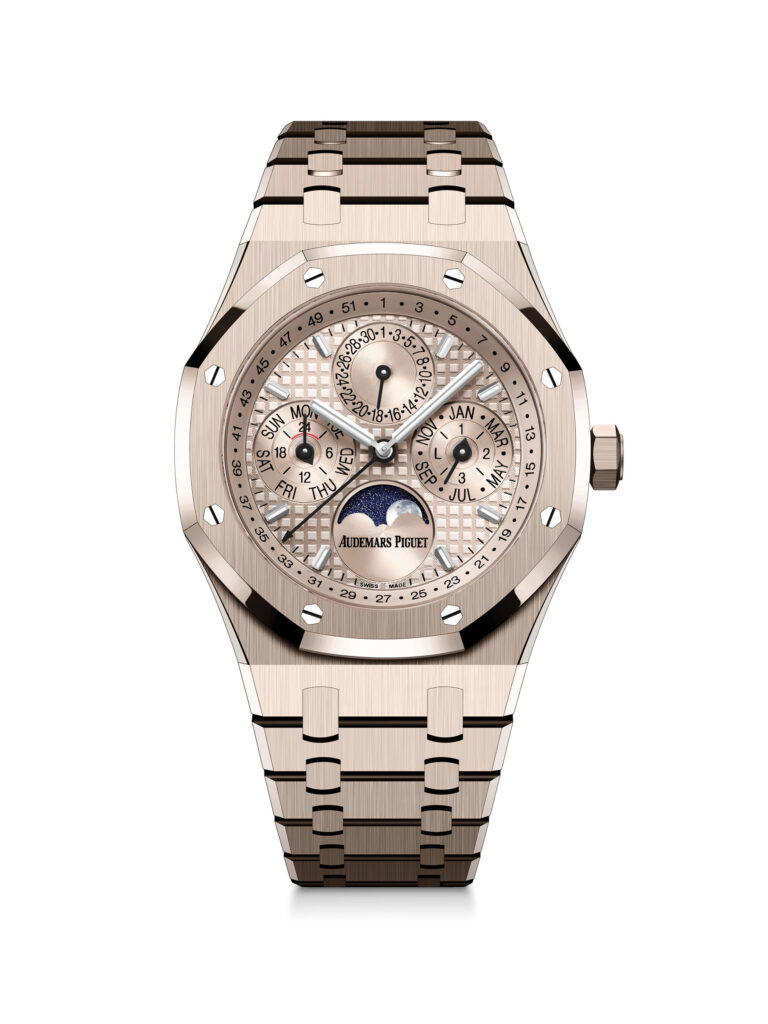
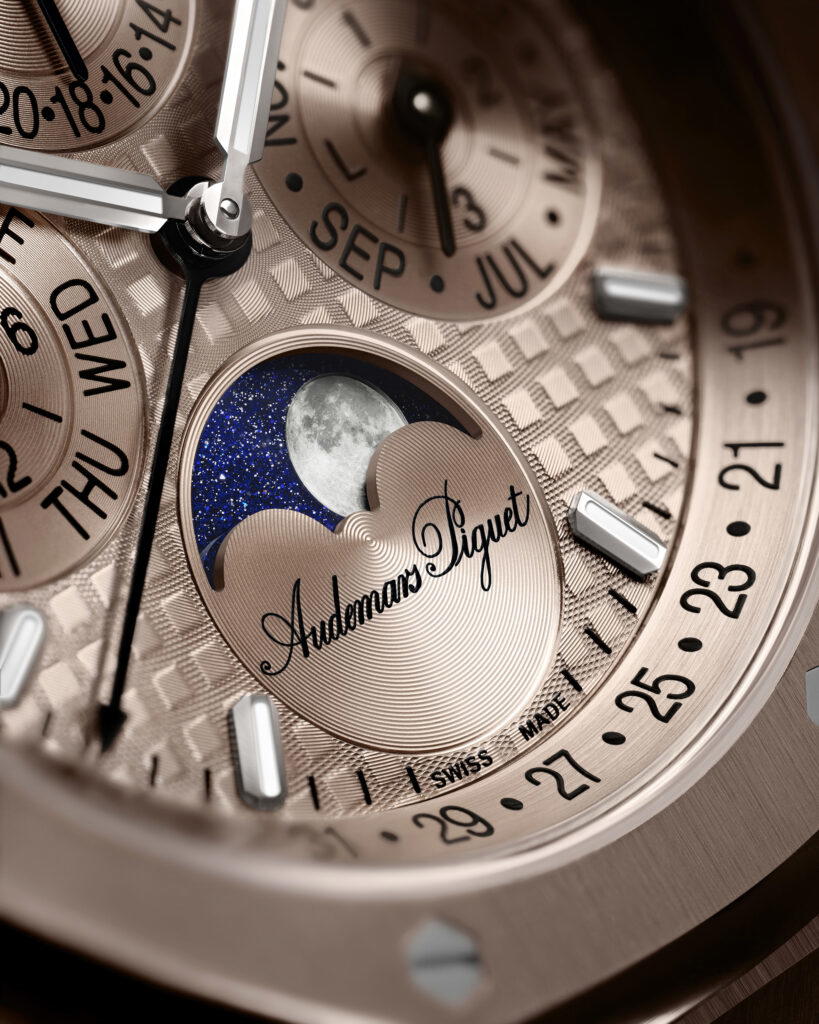
While the subdials maintain the classic European perpetual calendar layout, they’ve been reimagined for better legibility and symmetry. The first week of the year (“1”) now appears at 12 o’clock, and following this logic, both the first day of the week (“Monday”) and month (“1”) align at 12 o’clock in their respective subdials.
The date subdial features a patented progressive change, addressing a common issue with perpetual calendars: compressed numbers between 20 and 31. To improve readability and visual harmony, AP has introduced a bespoke 31-teeth wheel with varying tooth spacing to optimise the layout.
The movement is also designed to prevent accidental damage. A red-zone indicator on the 24-hour display warns users when corrections are temporarily locked between 9pm and 3am. This feature ensures that it is impossible to desynchronise or damage the watch, even if the user attempts to adjust the time while the automatic date-changing mechanism is active.


Dawn of a new era
The new calibre 7138 is introduced in three 41mm models: one from the Code 11.59 by Audemars Piguet and two Royal Oak references. As a result of the absence of case-side correctors, these watches have a sleeker silhouette and improved water resistance, offering 50m for the Royal Oak models and 30m for Code 11.59 by Audemars Piguet, as opposed to 20m.
In the Code 11.59 by Audemars Piguet version, a white gold case is paired with a smoked blue PVD dial featuring the collection’s signature embossed pattern, crafted in collaboration with Swiss guilloche craftsman Yann von Kaenel. White gold hands, markers, and calendar indications maintain a crisp two-tone aesthetic, complemented by a blue rubber-coated strap featuring a textile motif.
One Royal Oak model combines a stainless steel case and bracelet with a blue PVD Grande Tapisserie dial, white gold hands, and luminescent hour markers. Its white calendar indications add contrast. The second Royal Oak is made of sand gold, AP’s proprietary alloy that blends gold, copper, and palladium for a hue that shifts between white and pink gold. A sand gold Grande Tapisserie dial, matching subdials, and black calendar markings complete the monochromatic look.
In celebration of this milestone anniversary, AP has released three limited editions of 150 pieces each. The design mirrors the standard models but with subtle nods to the brand’s heritage. These include a cursive signature in the form of a vintage “Audemars Piguet” on the moon-phase subdial, as well as two engravings on the sapphire caseback frame: the “150” logo created for the occasion and “1 of 150 pieces.”
“Astronomical watches have shaped Audemars Piguet’s world since 1875. To celebrate 150 years of remarkable craftsmanship and innovation, our watchmakers and engineers have put the user and their experience at the forefront of their agenda to create a new perpetual calendar that is both intuitive and easy to use. To this end, they invented a one-of-a-kind system that makes all corrections possible using only the crown—a true mechanical breakthrough that required the complete redesign of the movement. The magic lies in the watch’s seamless blend of technical complexity and simplicity of use.”
Ilaria Resta, CEO of Audemars Piguet



Keeping Perfect Time
Other highlights from Audemars Piguet’s 2025 first semester novelties.
As AP enters a new era for its perpetual calendar watches, it bids farewell to calibre 5135, the movement that has powered the brand’s 41-mm openworked self-winding perpetual calendar wristwatches for nearly a decade. A fitting tribute comes in the form of a limited edition 150-piece watch that celebrates the brand’s 150 years of fine watchmaking.
The Royal Oak Perpetual Calendar Openworked “150th Anniversary” is inspired by a historic pocket watch, featuring a sapphire dial that shows off its sophisticated movement to great effect. The deep blue inner bezel and subdial contrast with silver-grey hour markers echo vintage aesthetics.
The watch features a combination of titanium and Bulk Metallic Glass (BMG), a palladium-based alloy co-developed by AP for improved durability and a sleek finish. At 6 o’clock, a moonphase disc—based on a Nasa photograph—displays the lunar cycle as seen from both hemispheres. With only 150 pieces available, this model incorporates design elements specific to the anniversary, reflecting the collection’s heritage.
No AP anniversary celebration would be complete without a bold reimagining of the iconic Royal Oak Offshore. This year, Audemars Piguet unveils two ceramic-driven models. The first, in 43mm, pairs a titanium caseback and push-piece guards with a green ceramic bezel, crown, and pushers. The dial, featuring AP’s latest Mega Tapisserie pattern in dark green PVD, adds depth and texture to the design.
The second model, a 42-mm edition, takes a sleek, monochromatic approach. Its black ceramic case and integrated bracelet create a seamless look, while the dial, inner bezel, and snailed counters are all in deep black. Steel hexagonal screws and grey accents on the tachymeter scale, chronograph indicators, and lume inserts provide subtle contrast.
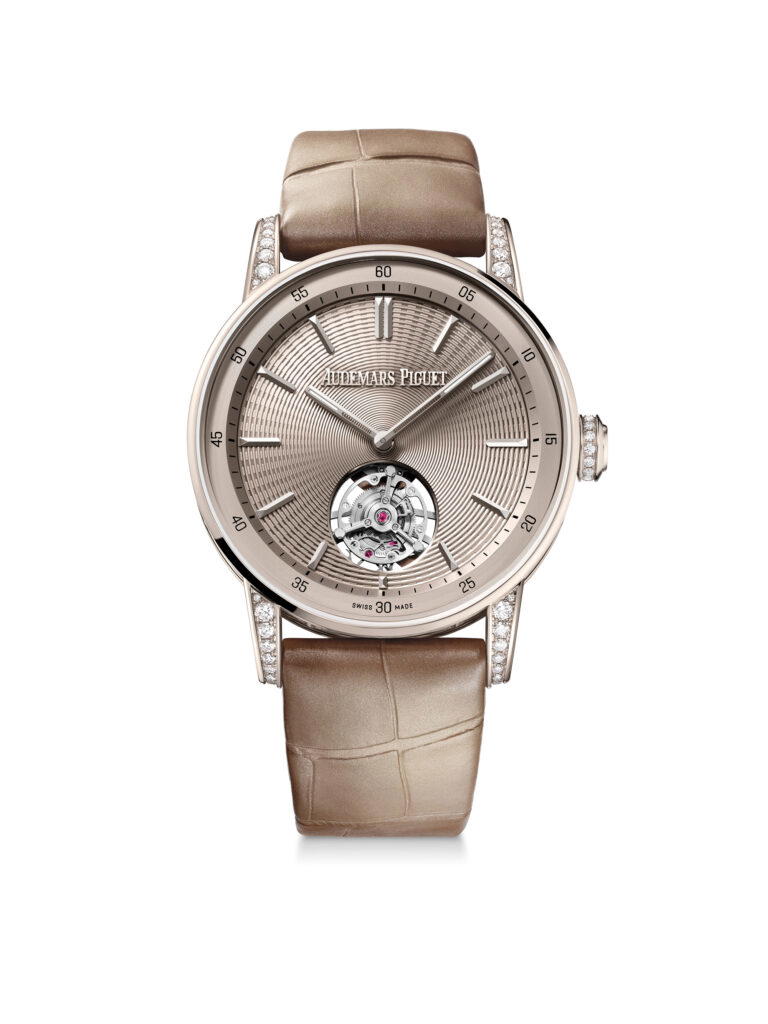
The Code 11.59 by Audemars Piguet continues to expand with the introduction of a Selfwinding Flying Tourbillon 38mm. Featuring the ultra-thin RD#3 movement and a sand gold case set with diamonds, this is the brand’s first self-winding flying tourbillon in this size.
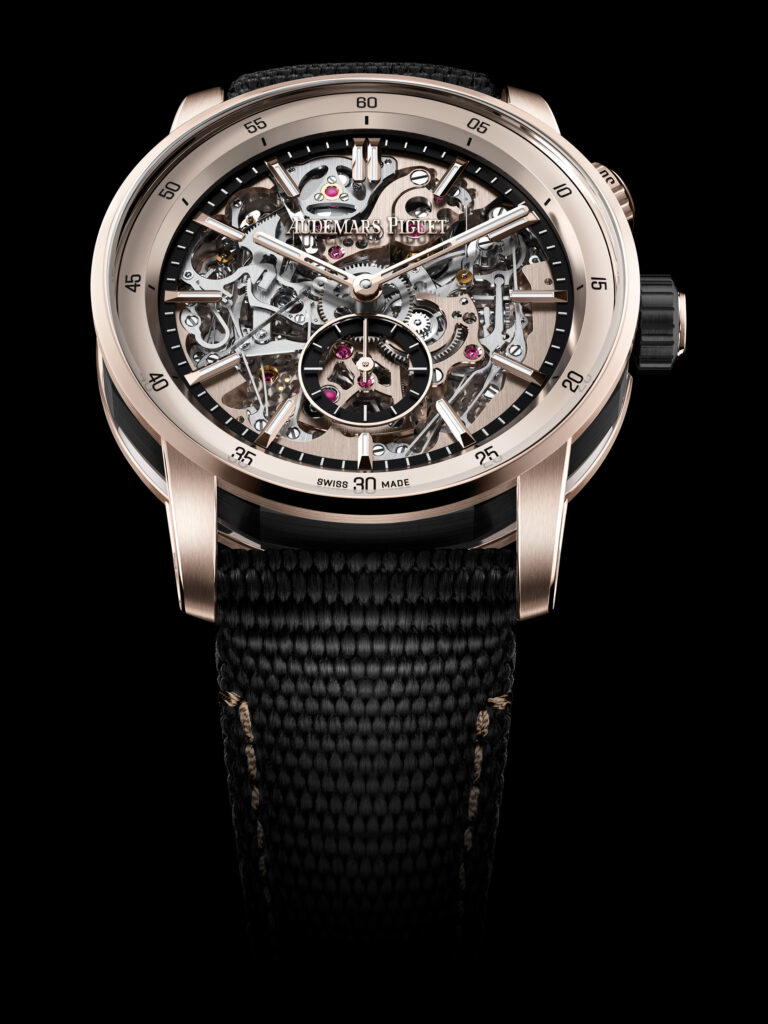
Also new are five limited 41-mm Code 11.59 by Audemars Piguet Grande Sonnerie Carillon Supersonnerie models. They represent the apex of the brand’s watchmaking expertise, fusing traditional craftsmanship with cutting-edge technology. The cases are crafted from precious and modern materials—black ceramic, platinum and white, pink, and sand gold—with dials that command attention.
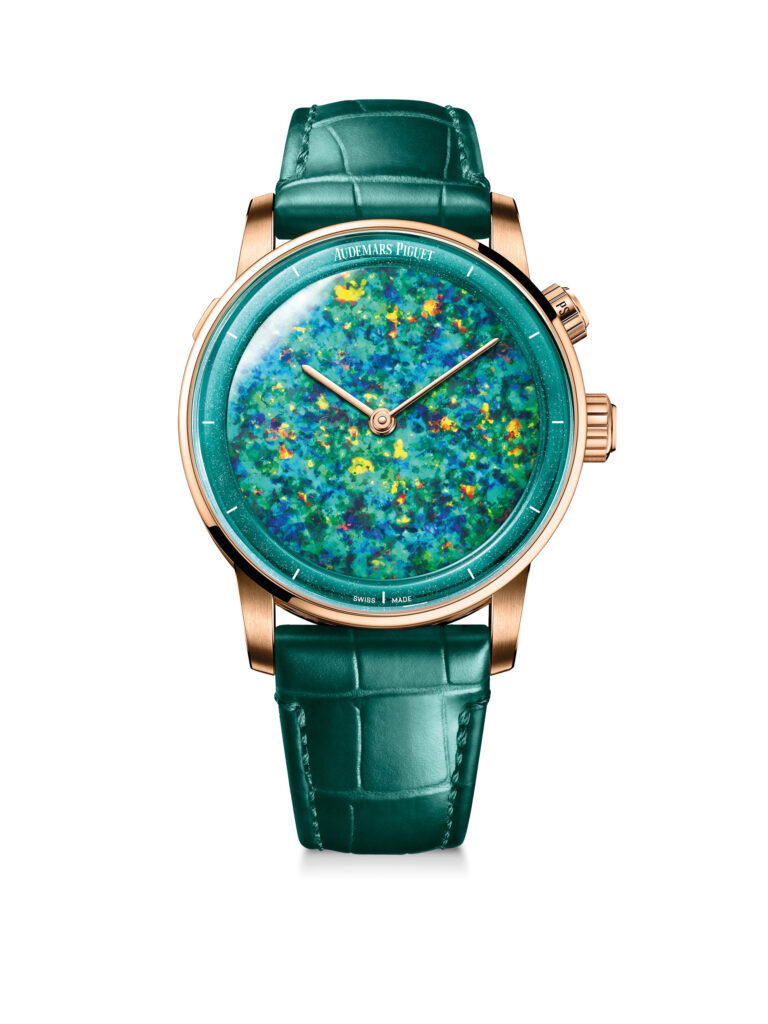
Two models feature iridescent harlequin opal beneath double-curved crystals, reminiscent of AP’s historic use of stone dials from the 1960s to the 1990s. The other three reveal the complex Grande Sonnerie mechanism through sapphire dials, showcasing its technical mastery.
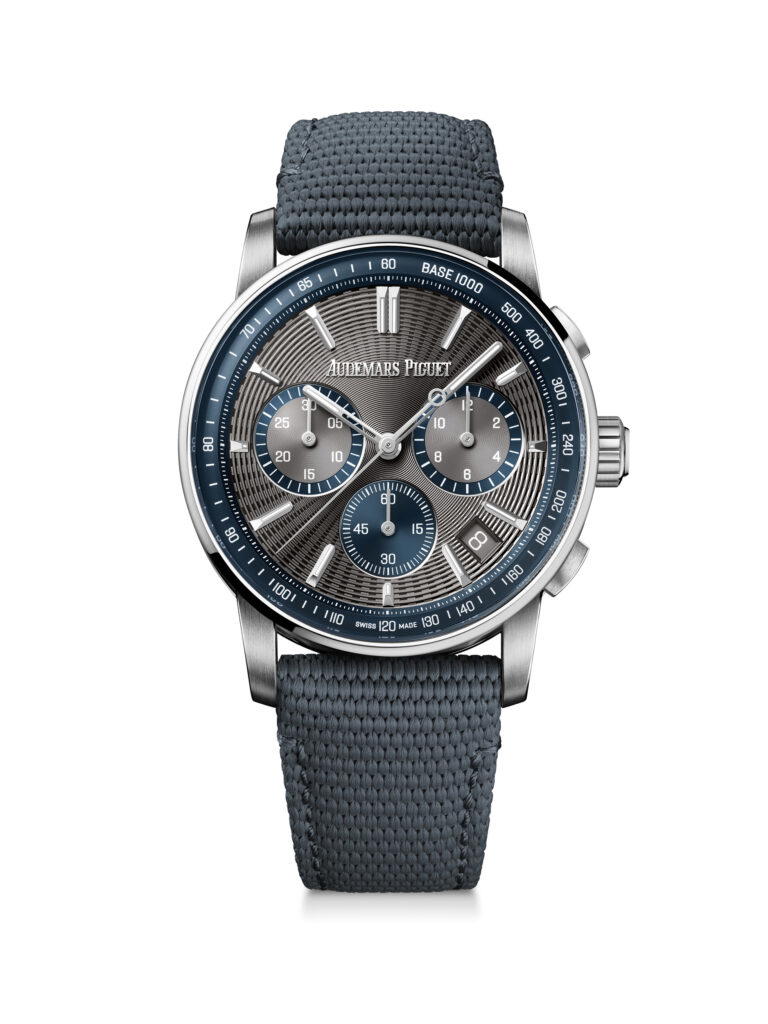
Finally, two new stainless-steel models join the collection, featuring refined grey dials with details in the signature Bleu Nuit, Nuage 50 hue. With Selfwinding and Selfwinding Chronograph versions, these watches focus on ergonomics, readability, and refined design.