
Audemars Piguet is still celebrating its milestone year with fanfare and confidence. Across its catalogue, the brand has refreshed core Royal Oak references, experimented with gem-setting that treats light as a material rather than a mere enhancement, and advanced its complication pieces with thoughtful and genuine innovation to benefit the wearer.
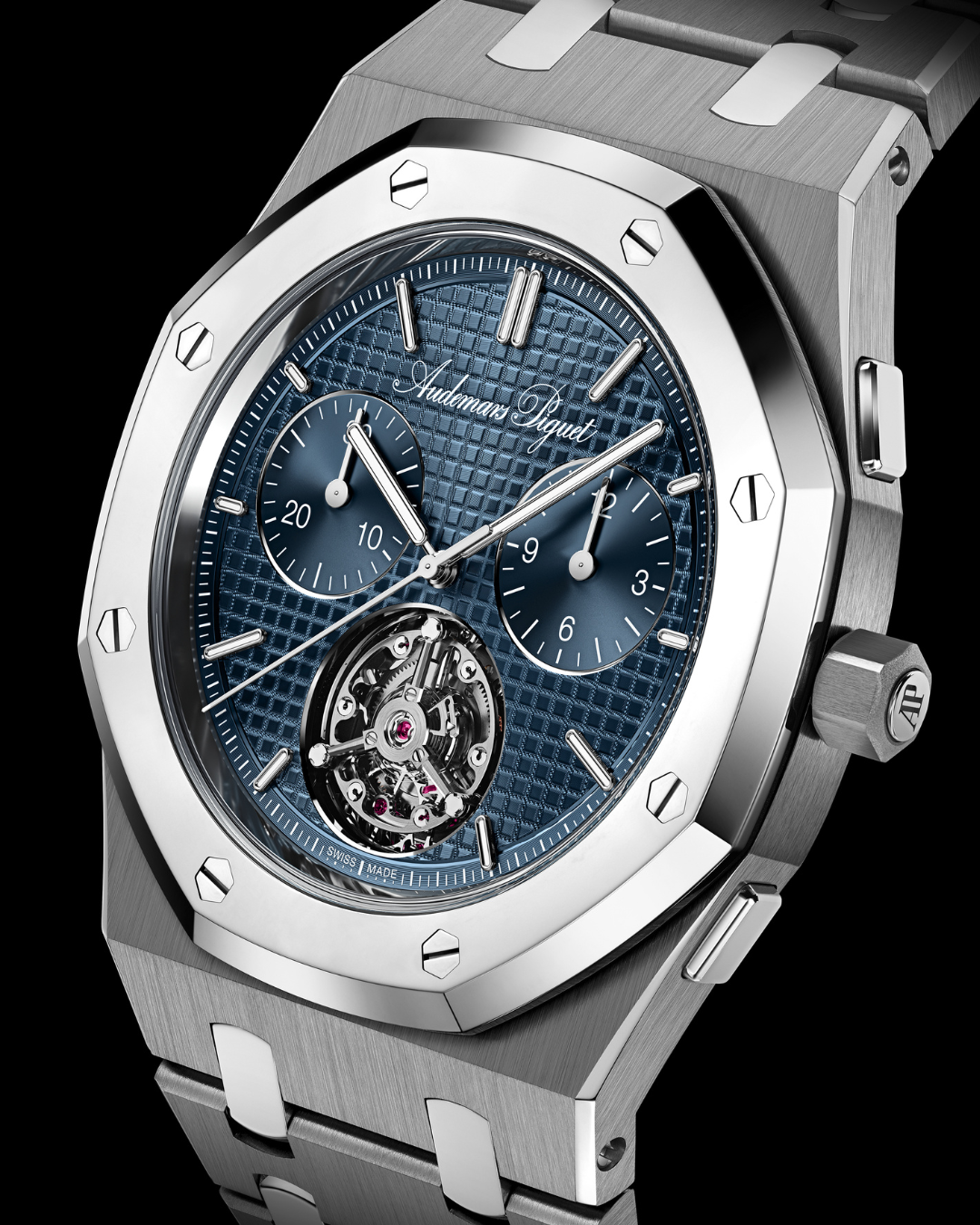
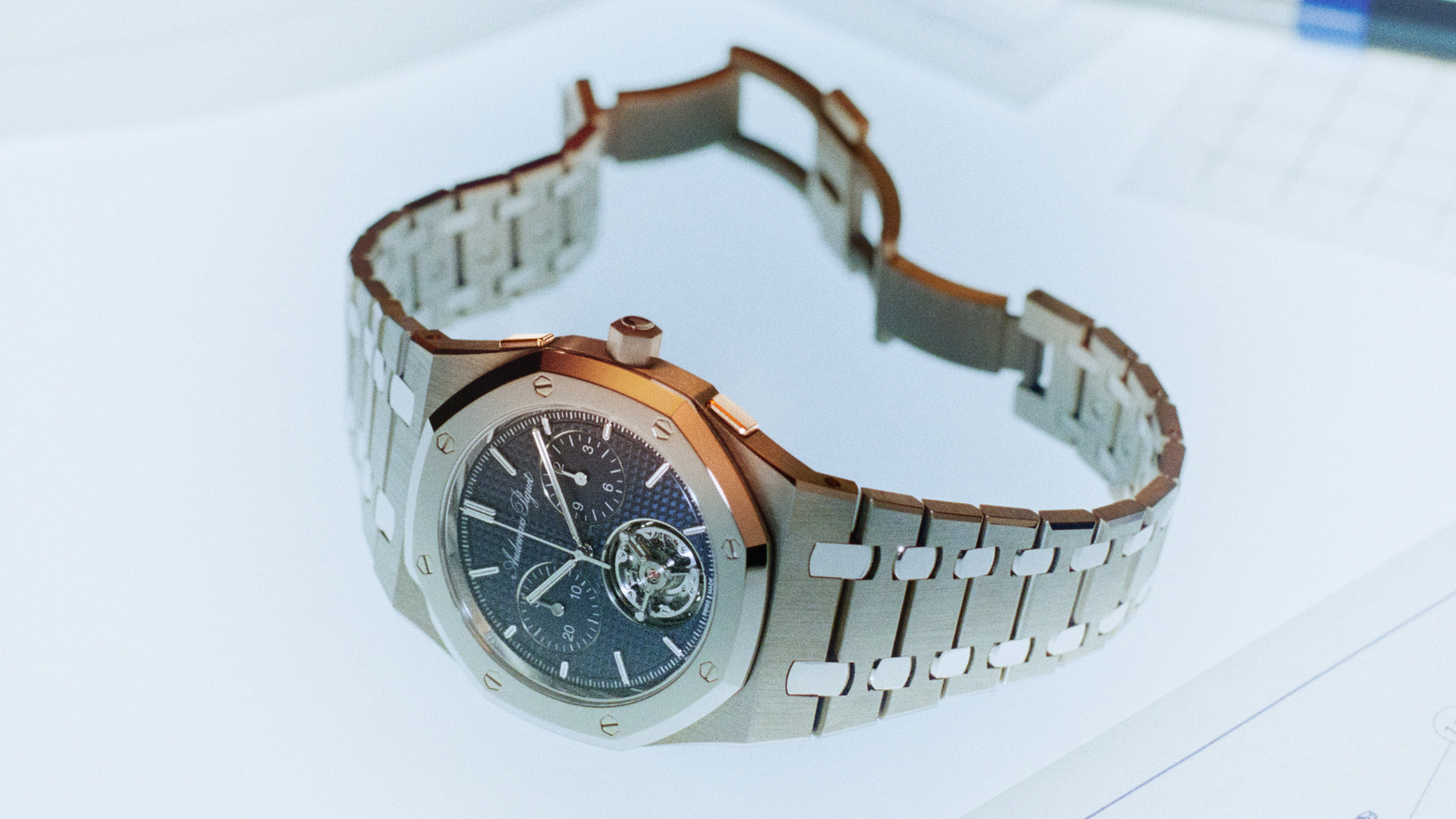
The company’s recent release, the Royal Oak “Jumbo” Extra-Thin Selfwinding Flying Tourbillon Chronograph RD#5, is another masterpiece. Limited to 150 pieces, it is the first Royal Oak watch to combine a flyback chronograph with a flying tourbillon inside the original 39-mm “Jumbo” case, and measures just 8.1-mm thick.
Bulk Metallic Glass (BMG), a metallic alloy, is combined with titanium in the case. With over 50 percent palladium, Audemars Piguet’s proprietary BMG offers exceptional durability. As a result, the watch wears comfortably and has a distinctive reflective sheen. To provide more room for the hands and peripheral rotor, the front and back crystals are hollowed on the inside instead of flat on the outside.
Ergonomics guide the design brief. In modern water-resistant chronographs, pushers require a forceful press to start, stop, and reset the watch. Giulio Papi, Director of Watchmaking Design at Audemars Piguet, redesigned that interface to make it more tactile.
Conceived with smartphone ergonomics in mind, the RD#5’s pushers require only 300g of pressure to operate. That is roughly one-fifth the force required by most chronograph watches. Additionally, the crown has been redesigned: a discrete function selector integrates a push-piece and a visual indicator, replacing the traditional crown while retaining the Royal Oak silhouette.
Developed over five years, the calibre 8100 is the heart of the watch. Traditionally, a hammer drops onto a heart-shaped cam in a chronograph to reset the hands, and a friction spring drags on the train to keep the central seconds from fluttering. This arrangement wastes energy and dulls the feel. The patented Audemars Piguet solution replaces that architecture with a rack-and-pinion system that keeps the mechanism under tension, storing energy during rotation and instantly releasing it.
Press reset and the stored charge snaps the hand back to zero in a controlled retrograde motion in under 0.15 sec. Titanium components, including the hand and chronograph wheel, ensure instantaneous resets requiring minimal energy.
“Think of the traditional chronograph as a car driving with the handbrake on. With calibre 8100, there is no handbrake, and the car leaves the garage attached to an elastic band that also brings it back to the garage. The energy lost due to friction in the handbrake is now stored within the elastic,” says Papi.
“Audemars Piguet has always embraced challenges. With our latest innovation, the RD#5, we wanted to offer enthusiasts a complicated watch that is also easy to use and comfortable to wear. Ultimately, a timepiece suited to today’s lifestyle that pays homage to the original ‘Jumbo’ through its aesthetic simplicity. Our teams’ tremendous work reflects the collective strength that has defined our brand for 150 years”
Ilaria Resta, CEO, Audemars Piguet
The movement also operates without lubricants, thanks to beryllium components, which ensure longevity. The calibre 8100 integrates an instant-jump minute counter—a detail collectors value because it reads cleanly at a glance—alongside a column wheel for precise start and stop control and a hybrid vertical clutch that reduces unnecessary rotations and the small stutters that can occur when lateral clutches are engaged.
The “Petite Tapisserie” dial in Bleu Nuit, Nuage 50 keeps the watch firmly in Royal Oak territory. Rhodium-toned gold hour markers pair with white-gold luminescent hands for a clean read, while the chronograph registers at 3 and 9 o’clock echo the same blue with a snailed finish to sharpen contrast. At 12 o’clock, a notable Audemars Piguet signature from the archives quietly marks the brand’s 150th year.
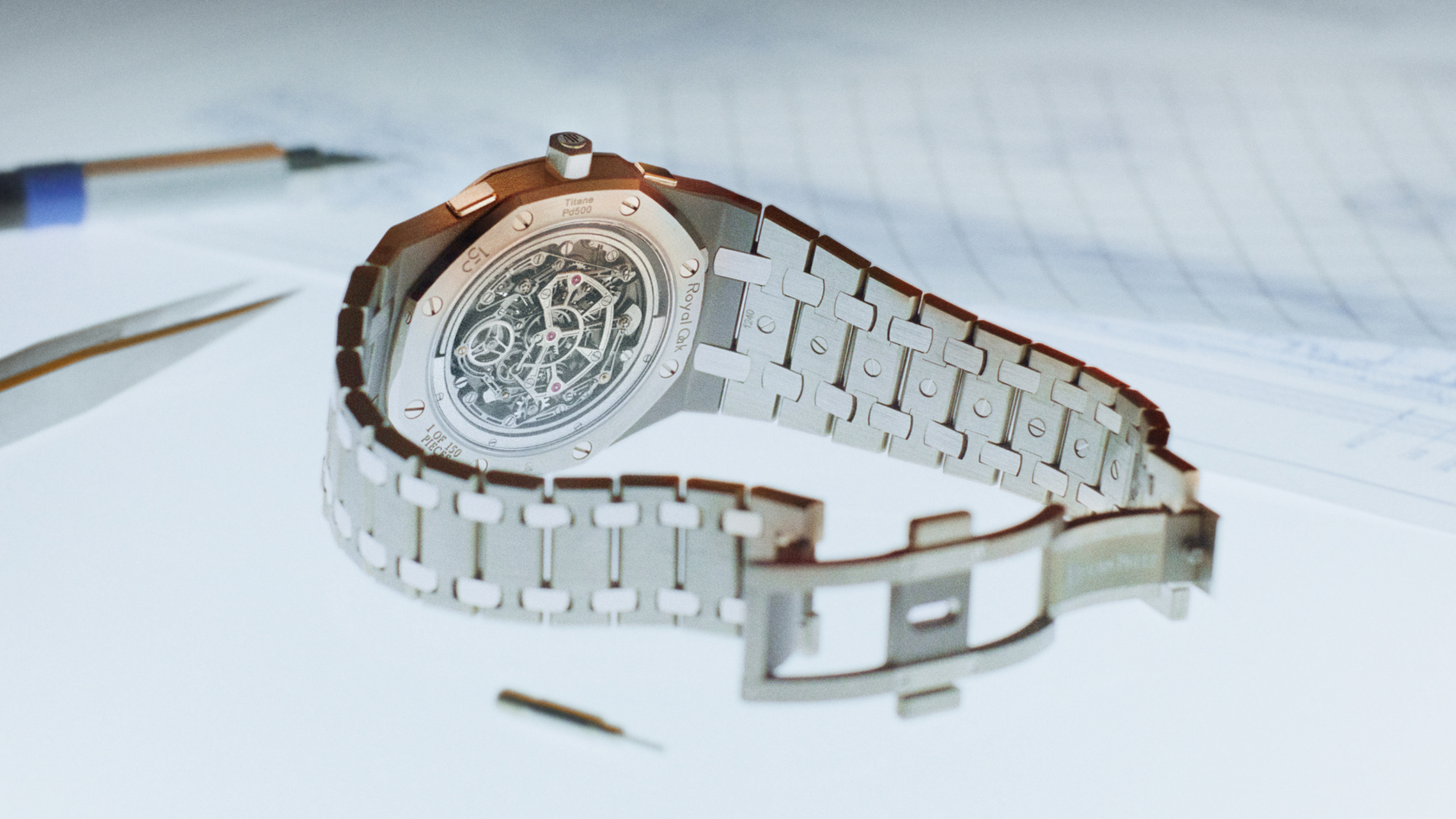
When you turn the watch over, the choices are just as clear as they are on the dial. Platinum peripheral rotors circle the movement, revealing the hand-bevelled bridges with sharp angles and straight graining in full view. Then, to create a captivating play of light, the titanium case and bracelet links alternate between satin brushed and polished bevels on the caseback.
For a brand that introduced its first chronograph watches in the 1930s, manufactured only 307 of them before 1980, and redefined the genre repeatedly with pieces like the Royal Oak Offshore Ref 26040ST and Royal Oak Concept Laptimer Michael Schumacher Ref 26221FT, the RD#5 is a fitting evolution.
As Papi puts it: “Entirely reimagined to meet our clients’ expectations, the RD#5 brings together all the hallmarks of a refined chronograph: a world-first in touch-sensitive push pieces, an instantaneous jump minute counter, remarkable thinness, and ingeniously designed ergonomics and legibility.”