

Natacha Vassiltchikov has traversed the world and mastered the ever-evolving international jewellery auction scene for the past 28 years. Her expertise and vast knowledge of the intricacies of high jewellery make her the ideal steward of Van Cleef & Arpel’s Heritage collection.
This treasure trove of the maison’s jewellery dates from 1920 to 1980, all of which are now for sale. Her responsibility is to breathe new life into the heirloom pieces, nurture their allure, and share their enchanting stories with collectors all over the world.
As a veteran in this field, how do you think it has evolved over the last few years?
The main evolution took place about 30 years ago, when high jewellery clients began to appreciate period jewels. Before that, clients would say that a piece from the past reminded them of their grandmother and didn’t fit their tastes.
In those days, clients were always looking for a style that suited the times. These period jewels were then sold to dealers who removed the main stones and mounted them in a more modern style. Occasionally, jewellers would replace the stones, but sometimes they would destroy the mount.
Today, our clients know how to appreciate the work of iconic jewellers. These pieces are timeless so it’s how you style them with today’s fashion.
How does the restoration process work?
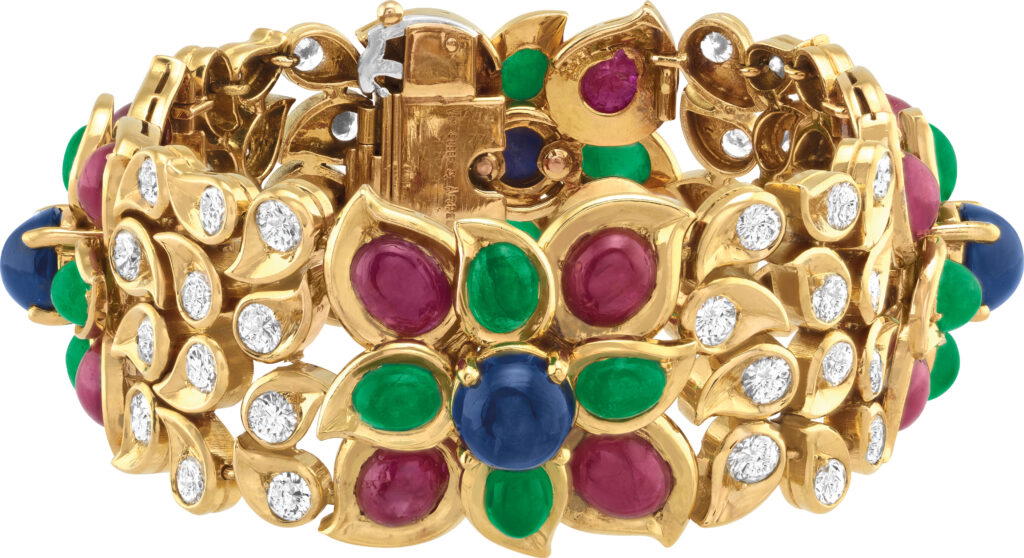
A dedicated team in Paris ensures that every piece from the Heritage collection is in excellent wearable condition. They also add gold hallmarks and the VCA signature. Some of our Heritage pieces may have two signatures because we keep the one from when they were created and always add the one from today.
The pieces are then carefully cleaned with soft brushes, water, and soap. Even without repolishing, they come back to life. Polishing removes a thin layer, so we don’t do it. According to the jewellery team, pieces shouldn’t be repolished more than twice in their lifetime.
Is there a formula for pricing jewellery from the Heritage collection?
Generally, no. There are many rounds of discussion involved. Our objective assessment of a piece’s worth depends on its price, the rarity of the stones, and the craftsmanship. Is this a unique piece? Is it a repetitive design? What is its age? There are many factors to consider.
A piece from the 1920s, for example, has a greater historical value than one from the 1980s. The guiding principle is that there should always be a correct mix of objective factors, market value and perceived value.