
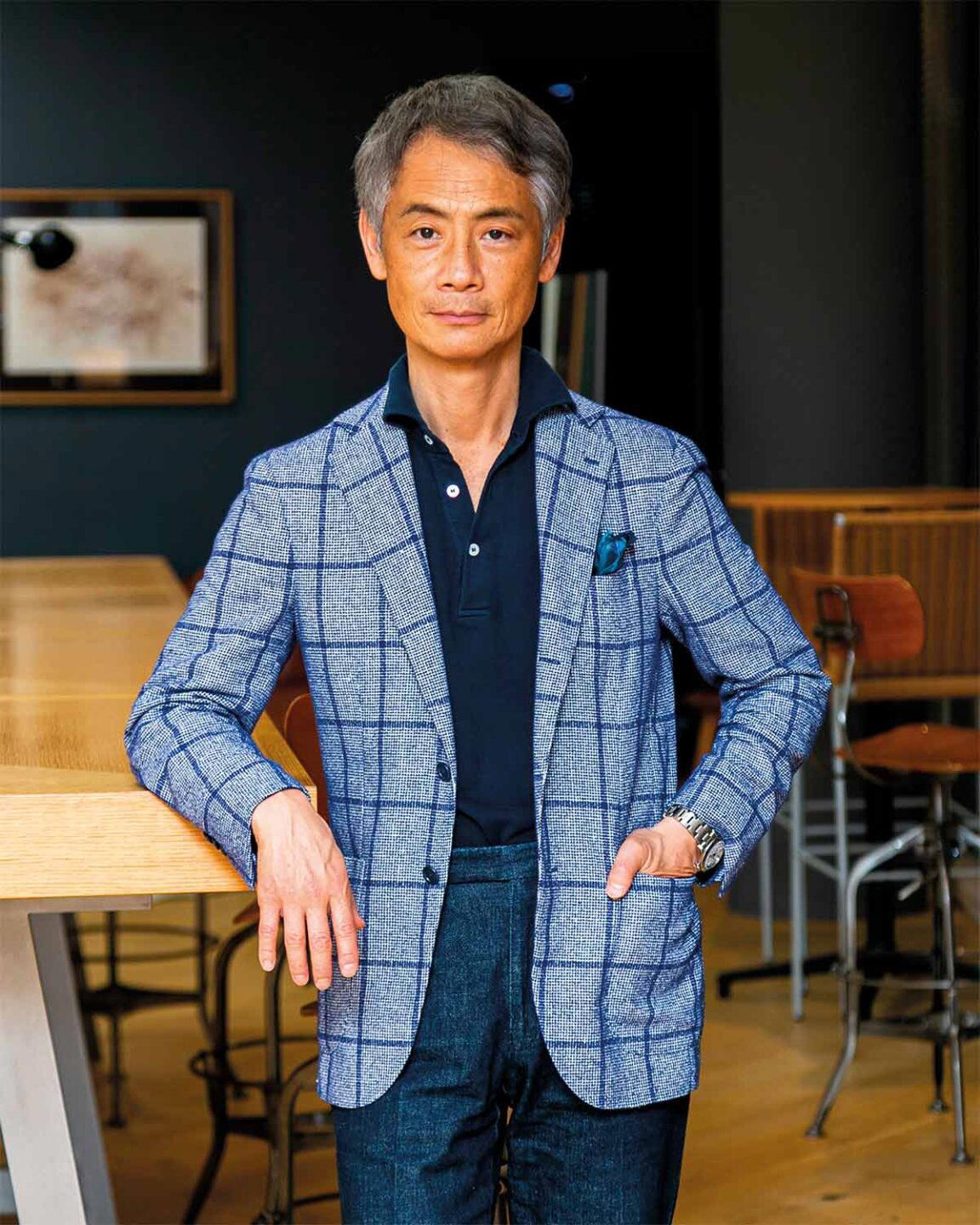
Tatsuya Nakamura looks younger than his 59 years of age. And even more so by the cotton-linen denim suit that hangs over his slim frame. His coiffed hair, a shade lighter than his outfit, is the only thing that reveals his age.
We agreed to meet on the last day of his three-day visit—his first, mind you—to Singapore. As we communicated through Emiko Sakashita, who served as our translator, he answered with the care of someone carrying a bowl filled to the brim with thoughts; taking care not to spill a drop.
As a child, Nakamura remembers growing up in the garment and footwear industry. His paternal grandfather was a cordwainer, and his maternal grandfather was a textile merchant. His parents were always busy, so he had to be independent. He and his older sister cooked for themselves. To chase away boredom, the siblings would make their own fun whenever possible. “I remember playing at the garment office and my grandfather would shoo us away because it was a busy day,” Nakamura recalls.
A relative constructed a suit for him from leftover fabrics after a sale, but the gesture had little meaning to him as a child. “When I wore it to primary school, I had no idea why it looked good, but it was pretty cool.”
Originally from Niigata Prefecture, Nakamura moved to Tokyo to attend university. He would frequent clothing stores after classes; Beams being his favourite. The multi- label store—which began with American styles to show what the world had to offer—is the cornerstone of the Japanese menswear industry.
His constant presence at Beams made the staff recognise him. “Probably because I didn’t buy anything from them,” he ventures. He joined Beams part-time and became a full-timer after graduation.
We discussed fate. Would Nakamura have continued with his Economics degree if he hadn’t worked part-time at Beams? Nakamura grins as he says that even if he hadn’t joined Beams, he would still find a way to work in menswear. Such is the pull of his calling.
It was at Beams that Nakamura met Yasuto Kamoshita. Kamoshita was well-regarded, and the two men formed an easy friendship. After Kamoshita left Beams in 1989 to form United Arrows with Hirofumi Kurino and Osamu Shigematsu, they remained friends. “Kamoshita-san would often ask me to join them at United Arrows,” Nakamura confesses.
Given how similar the two clothing lines are, is Nakamura interested in having his own clothing line? “I’d love to have my brand, but it won’t sell,” he laughs. If Nakamura asks, Beams would grant it, but at the moment, there is no longing for it. However, it is on his to-do list before he retires.
In the event Nakamura has his own line, he will introduce the French Ivy look; he wants to see the style return in the future. In the 1980s, many people, he says, adopted the French Ivy style, and since last year, it has gained popularity in Japan as well. Essentially, it’s a mix of American, English, and French brands. Nakamura explains, “If you haven’t lived through the 1980s, it’s hard to understand the allure of it.” Who introduced him to the French Ivy look? Yasuto Kamoshita, of course.
Nakamura’s average workday begins later than usual. He’s not a morning person so he’ll stroll into the office later and work on emails and paperwork until noon. Meetings follow lunch. He plans schedules and buys during lulls. Because he cannot work effectively in a noisy environment, he remains in the office after his staff has left. As Nakamura puts it, “It’s a simple life”.
Kozo Kawamura worked with Nakamura years ago when he was at Beams. After Kawamura left Beams to start Colony Clothing, Nakamura was supportive. “Truth be told, I couldn’t buy anything for Beams,” Nakamura says. “But years after Colony Clothing started, I saw a striped lounge shirt they made. I told them I would buy a plain version for Beams if they made one.”
Kawamura took his advice, Nakamura made an order, and it sold out. “His attention is solely on the product and his customers’ wants,” Kawamura says. “I appreciate Nakamura’s frankness. When he buys our clothing, it means we’re doing something right.”
Twenty years ago, Kawamura and Nakamura were at Pitti Uomo. It was Kawamura’s first time attending the biannual menswear trade show and he’d paid for the trip himself. He remembers Nakamura’s steadfastness. “For all three days of Pitti Uomo, he walked the booths. A buyer usually walks the first day and then relaxes the rest of the way. Every day, Nakamura scrutinised and inquired about the samples.”
The wait-and-see approach has served him well. For his long-standing blog, Nakamura works on a post for five or six hours, then edits it the next day before uploading it. “My mother always tells me, ‘Don’t go for the fads’. That advice has stuck with me.”
He mentions an episode involving Osamu Shigematsu, one of the founding members of Beams. Two years before the latter left Beams to create United Arrows, he met buyers dressed from head to toe in luxury. If they were really fashionable, he told them, they would able to pull off an outfit purchased from a supermarket.
Shigematsu’s candour shocked Nakamura, who was in the room at the time. In the first place, people of rank like Shigematsu rarely express their opinions; in the second place, Nakamura had the same thought when he saw the buyers wearing branded labels. Shigematsu verbalised what Nakamura was thinking. “Even the most basic item could look fashionable if coordinated well,” Nakamura says.
Kawamura suggested Nakamura’s work should be collected into a book. However, Nakamura is sceptical. “It won’t work in Japan because readers want pictures of influencers wearing the clothes and tagging the brands. That’s not my way.” Kawamura believes it’ll do better in the rest of Asia. “The younger generation and fashion types would want to learn from someone like Nakamura-san.”
As a man aware of the impermanence of trends, Nakamura cherishes two possessions. “I found a pocket watch that used to belong to my grandfather. Although it doesn’t work anymore, I got emotional when I held it in my hands, and I am happy to have it. I also found shoe lasts from my grandfather’s shoe shop, but I do not know who they belong to. It was as if I had reconnected with my roots.”