
For as long as he can remember being an artist, Heman Chong has always been drawn to books, libraries, and writings in paintings.
“We are surrounded by things made of paper. So much of our lives are mediated via paper documents, paper packaging, books, waste,” he explains. “Within the realms of art and culture, our relationship to paper revolves around inscribing words and images on paper, and later on, learning how to preserve them for a future generation.”
Chong’s extensive body of work reflects his preoccupation with texts, books, and paper. It goes all the way back to 2003, when he was selected to represent Singapore at the 50th Venice Biennale. His presented work “Murmurmurmurmurmur (Venezia/Accademia Remix)” (2003) was inspired by a short story written by Singaporean writer and poet Alfian Sa’at.
In recent years, this motivation can be seen in his solo presentation “Ifs, Ands, or Buts” (2016) in which he invited lawyer, author, and translator Ken Liu to select fiction and non-fiction books loosely related to the law for a site-specific installation titled “Legal Bookshop (Shanghai)” (2016).
When further probed about his interest in paper, Chong reveals it began early in his “other life” as a graphic designer, where the concept of paper differs from that of an artist. “At least for me, there is always that possibility of touch. I’ve always been obsessed with that intimacy with paper since the very beginning of my life as an artist.”
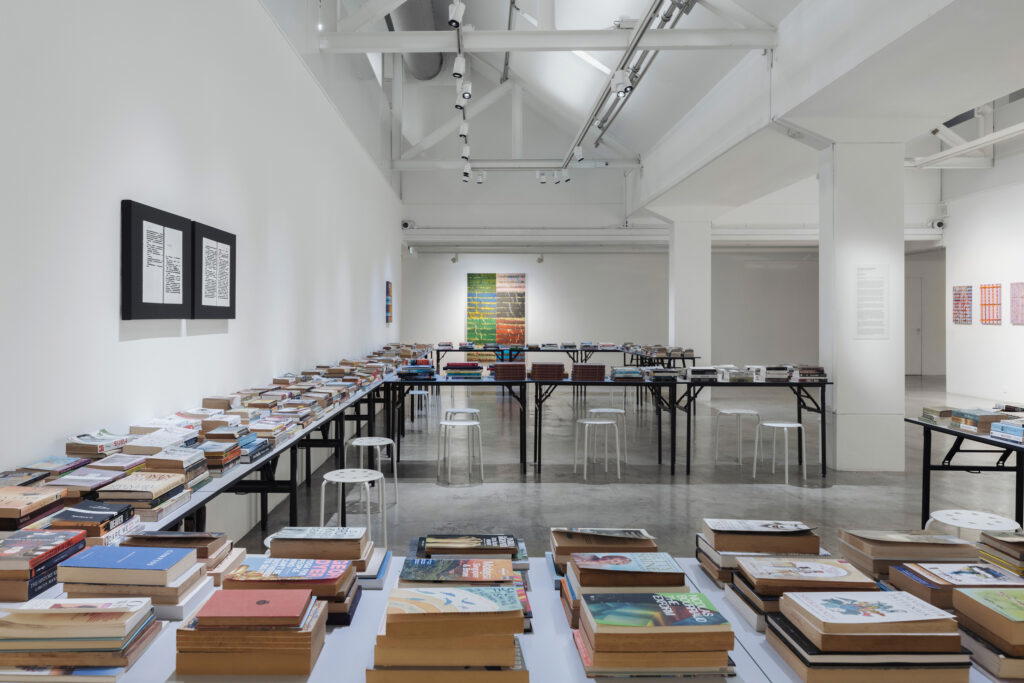
This intimacy continues in his ongoing project “The Library of Unread Books”, which began in 2016. He collaborated with Renée Staal to create an artist-run space functioning as a temporary public library. Participants can donate their unread books to the project. They subsequently appear in various pop-up sites and exhibitions, where others may touch, read and share whatever knowledge they glean from them.
Books, texts, and libraries are integral to Chong’s works, but they are not the only influences he draws from. “I am constantly thinking about artists, their work, and their private lives,” he says. “Film-wise, I watch a lot of gritty Lee Chang-dong as well as a lot of rom-coms like The Devil Wears Prada and Notting Hill when I am resting.”
While no obvious links can be drawn to The Devil Wears Prada in Chong’s works, audiences can still find strong parallels between his art and films. For instance, “Works On Paper #1: Notes on Roads, Trips and other Slips and Falls” (2024-ongoing) takes the form of a myriad of posters installed in a public space. The film stills in these posters have been recycled, redistributed, and reframed, much like the images we encounter online.
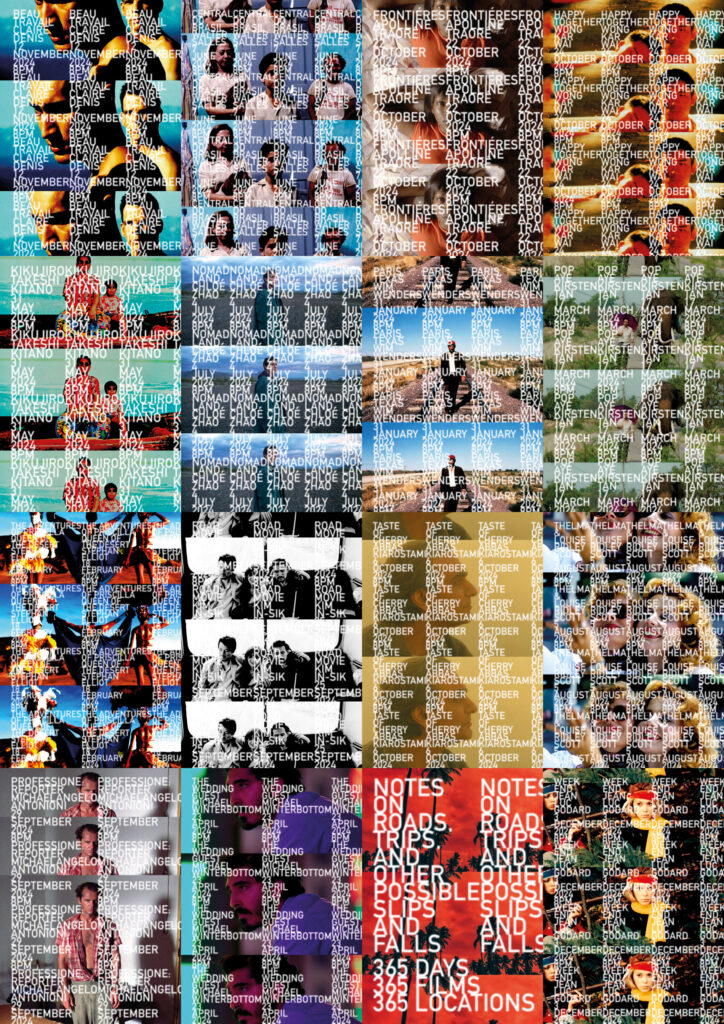
“Works On Paper #1” is one of the many artworks displayed at his most recent exhibition at STPI titled Meditations on Shadow Libraries, where his contemplation and study of books can be experienced in yet another way.
“Meditations on Shadow Libraries navigates personal, informal libraries in relation to ways in which individuals rapidly share information and knowledge today,” Chong explains. “At the heart of this journey are stories about capacity building within communities; stories of growth and possibilities.”
With his artistic career spanning decades now, one can’t help but wonder about Chong’s own artistic process. “I work slowly and without the help of any assistants,” he answers. “I would like to think that every show I make is the very last, so I will always do my best. Having said that, I believe several works of mine have changed the way I have looked at myself and my art.”
One such work he often thinks about dates back to 2008. He describes the title as “ridiculously bombastic [and] out of proportion, and the kind for a work that polarises audiences; you either like or hate it”. “Monument to the People We’ve Conveniently Forgotten (I Hate You)” (2008) comprised a million business cards randomly discarded on the floor of a space.
Once again, paper is involved. “The business card, especially in East Asia, is a cultural object,” he says. “It is a representation of one’s identity and status in society. To have a million cards haphazardly thrown all over the floor can be something shocking. It has this potential to speak about all the failed connections and relationships found in our lives.”
Chong’s evolution as an artist is similar. “I would say that I’ve gotten better at saying no to most things and focusing only on the things that matter. I don’t allow myself to speak about anything that doesn’t deal with anything but my work.”