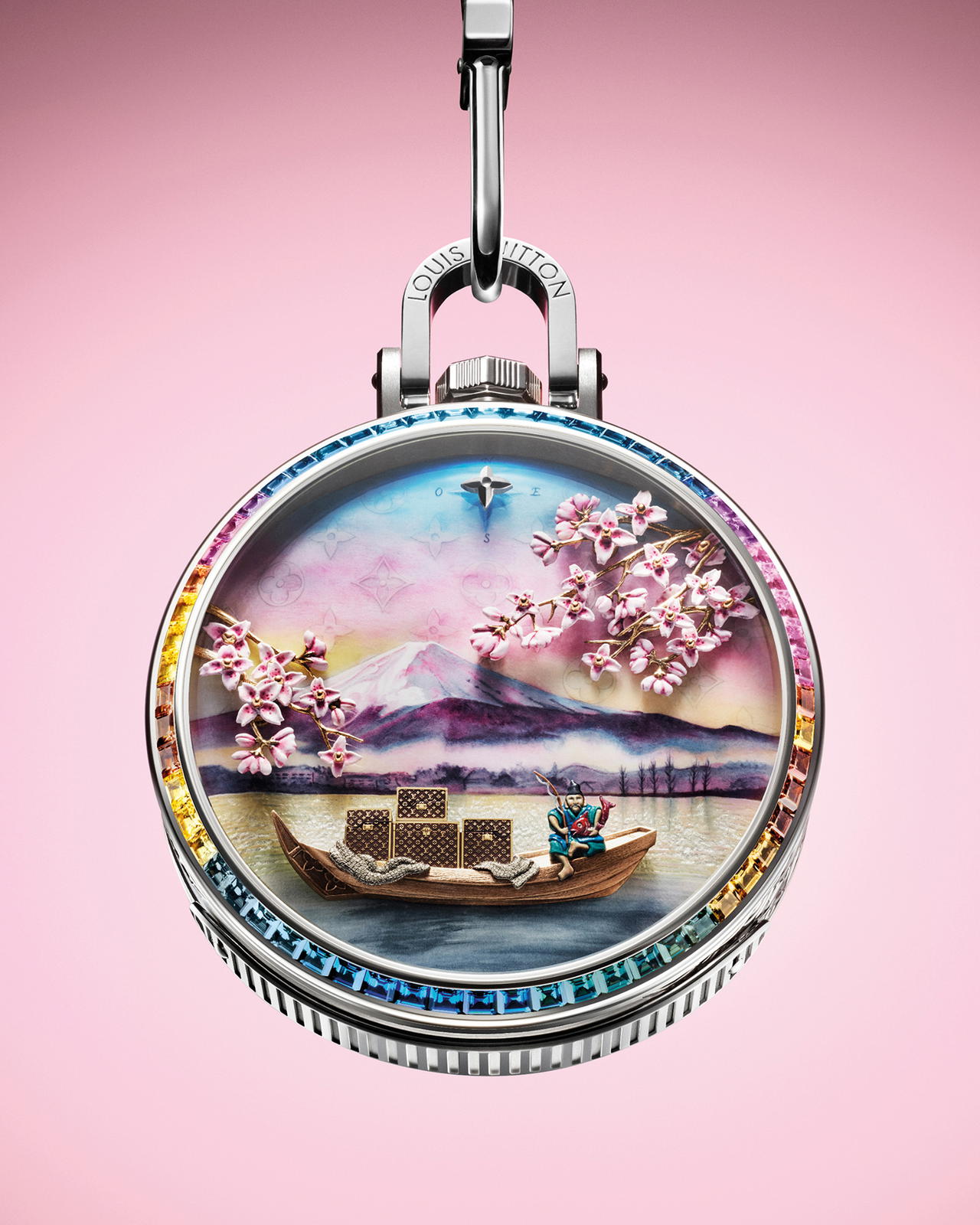
The Japanese have a phrase for the bittersweet realisation that all beauty is transient: “mono no aware”. In their view, the impermanence of beauty is what gives it weight. A cherry blossom, a perfect morning, a cloudless sky, the particular quality of light over Mount Fuji at dawn: each is beautiful precisely because it does not last.
Louis Vuitton took considerable time to ponder this. The result is Escale au Mont Fuji, the latest addition to its Escales Autour du Monde collection of pocket watches. Previous models were based on the Amazon and Paris, so it was inevitable that Japan required something even more unique.
On this pocket watch, you can see a spring morning on the banks of Fuji. It features a wooden fishing boat gliding across the dial. The vessel is steered by Ebisu, the Japanese god of luck and patron of fishermen and merchants, holding a fishing rod and a sea bream to symbolise prosperity.
On board, gold Louis Vuitton trunks gracefully open and close to reveal Monogram flowers, while a compass rose turns at 12 o’clock. Around the dial’s edge, nine cherry blossom appliques—sculpted in yellow gold and enamelled in graduated shades from pale pink to deep red—sway gently, driven by the same automata mechanism that sets the rest of the scene in motion. Framing it all is a bezel set with 60 baguette-cut sapphires, selected and arranged in a colour gradient matching the dial’s colour palette.
The enamel work on that dial is an achievement in its own right. The sky, fading from deep pink at the horizon to pale blue above, consists of 33 individually prepared hues, each ground by hand and mixed with water at the time of application. The dial undergoes 40 firings in total, with each round posing the risk of cracks or colour shifts severe enough to require the artisans to return to the beginning.
The river is created with paillonne enamel, a technique that places metal leaf beneath translucent enamel to create depth and movement. In this case, a single sheet of silver is used instead of gold, adding another layer of complexity—silver reacts differently to heat, making each firing less predictable. The result is water that appears to catch the light and release it again, changing subtly with the angle of view.
Meanwhile, Mount Fuji rises in the background as it would on a clear spring morning, its outline softened by a sky still tinted by dawn. The enameller built this effect through translucent washes, layering colours to give the mountain depth while deliberately blurring some edges into the background to create the illusion that mist and stone are almost merged. As clouds drift lightly across the summit, the buildings and trees below seem half-lost in the haze, their reflections trembling in the water. A final layer of fondant enamel was applied across the entire scene and polished back, giving the dial a luminous depth that makes the light seem to emanate from within.
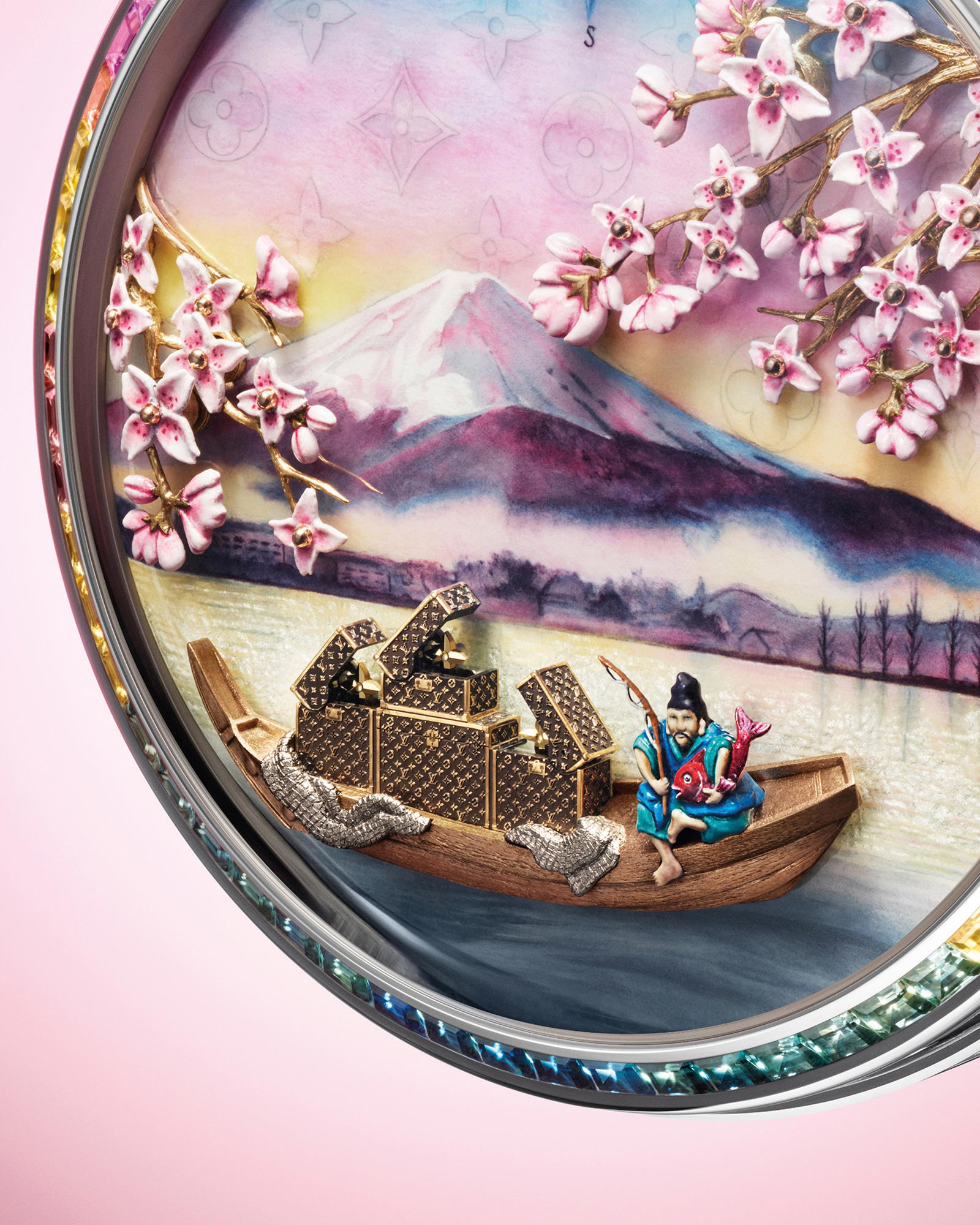
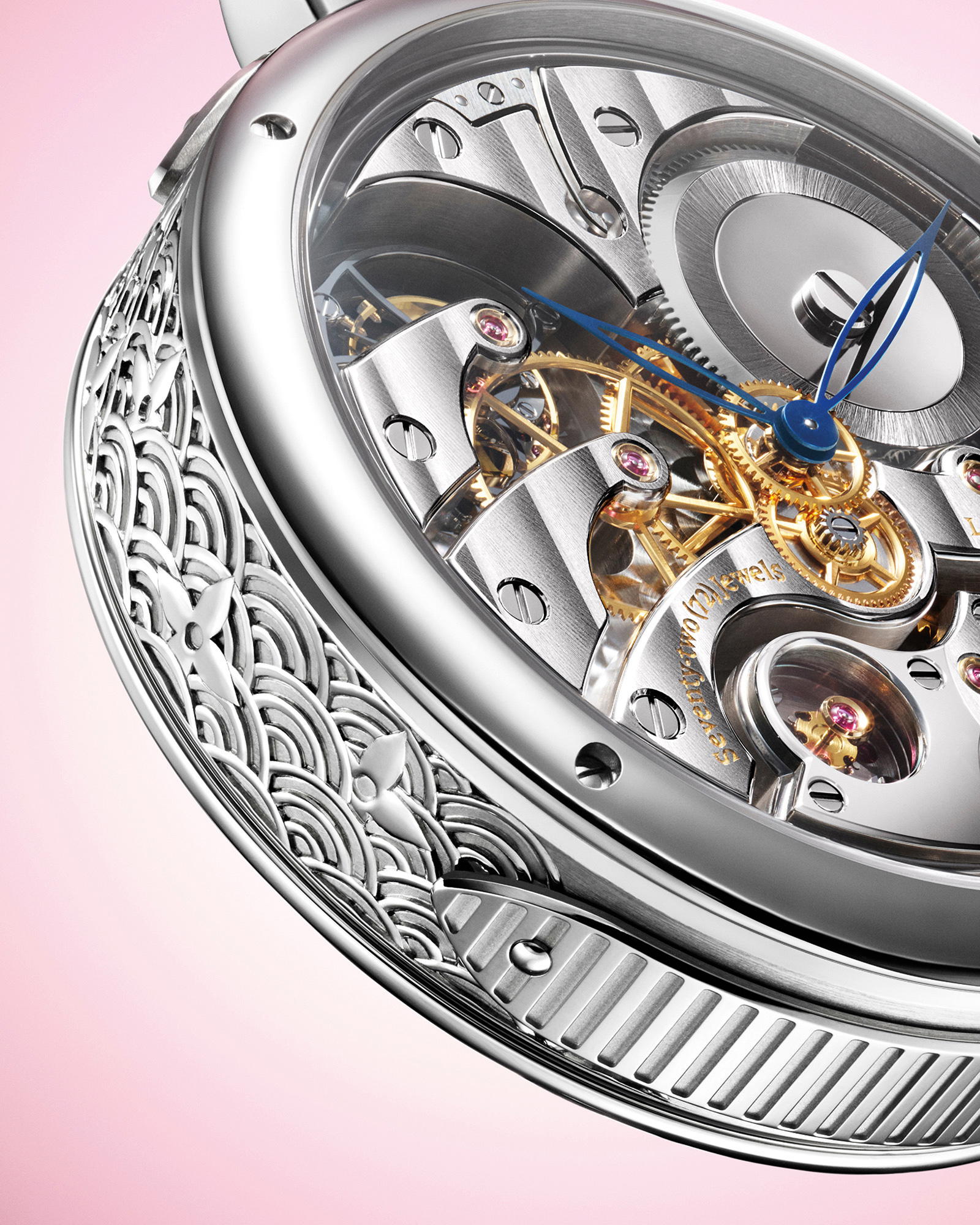
The engraving is no less demanding, requiring around 160 hours. From Ebisu’s moustache, expression, and his hat folds to the fish tucked under his arm and the fishing net slung over the side of the boat, every moving element was hand-carved. Because the figures measured just a few tens of millimetres, the master engraver had to make his own tools, shaping them by hand to work at that scale. Along the case side, wave motifs conceal Monogram flowers woven into the pattern —visible only on close inspection—a private joke between the maker and anyone attentive enough to notice.
The pocket watch is powered by the LFT AU14.03 calibre, with 561 components, and took more than 500 hours to assemble and hand-finish. Seven hundred internal angles across the movement were individually bevelled; the ratchet wheel alone, sculpted into a concave shape, took three weeks to complete. Every element was finished to a standard far beyond expediency, including the Côtes de Genève stripes across the bridges, the mirror-polished screws, the monobloc gongs, and the tourbillon cage. Creating the masterpiece in its entirety took over a thousand hours.
The pocket watch is presented in a bespoke trunk made in Louis Vuitton’s historic Asnières workshop. It is accompanied by a doctor-style bag inspired by an archive piece from 1906. Both are pale blue, echoing the dial’s pastel shades.
The Japanese recognise that transience does not mean loss but rather a heightened awareness of the present. The Escale au Mont Fuji captures this concept perfectly as a mechanism built to last, in honour of everything that doesn’t.