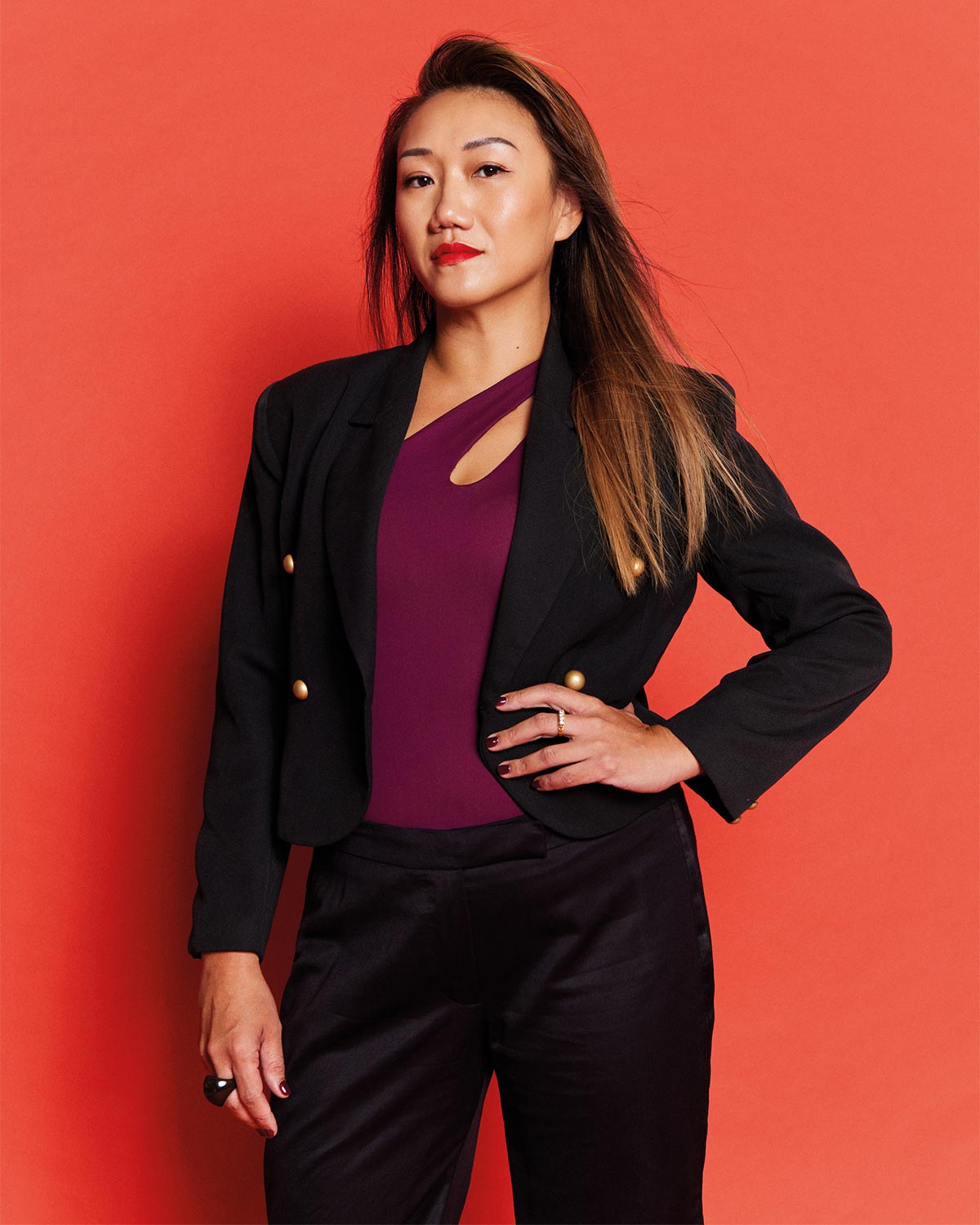
You might say that florist Gracelyn Lin’s supercentenarian family business has evolved in lockstep with Singapore’s breakneck development.
Started in 1879 as a smallholding supplying tuber roses, orchids and chrysanthemums to wet markets and Indian temples, Sing See Soon Floral and Landscaping was shuffled from precinct to precinct by dint of Singapore’s hastily growing urban footprint. “When HDB started developing Toa Payoh, the Singapore Land Authority (SLA) relocated us to Upper Paya Lebar road, where the flyover to Bartley now is.”
They were billeted there for a good 20 years before land-use stipulations gradually edged them out to their current premises at Punggol and Simei. The latter is an experiential garden centre hosting biophilic-themed workshops and activities.
In many ways, it can feel like the fastidiously drawn boundaries are closing in on the firm, which provides consultation and creative services for hospitality behemoths such as Shangri-La and InterContinental Singapore, as well as headline event Formula One.
For one, they were throttled by sweeping migrant dormitory lockdowns enacted during the most precarious crests of the pandemic. “My ‘ah kong’ and ‘ah ma’ started the business from the ground-up; fast-forward four generations and the global impact of the pandemic forced us to revert to our old model, with my family members and I going out to service things ourselves.” shares the fifth-generation business owner.
Covid-19’s volatility compelled Lin to view succession through a less mawkish lens. “We initially disagreed over talent sourcing, because in family businesses you typically look inwards. But considering the concept of incest and how a diverse gene pool is ideal, we need to look beyond the family for talent.”
Forthright and acerbic, Lin bears an assertiveness you may expect from a hard-edged construction ‘towkay’ rather than someone who deals dainty blooms. At her idyllic garden centre in the eastern heartlands, she addresses employees warmly, while peremptorily conveying instructions in the same breath.
The CEO has certainly left her imprint on the brand, which now wears a sustainable, community-centric slant. Plants used in large-scale events are repurposed for free floral jamming events for the public. During the pandemic, bouquets crafted during such sessions were gifted to frontline workers at Changi General Hospital. They’re also exploring waste composting options turning plant waste into fertiliser for their onsite microgreens, and are in talks with local organic fertiliser firm Bioark. This corresponds to their workshops exploring urban farming as well as cooking with homegrown herbs.
“The game has changed and people are hungry for something that has purpose and meaning, which is why it makes sense to tie the loop. Let’s see how we can make it a more sustainable rather than transactional relationship and make an impact,” she reasons.
The 42-year-old says she joined the family business fresh out of university in the US and has never been “bastardised by the corporate world,” so to speak. Growing up in a shophouse in Syed Alwi Road, she has quaint memories of ripping up the Yellow Pages directory to wrap packages of cut chrysanthemum pom poms. Lin credits her fourth-generation antecedents for transforming the humble mom-and-pop operation in the 1970s.
“The economy was accelerating quickly, and my aunties and uncles were strong entrepreneurs who followed their instincts. My talented uncle Sebastian Ee was one of the first Asians to be inducted in the American Institute of Floral Designers,” she shares. Ee, who is Sing See Soon’s creative director, helped expand the firm’s product range and placed it on the radar of high-end hotels such as Shangri-La.
Flowers may have invariably formed the backdrop to her life, but it’s been no twee bed of roses. As an undergraduate at the University of Nebraska-Lincoln, she clocked 90-hour weeks working at a laboratory, restaurant and fresh flower chain Flowerama to supplement her school fees.
“I’ve worked at a supermarket florist as well as a South Baptist business where the only products were funeral and Memorial Day flowers as well as corsages for prom, It was interesting to see the different models and how they influenced the community.”
Upon her return to Singapore, she swooped up projects including a wedding at Jordan’s imposing stone-flagged Zahran Palace, as well as collaborations with high-end brands including Bulgari and Cartier. Needless to say, ostentatiousness and obscene budgets are all in a day’s work. She once had a client who specifically requested for roses with eight round petals. “I don’t even want to revisit that nightmare,” she pronounces with an eyeroll.
Suffice to say, Sing See Soon has ingratiated itself with the tricked-out luxury sector. Yet, Lin remains circumspect over the business’ continuity, given Singapore’s land scarcity. Fresh off a trip to Indonesia, she’s scoping out land to grow their own plants. “The pandemic has made me look clearly at how easily handicapped we can be if we only rely on certain channels,” she asserts.
She proclaims to be frazzled from SLA’s byzantine regulations, which recently curtailed her fundraising event for Breast Cancer Foundation due to leasing restrictions.
“I don’t understand why I’m fighting over this cause with my own landlord. It is frustrating for me and I’m worn out, but I can now understand the battles my gen-3 and -4 predecessors endured. Community is important because you never know when somebody may need help.”
Photography: Mun Kong
Styling: Chia Wei Choong
Hair: Peter Lee, using Goldwell
Makeup: Keith Bryant Lee, using Dior Beauty