


Audemars Piguet’s Royal Oak Offshore is the OG of flashy oversized watches. When it was first released, its 42-mm case dimension was considered unusually large and unprecedented. Paired with an audacious design and bold personality, it made a significant impact during a time when change was eagerly expected. Although initially intended to reflect the glitz and extravagance of the 1980s, the watch became a favourite among the jet setters of the 1990s and 2000s.
been defined by its oversized diameter (42mm),
visible rubber gaskets and imposing thickness.Photo: Audemars Piguet.
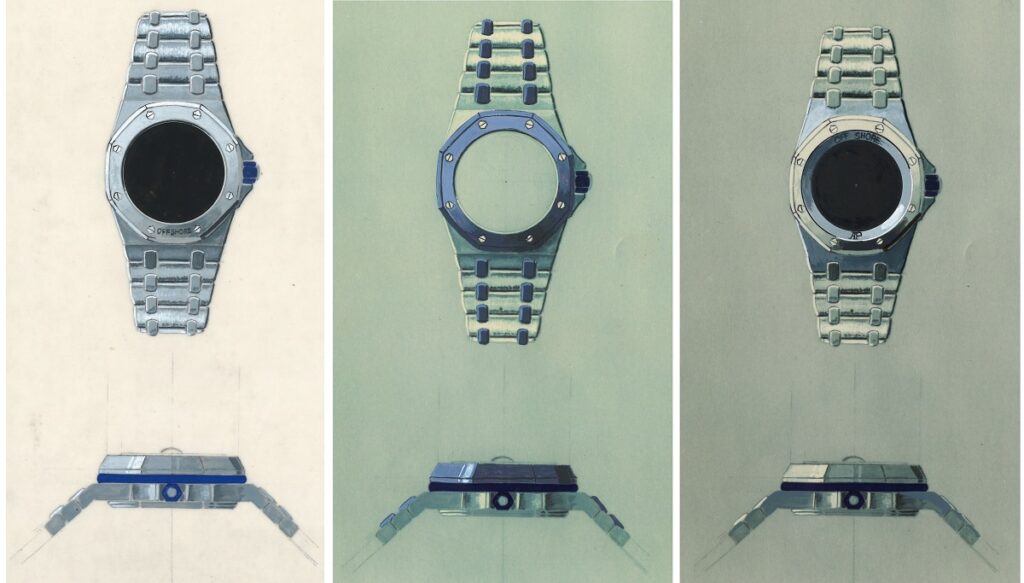
The Royal Oak Offshore’s audacious journey began in 1989 when Emmanuel Gueit, a 22-year-old watchmaker, was tasked with designing a watch inspired by offshore powerboat racing for the 1990s. It was popular among wealthy thrill-seekers who craved danger and excitement and Gueit found motivation for his upcoming design in this environment. The large water- and shock-resistant watch featured a thick gasket, a coloured rubber-coated crown, links, and studs. Dripping with machismo, the eye-catching design was also visible from a distance.
The Royal Oak Offshore challenged convention in the same way as its predecessor, the Royal Oak. Its design was so controversial that the brand’s internal stakeholders pulled the plug on its release a few times, delaying its launch. Eventually, they removed the Offshore branding on the inaugural model (ref 25721) that debuted in 1993. While it started off rocky, it found a fan base among younger generations soon after.
With later versions, the Offshore logo was engraved on the back of the case, and the collection quickly expanded to cater to growing demand.
In 1996, Audemars Piguet unveiled six new Royal Oak Offshore models, including two 30-mm models for women. It was a significant step in the collection’s launch. The following year, it was further enhanced with a perpetual calendar, a dual time zone function, and gems, laying the foundation for the Royal Oak Offshore’s commercial success in the new decade.



In the 2000s, limited editions and collaborations played a significant role in increasing its popularity. With endorsements from big names like Arnold Schwarzenegger (the first celebrity to be associated with the brand and collaborate with Audemars Piguet on multiple watches), Jay-Z, and LeBron James, the Royal Oak Offshore watch gained acceptance in street culture. These exclusive editions transcended mere timekeeping and embodied the cultural zeitgeist.
Even though the watch has undergone many changes in the past three decades, the collection still adheres to the same aesthetic principles as the 1993 original model. It also continues to break rules, serving as a platform for testing out new materials and featuring bold designs like the ref 25721BA (1994), which weighs a hefty 400g due to its full gold construction, and the ref 25940SK (2001), which has a gold bezel completely covered in rubber.

This year, as part of an exciting line-up of watches commemorating the Royal Oak Offshore’s 30th anniversary, Audemars Piguet reveals a reinterpretation of the 1993 Royal Oak Offshore. For the first time, it is designed entirely in black ceramic. Featuring a black Petite Tapisserie dial, the modern monochrome watch is powered by the calibre 4404, an in-house integrated chronograph movement with a flyback function.

There is also a new Royal Oak Offshore Selfwinding Chronograph that celebrates the watch that launched the brand’s many celebrity partnerships: the Royal Oak Offshore “End of Days”, released in 1999 with Arnold Schwarzenegger. The new 43-mm black ceramic ticker features touches of yellow luminescence on the tachymeter scale, the hour markers, and the blackened white gold hands. It is powered by the manufacture’s latest self-winding chronograph movement, calibre 4401, complete with a column wheel and flyback mechanism.

Another burly launch primed to capture the hearts of loyal Royal Oak Offshore fans is the latest Royal Oak Offshore Selfwinding Flying Tourbillon Chronograph. In addition to a new full-black ceramic case, it also features an anodised green rehaut and inner bevels on the titanium bridges visible on the dial side. Driven by the 526-part flyback chronograph calibre 2967 tourbillon movement, it is a glorious showcase of Audemars Piguet’s technical prowess and relentless pursuit of innovation.
The highlight of this year’s new releases, however, are the four new gem-set Royal Oak Offshore Selfwinding Chronographs offered in 37-mm pink gold, yellow gold or stainless steel cases. They all feature the hours, minutes, small seconds, and the date, and are powered by the self-winding chronograph, Calibre 2385. What sets these watches apart is their stunning gemstones of exceptional clarity, cut, and colour, which blur the line between traditional timepieces and jewellery.


For those who adore diamonds, there are two options with bezels set with brilliant-cut diamonds. The pink gold version is paired with a light blue dial and is offered with two interchangeable rubber straps in beige and light blue, which match the dial’s colour. In the stainless steel variant, a warm salmon dial is paired with two interchangeable rubber straps in light and dark grey. Audemars Piguet’s signature satin-brushing and polished chamfers add an infinite interplay of light.
The manufacture has also unveiled two other gem encrusted head-turners—one in yellow gold and the other in pink gold—for those who love the rainbow aesthetic. The yellow gold features a beautiful royal blue dial and a bezel channel-set with tsavorites and yellow and blue sapphires. The pink gold model has a bezel channel-set with 32 baguette-cut rubies, tsavorites, topazes, tanzanites, amethysts, and sapphires that encircle a black dial. Like the two diamond-set variants, they are offered with two interchangeable rubber straps.


The watches introduce Audemars Piguet’s new dial print called the Lady Tapisserie motif, which showcases truncated pyramids that are slightly wider compared to the earlier versions. There are other subtle differences in the new watches, too. The brand logo, for instance, gets an update: the previously transferred “Audemars Piguet” signature has been replaced with the AP monogram. The snailed zone found on the older 37-mm models has been removed so the watches appear sleeker and more elegant. In addition, hour markers are now more prominently displayed, resulting in a bold and striking appearance. To meet the demands of modern women, every watch comes with an interchangeable strap system that allows the wearer to effortlessly switch straps to match her mood.

To round out the impressive line-up of Royal Oak Offshore novelties, Audemars Piguet introduces a new version of the Royal Oak Offshore Music Edition. It features a 37-mm black ceramic case, bezel, and screw-locked crown, as well as titanium elements like studs inspired by the knurled patterns on jack plugs, crown guards influenced by faders, and a pin buckle on the strap to provide contrast. The Tapisserie dial features a vibrant VU meter that symbolises the long-standing collaboration between the brand and the music industry.
Audemars Piguet has introduced more than 230 versions of the Royal Oak Offshore over the past 30 years. Undoubtedly, the collection will continue to grow with the times while remaining a tangible symbol of exclusivity, craftsmanship, and personal expression.