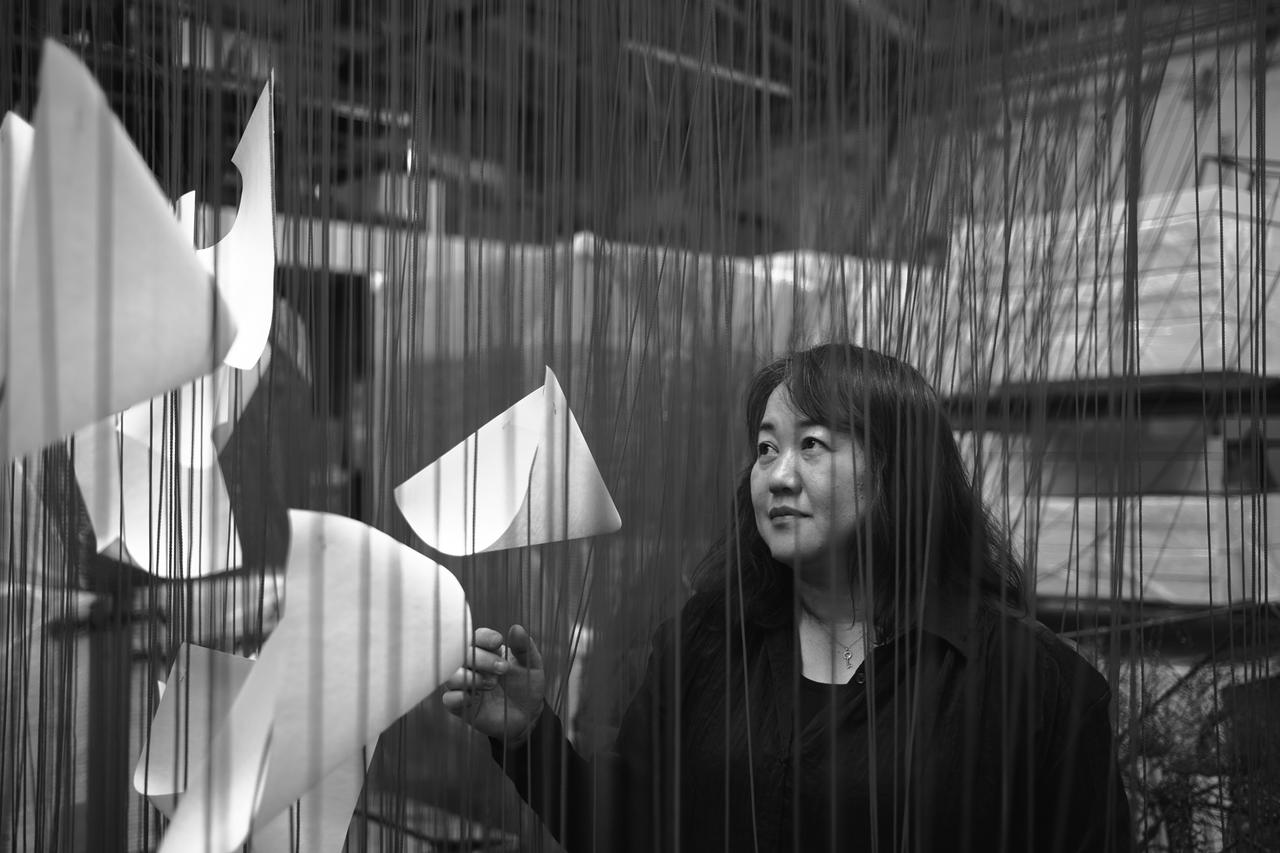
Imagine stepping into a room where thousands of wool threads stretch from the floor to the ceiling, weaving a labyrinth of invisible ties that bind human existence. The delicate yet unyielding threads in Chiharu Shiota’s work represent our fragile and resilient relationships, tracing the unseen lines that bind us and our echoes of the past.
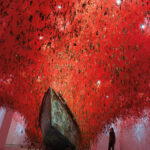
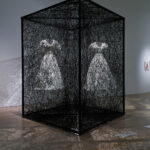
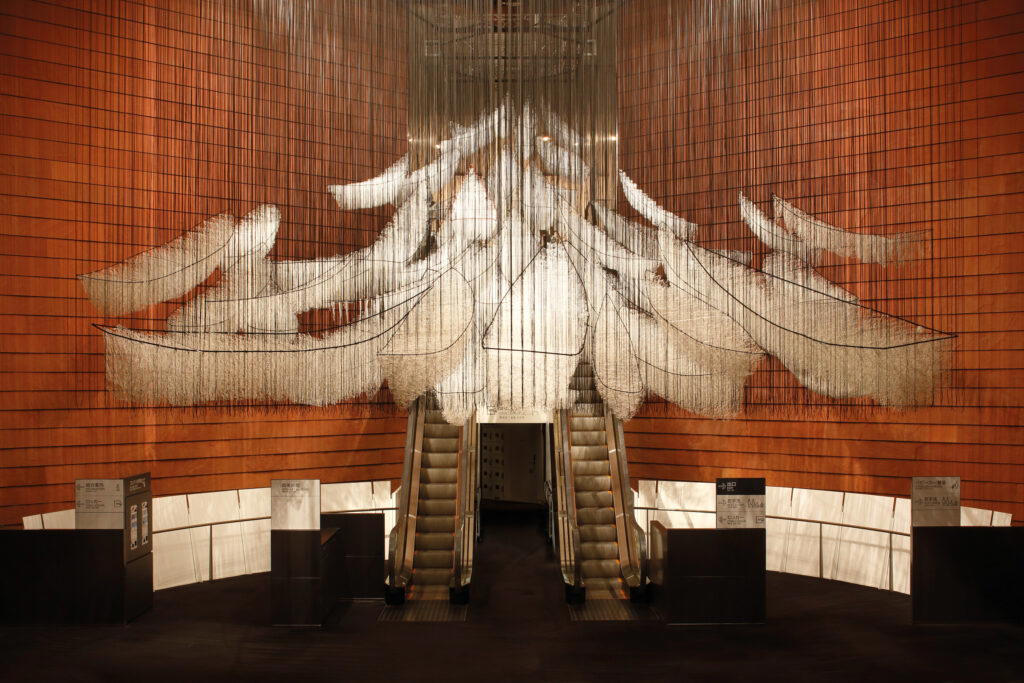
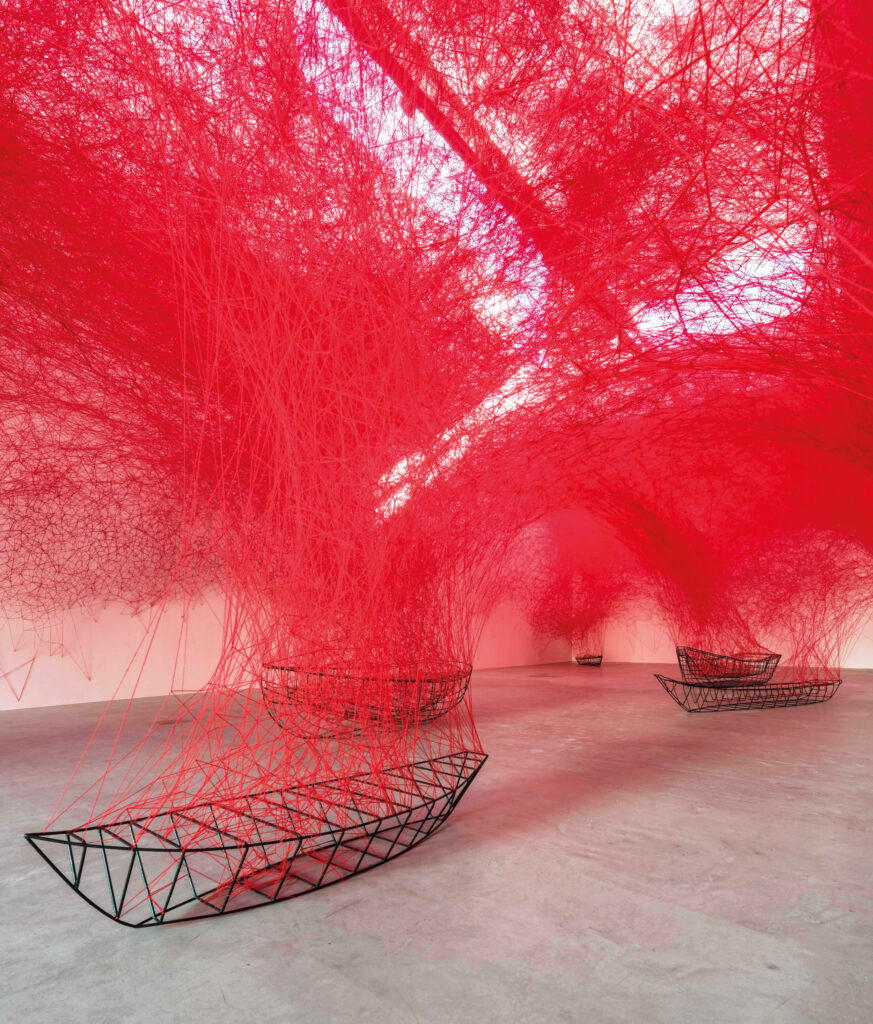
Everyday objects, like worn dresses, weathered chairs, and skeletal boats, are often incorporated into her work. In ‘Uncertain Journey’ (2016), for example, 750,000m of blood-red yarn cascade over empty boat frames, conjuring a haunting image of life’s voyage as an endless odyssey.
“I use only old, worn-out items that belonged to someone else,” Shiota explains. “When I use new items, there is no memory inside.” At Berlin flea markets, she collects objects imbued with life—family albums, passports, and certificates—transforming them into vessels of shared memories.
Her creative process is just as complex as her installations. Each piece begins with an unspoken emotion—a nebulous feeling rooted in personal experience or reflections on universal human connections. Afterwards, she collaborates closely with her team, visiting exhibition spaces repeatedly and translating those emotions into immersive environments. Often lasting weeks, the process transforms delicate threads into powerful 3D stories.
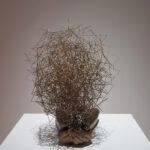
“Thread is a very flexible material. When it is cut, tangled, loose, or tense, it is like a mirror of my feelings. The material is about emotions and relationships of human beings,” she explains.
The impermanence of her installations is integral to her philosophy. “My work doesn’t last forever, like a painting or sculpture, but it lives on in people’s memories.”
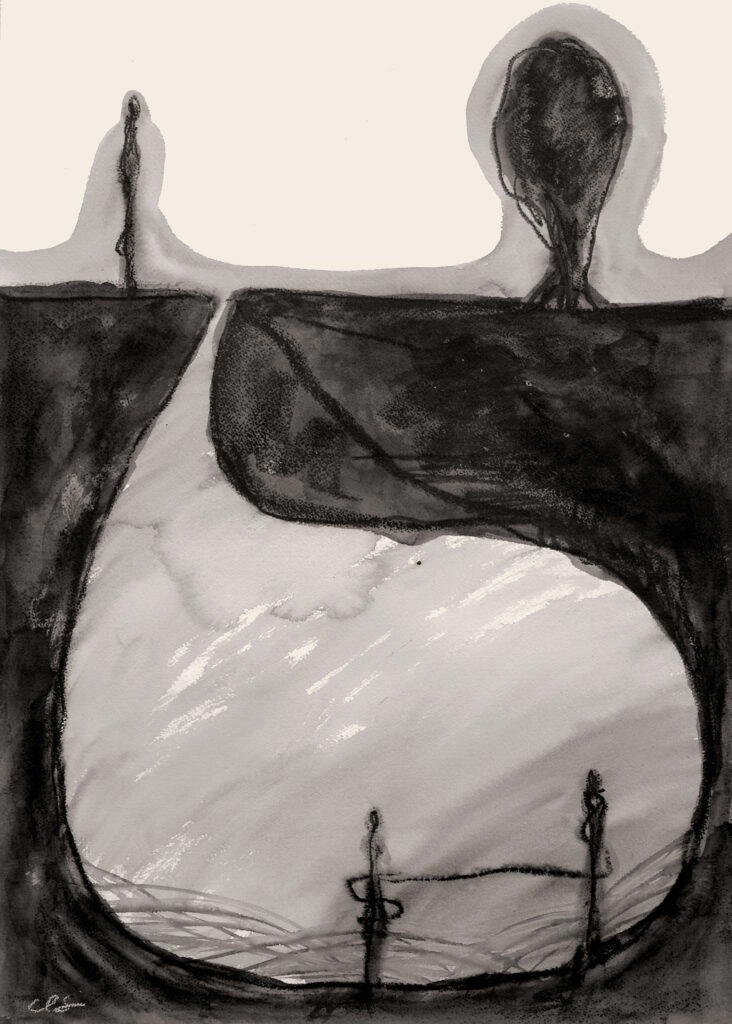
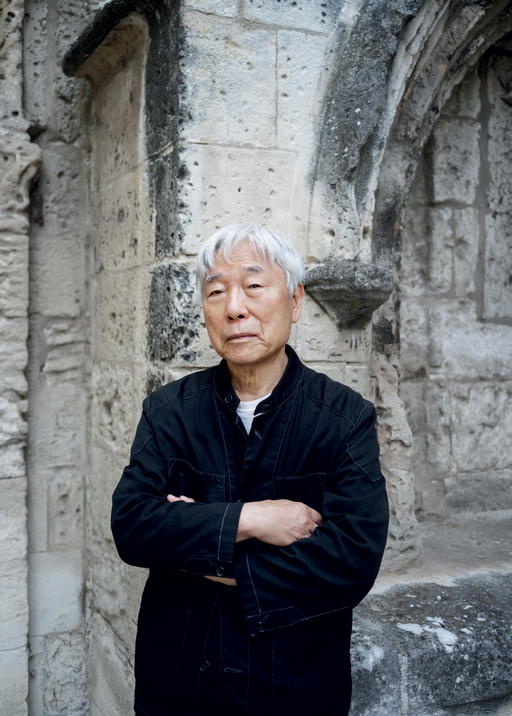
Born in Osaka in 1972, Shiota originally studied painting at Kyoto Seika University. The flatness of the canvas, however, limited her creativity. “I always wanted to paint, but everything I created felt like it had already been done,” she recalls. “It was like I was copying someone else’s work.” She wanted to draw in the air, create something 3D. This epiphany led her to thread, which became her primary medium.
Her artistic evolution continued in Germany, where she studied under renowned performing artist Marina Abramović and has lived since 1997. Shiota’s work is heavily influenced by her cross-cultural experiences and her reflections on themes, such as memory, human relationships, and the inevitability of death.
“The Soul Trembles”—her current solo exhibition at the Grand Palais in Paris until
19 March—marks a turning point in her career. In addition to offering an exploration of her three-decade career, it is the most comprehensive retrospective of her work in France.
Since its debut in Japan in 2019, the exhibition has travelled to South Korea, Taiwan, Australia, and China, connecting with audiences through Shiota’s emotional worlds.
“The collection of installations and artworks is a representation of my life, and
life in general,” she says.
“I always wanted to paint, but everything I created felt like it had already been done.”
One of the works is ‘In Silence’, inspired by a childhood memory of her neighbour’s house burning down. The following day, a charred piano remained in the ruins, a haunting image she will never forget. Shiota recreates this scene with black threads enveloping a burning piano, evoking an absence of music. “The piano was broken and couldn’t make a sound anymore, but its existence was very strong,” she reflects.
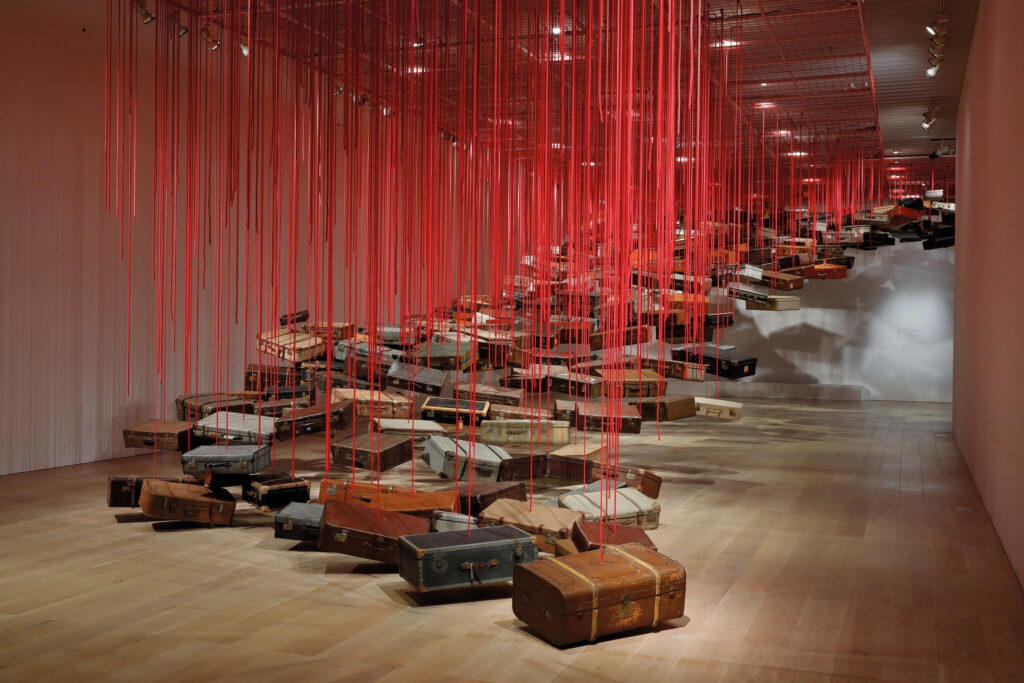
The exhibition also includes ‘Accumulation: Searching for the Destination’, with hundreds of suitcases dangling from red ropes, and ‘The Key in the Hand’, first shown at the 56th Venice Biennale in 2015. There are thousands of keys donated by individuals from around the world suspended in a crimson web and anchored by two wooden boats as part of this installation. Keys serve as metaphors for collective memory, connecting Shiota’s personal narrative to strangers’ lives.
As a result of her artistic practice, her oeuvre is unified by a concept she calls “existence in absence”—evoking human presence through objects rather than bodies. Her items carry traces of lives lived. The memory of a deceased person becomes even stronger after their death, according to Shiota.
“Despite the absence of the person, their memory and existence are still present. Through the memory, I can see their existence and feel them.” Throughout the Grand Palais, visitors navigate labyrinths of intertwining threads, each installation reflecting the fragility and resilience of the human experience.
As Shiota’s art transcends cultural and linguistic boundaries, expressing something primal and universal, a visit to the show might make you feel more like a participant than an observer in the fragile, trembling web of shared humanity.