

After a year of landmark achievements—numerous technical breakthroughs, the grand opening of The Arc, its new manufacture—Audemars Piguet wrapped up its 150th anniversary in 2025 without pausing for breath.
The excitement had barely subsided before it transitioned into a new phase: an exciting collection of novelties revealed in February at the Audemars Piguet Social Club (APSC) at The Chedi Andermatt. APSC is the brand’s private gathering of collectors and press, and the February edition traditionally sets the tone for the year ahead.
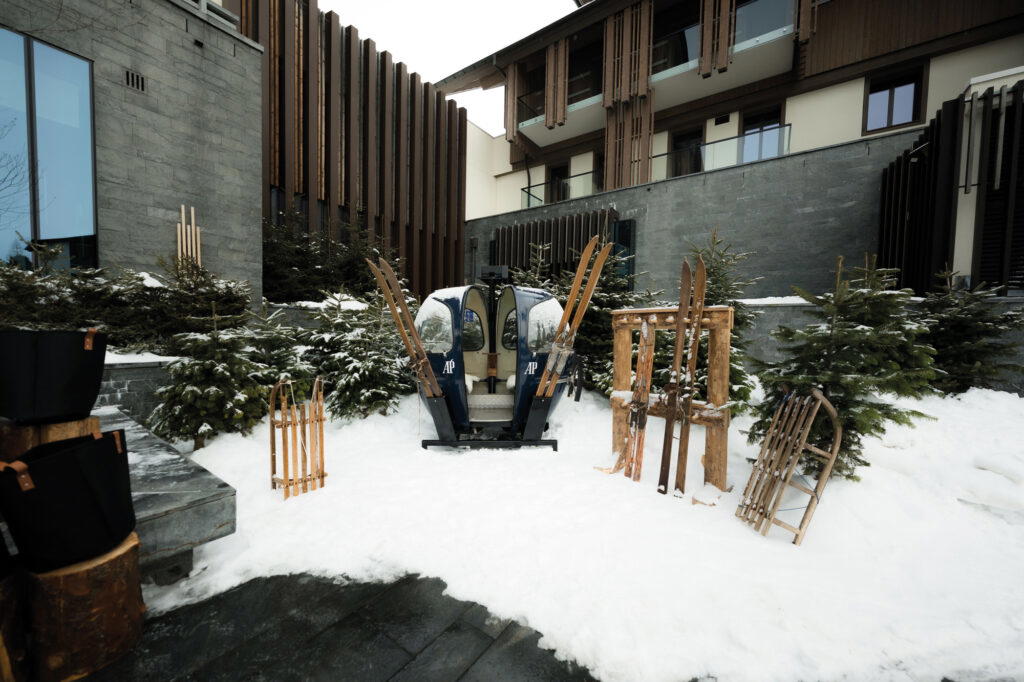
The drive to Andermatt was long, the road narrowing as the mountains closed in—imposing, white, and seemingly indifferent to everything beyond them. Then The Chedi Andermatt appeared, its stone and timber architecture better resembling a mountain lodge than a luxury hotel, but it is unmistakably both.

The choice of venue was deliberate. Andermatt, where four Alpine passes meet, is characterised by crossings and confluences. More than just a beautiful setting for discovery, it reinforced the idea that the brand, even after 150 years, remains a house in motion rather than one resting on its past. In the words of its anniversary slogan, “The beat goes on”.
CEO Ilaria Resta echoed this message in her welcome speech. She delivered it with minimal embellishment, allowing the figures to speak for themselves: revenue rose by 10 percent, and 2025 was the brand’s strongest yet for the sale of complications. More revealing, however, was the shift in customer demographics. The Royal Oak Mini had quietly become a success, making women AP’s fastest-growing segment. It happened so quickly, Resta suggested, that the old categories no longer applied, and differentiating between men’s and women’s watches was unnecessary.
For 2026, the priorities are about deepening what already works. Manufacturing excellence remains the north star, underscored by the recent inauguration of a new facility in Meyrin, a building three years in the making that has nearly quadrupled the brand’s previous production footprint on the same site. In addition to research and development, client engagement is also being expanded, most visibly through AP Lab, a series of masterclasses open to the public. The message is clear: the manufacture is no longer just a place. It is becoming a point of access.
BRINGING LE BRASSUS TO COLLECTORS
In Andermatt, that concept became a reality. For one week, The Chedi transformed into a pop-up manufacture: the same machines and the same team, but without the distance that usually separates watchmaking and ownership. Across the hotel’s lounge and event spaces, watchmaking stations displayed heritage watches, novelties, old hand tools, and high-tech equipment that looked like they belonged in a laboratory.
Sebastian Vivas, the brand’s Heritage and Museum Director, arrived in character as Einstein. Relativity, it turned out, is a surprisingly useful lens for understanding how time is measured. Nearby, master watchmaker Giulio Papi held court over the 150 Heritage pocket watch, a treasure that gets the space it deserves later in this story.
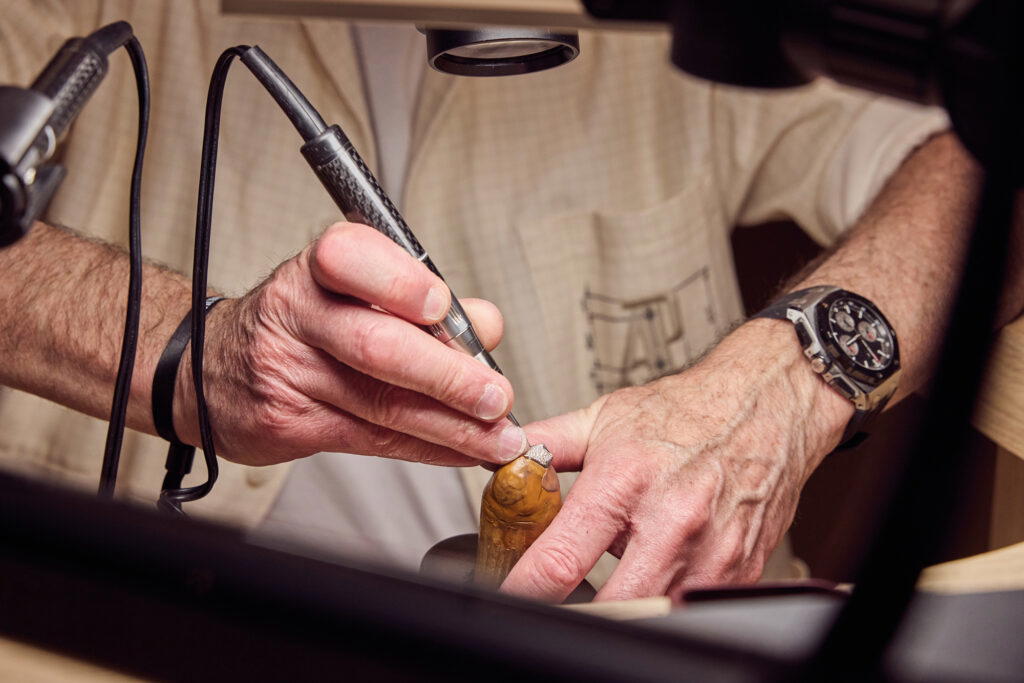
Elsewhere in the resort, AP offered a glimpse into its Fab Labs’ capabilities. With RD#5 marking the end of the RD series’ decade-long run, the Fab Lab exemplifies the brand’s commitment to experimentation: a research space where watchmakers can develop ideas free from the constraints of commercial timelines. Here, AP also revealed what it has been quietly working on, such as a new polychrome ceramic and a CFT carbon case set with diamonds, achieved without additional bonding materials, thanks to the material’s near-zero porosity.
Just steps away, a robot simulated a decade of wear on a Royal Oak Offshore by pulling crowns, rotating bezels, pressing pushers. It served as a reminder that, even in the most manual aspects of watchmaking, advanced technology provides vital support.
There was also a station that showcased AP’s obsession with creating wearable watches, as seen in the recent RD#5. Designed for modern use, this ultra-slim, lightweight, and easy-to-
operate chronograph prioritises ergonomics and clarity. One question AP sought to explore was deceptively simple: why does pressing a chronograph pusher require so much force? At the station, a machine measured the tactile resistance of each pusher with clinical precision. Guests were invited to test it themselves, and the difference was immediately noticeable: a crispness more akin to an iPhone than a wristwatch—exactly the intended effect.
THE 150 HERITAGE POCKET WATCH FOR THE AGES
Among the new launches at Andermatt, two timepieces commanded the most attention. Firstly, the 150 Heritage pocket watch, unlike anything AP has ever produced before, is both outrageously attractive and ambitious. Among its 47 functions and 30 complications are a grande sonnerie, minute repeater, split-seconds flyback chronograph, flying tourbillon and a semi-Gregorian perpetual calendar. It is powered by the new ultra-complicated hand-wound calibre 1150, which comprises 1,140 components and builds on the architecture of the calibre 1000 introduced in the RD#4 in 2023.
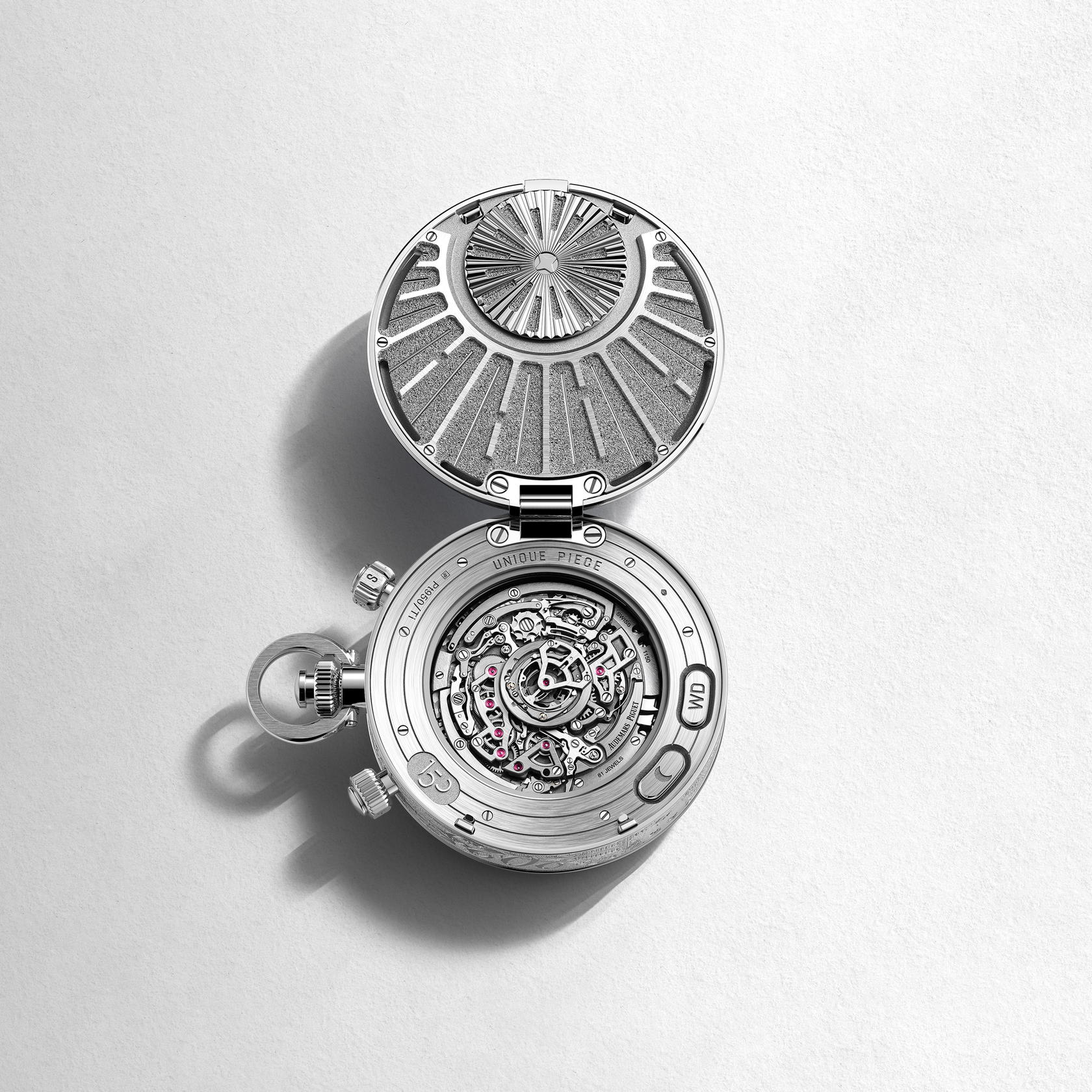
Two pushers and a crown, each multifunctional, are precisely positioned along the central axis, symmetrical from front to back and perfectly centred when the watch is closed. This is the first ultra-complicated pocket watch designed specifically for trouser pockets, which makes accidental activation of any of its numerous complications a real concern. The solution required an entirely new interface between movement and pushers, removing any unnecessary controls. As Papi put it: simplicity is the last stage of complexity.
The dial follows the same logic. All the calendar indications appear in dedicated apertures, displaying day, date, month, and year in a sentence-like format. In addition, there is no clutter on the chronograph counters, and the tourbillon, a complication originally invented for pocket watches, performs its balletic dance at 6 o’clock.
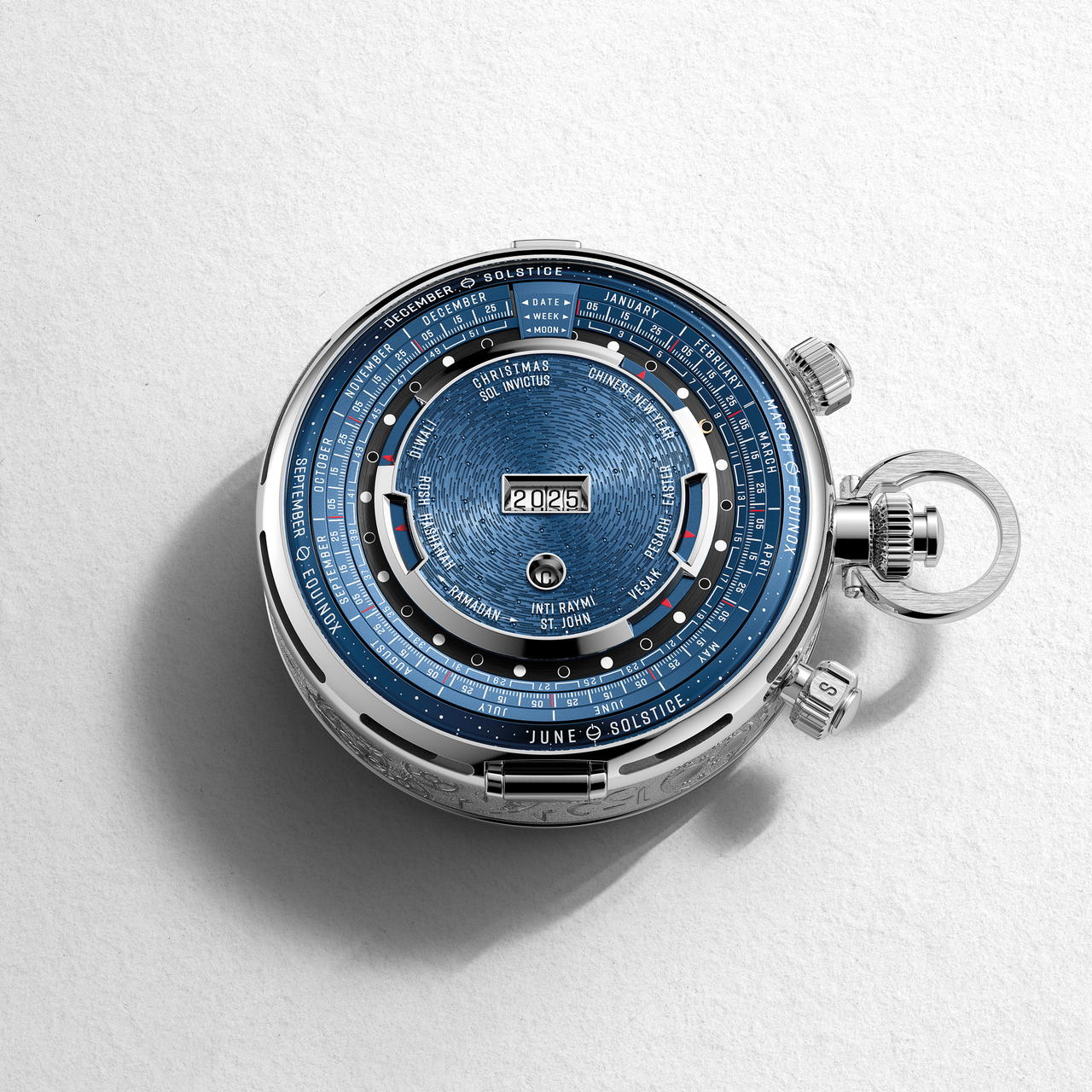
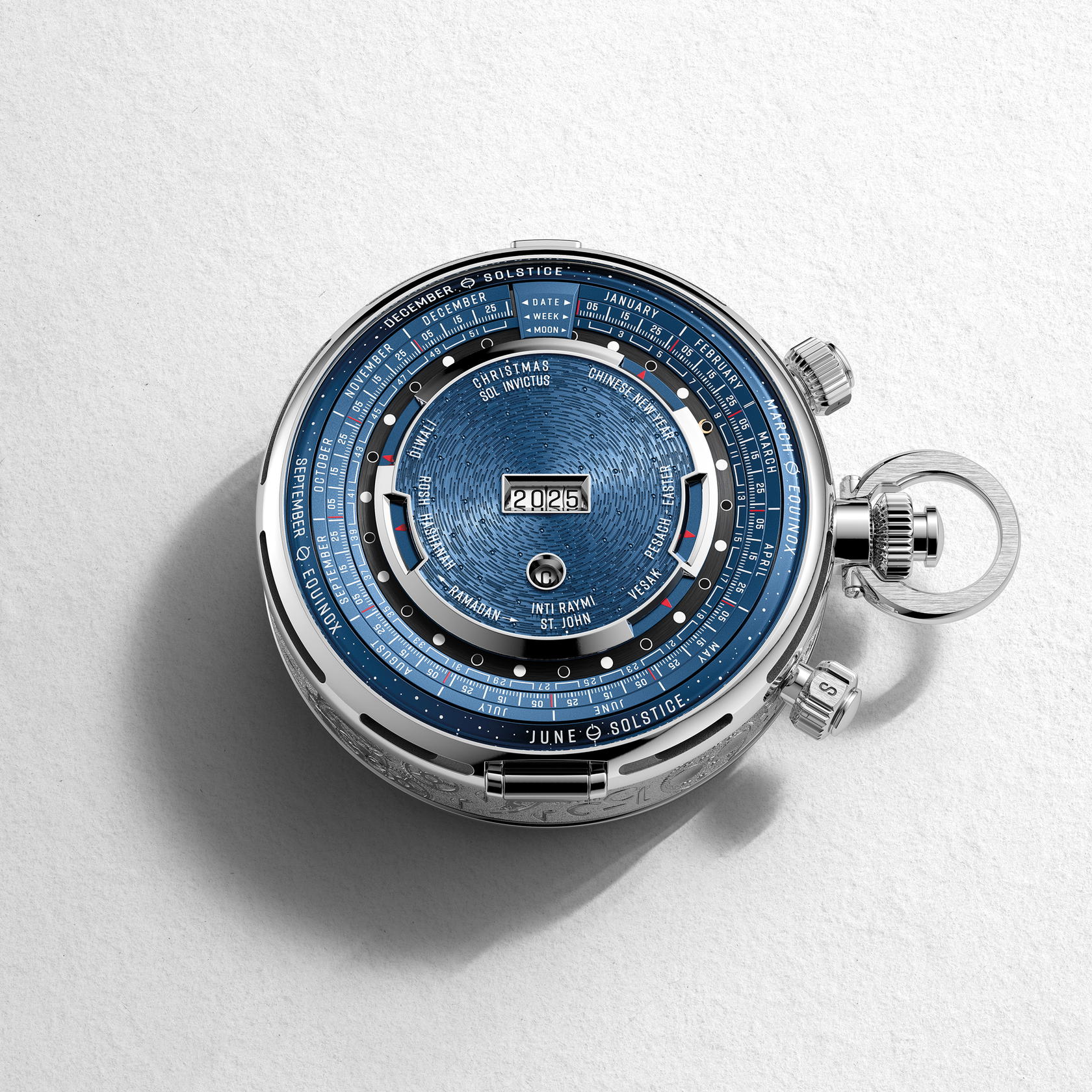
Flip the 150 Heritage pocket watch over to discover the Universal Calendar, a mechanical calculator that operates independently of the main movement and spans two centuries of calendrical cycles from 1900 to 2099. A single bidirectional wheel instantly updates the display, showing moon phases, solstices, equinoxes, and cultural holidays (including Ramadan,
Diwali, Rosh Hashanah, Vesak, Easter, and Chinese New Year).
This creation rewards close attention because humanity has never agreed on a single calendar system before this. Different civilisations independently developed solar, lunar, and lunisolar systems, each consistent but not interchangeable. The Universal Calendar integrates all three, enabling users to locate Chinese New Year in 2027 or the start of Ramadan in 2031 with a simple turn of a wheel. Opening a hidden caseback reveals the Supersonnerie sapphire soundboard. Besides enhancing the acoustic performance of the chiming mechanism, it also offers a view of the intricate calibre 1150.
Only two platinum examples of the 150 Heritage pocket watch will be produced, each hand-engraved, with a grand feu enamel dial and a handmade platinum chain. One will be offered to a single distinguished customer, while the other is destined for the AP Museum. Later in the year, a limited selection of gold variants will be available, according to Papi.
THE RETURN OF THE JUMPING HOUR
The Swiss watchmaker has a richer history with the jumping hour than most people realise. It produced 347 watches with the complication between 1924 and 1951 before it quietly disappeared from the catalogue for seven decades. The reason was largely mechanical.
Previously, AP’s Jumping Hour watches relied on hand-wound movements. However, the introduction of the calibre 7122, an automatic movement derived from the same base that powers the Royal Oak Jumbo, marks the brand’s first self-winding jumping hour movement, seamlessly integrating a complication with roots in 17th-century night clocks into modern watchmaking.
The watch is based on the pre-model 1271, a rectangular piece that was produced in just 14 examples in 1929, most of which were sold before the stock market crash that brought the Roaring Twenties to an end. That was a product of Streamline Moderne, the design language of ocean liners and locomotives stripped of Art Deco ornamentation.
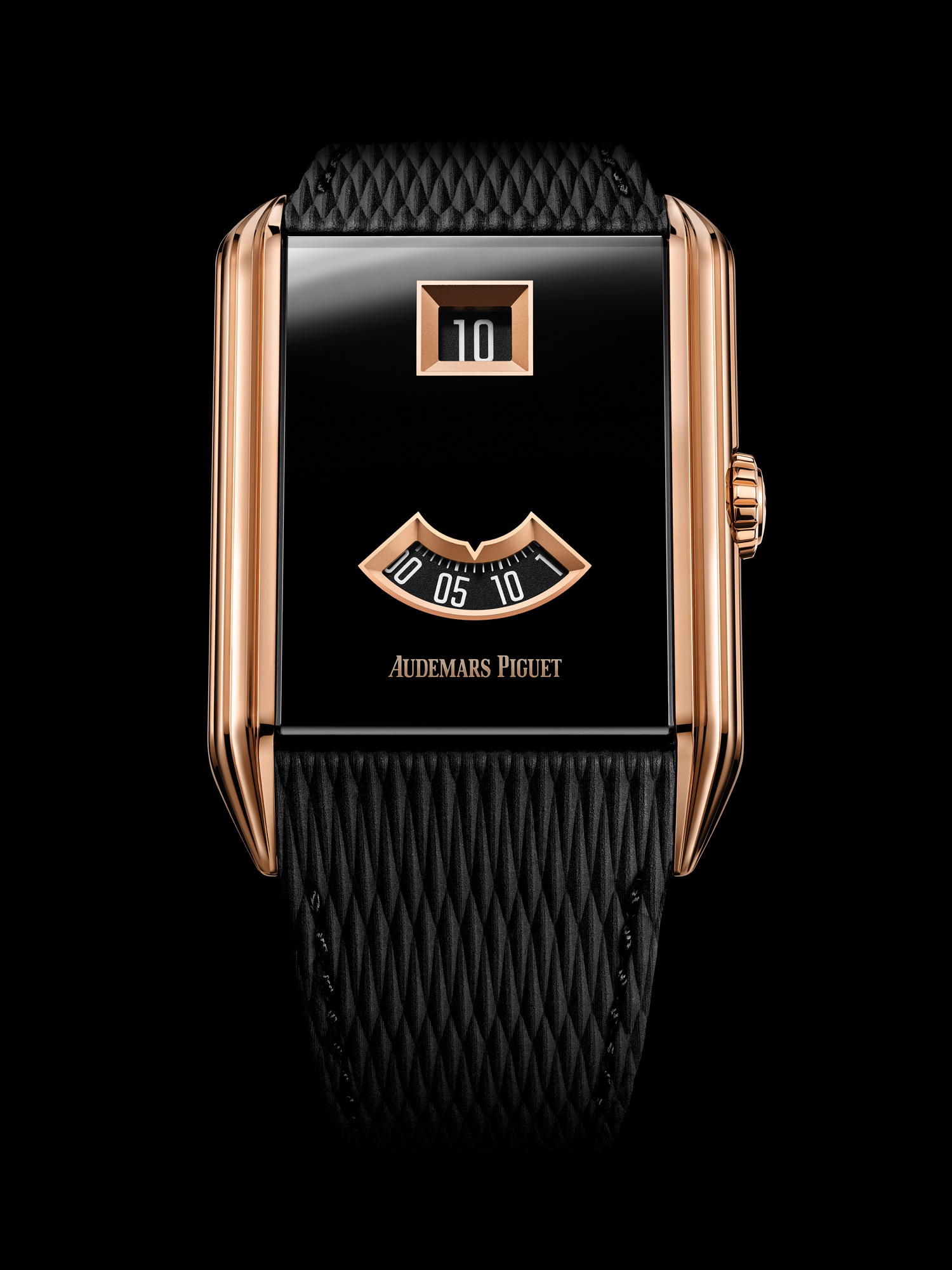
The new Audemars Piguet Neo Frame Jumping Hour inherits its vertical gadroons, elongated proportions, and pointed lugs. Other than that, everything else has been redesigned.
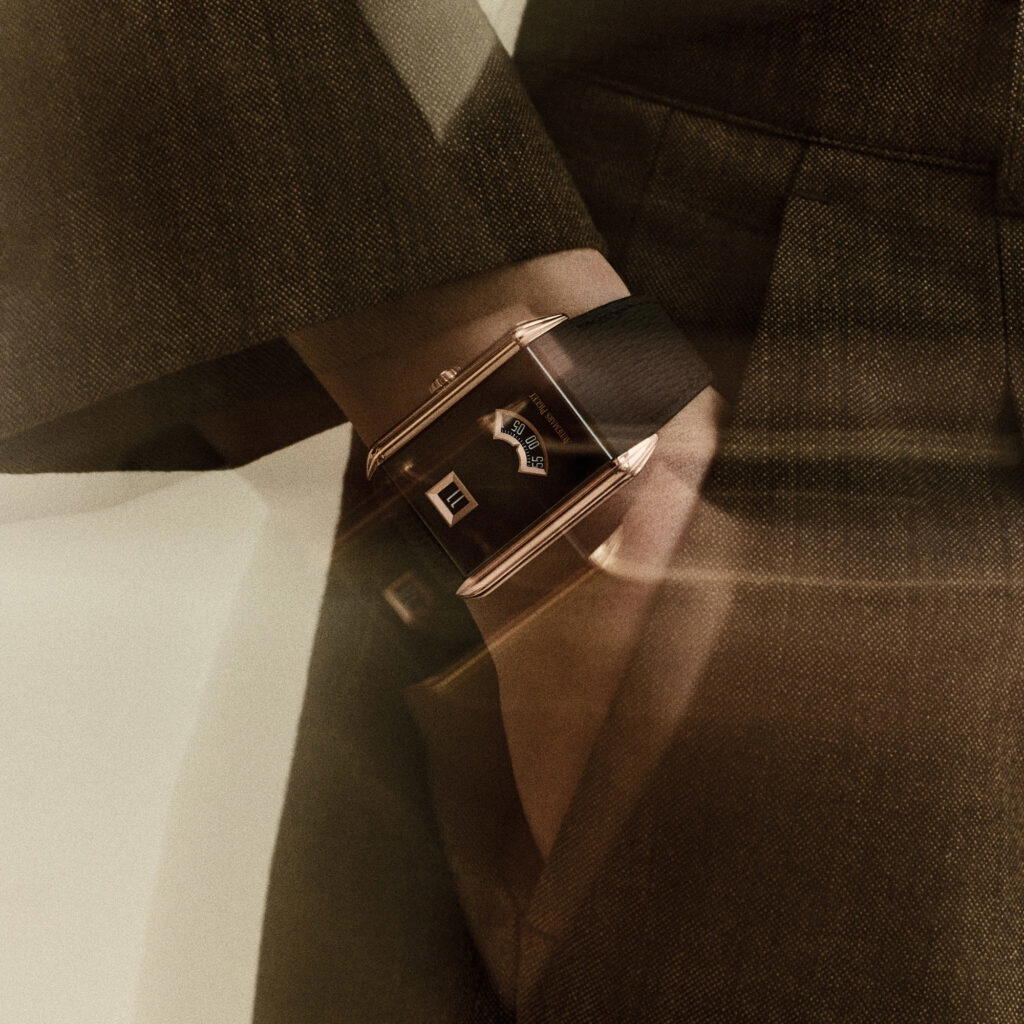
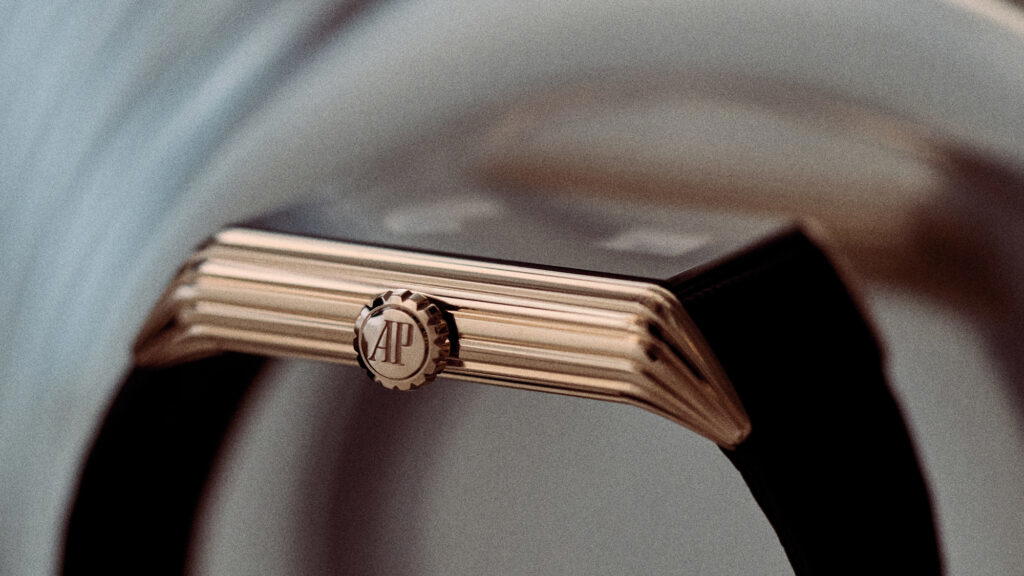
The case is pink gold with a black PVD-treated sapphire crystal replacing a metal dial, a deliberate choice that gives it a distinctive appearance. Two gold-framed apertures display the time—the jumping hour above and the trailing minutes below—while the hour and minute numerals are printed in white on black. The sapphire presented an engineering challenge: without metal framing at 12 and 6 o’clock, conventional water-resistance methods could not be used. To fix this, the dial plate was bonded directly to the sapphire and screwed into the case, a technique developed specifically for this watch.
The calibre 7122 has a power reserve of 52 hours. A titanium hour disc and an aluminium minute disc are used to reduce inertia and enable an instantaneous hour jump. In addition, a patented shock-absorbing system prevents accidental hour changes caused by impact—a practical feature the delicate 1929 original never had to contend with.
The 150 Heritage pocket watch and the Neo Frame Jumping Hour are just 2026’s opening moves. While the gathering at Andermatt hinted at other developments, some stories are best revealed in their own time. What is certain is that AP has no intention of slowing down. It may have been a milestone anniversary, but the momentum continues. Like clockwork, the beat goes on.