
The 1960s was a crucible of creativity. Colour-block dresses and space-age plastics transformed fashion trends, hemlines rose, silhouettes blurred between genders, and design leapt fearlessly into the future. It was also the decade that produced two enduring icons: Zenith’s El Primero chronograph, launched in 1969 as the world’s first high-frequency automatic chronograph, and USM’s Haller modular furniture system, patented in 1965, a design classic that remains a model of clarity and versatility.
More than half a century later, these two brands have finally crossed paths. Zenith and USM have joined forces on a capsule collection that reimagines what might have happened had these two Swiss pioneers collaborated at the height of that transformative decade.
The original 1969 Zenith Defy was the obvious starting point for this creative partnership, a watch defined by its angular octagonal case and fourteen-sided bezel. Over the years, the Defy has taken many forms, but it was never made as a chronograph—until now. The new Defy Chronograph USM envisions what the model might have looked like if it had debuted as a chronograph in 1969, with design details inspired by the clean geometry of USM’s modular system.
The watch keeps the sharply angular 37.3mm stainless-steel case of the original, complete with its octagonal profile and fourteen-sided bezel. Pump-style pushers amplify its retro silhouette, while the stainless-steel “ladder” bracelet, created in 1969 by Gay Frères exclusively for Zenith, makes a return.
“Both USM and Zenith were born as owner-driven workshops in a microcosm of Swiss craftsmanship…Though our products and industries are different, we’re bound by a devotion to timeless quality and purposeful functionality”
Alexander Schärer,
CEO of USM
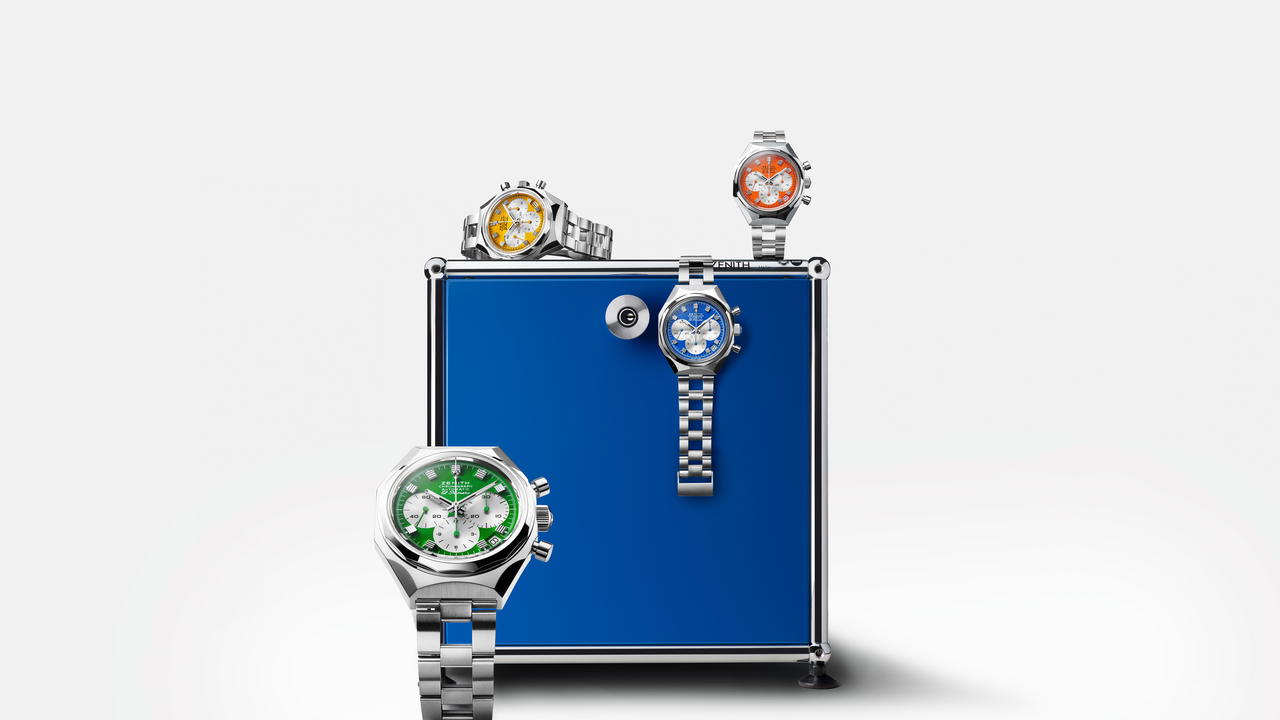
USM’s design language comes through in the dial. Square, grooved markers evoke architectural precision, while overlapping silver counters with an azuré finish recall the texture of the brand’s furniture handles. The chronograph seconds hand ends in a miniature USM Haller ball joint filled with Super-LumiNova, and when the hand sweeps into motion, it reveals a hidden Zenith star—one of several playful design elements incorporated into the piece. Each dial is available in one of four USM signature colours, with each colour limited to 60 pieces: Gentian Blue, Pure Orange, Golden Yellow, and Green.
Each watch is powered by the El Primero 400 calibre, a direct descendant of the revolutionary El Primero 3019 PHC, which was the world’s first automatic high-frequency chronograph, introduced by Zenith in 1969. It runs at 36,000 vibrations per hour, offers a 55-hour power reserve, and drives central hours and minutes, small seconds at nine o’clock, a date at 4:30, and a column-wheel chronograph with 30-minute and 12-hour counters. The sapphire caseback reveals an openworked rotor shaped into the Zenith star, flanked by the El Primero and USM logos—a symbolic meeting point of horological craft and architectural design.
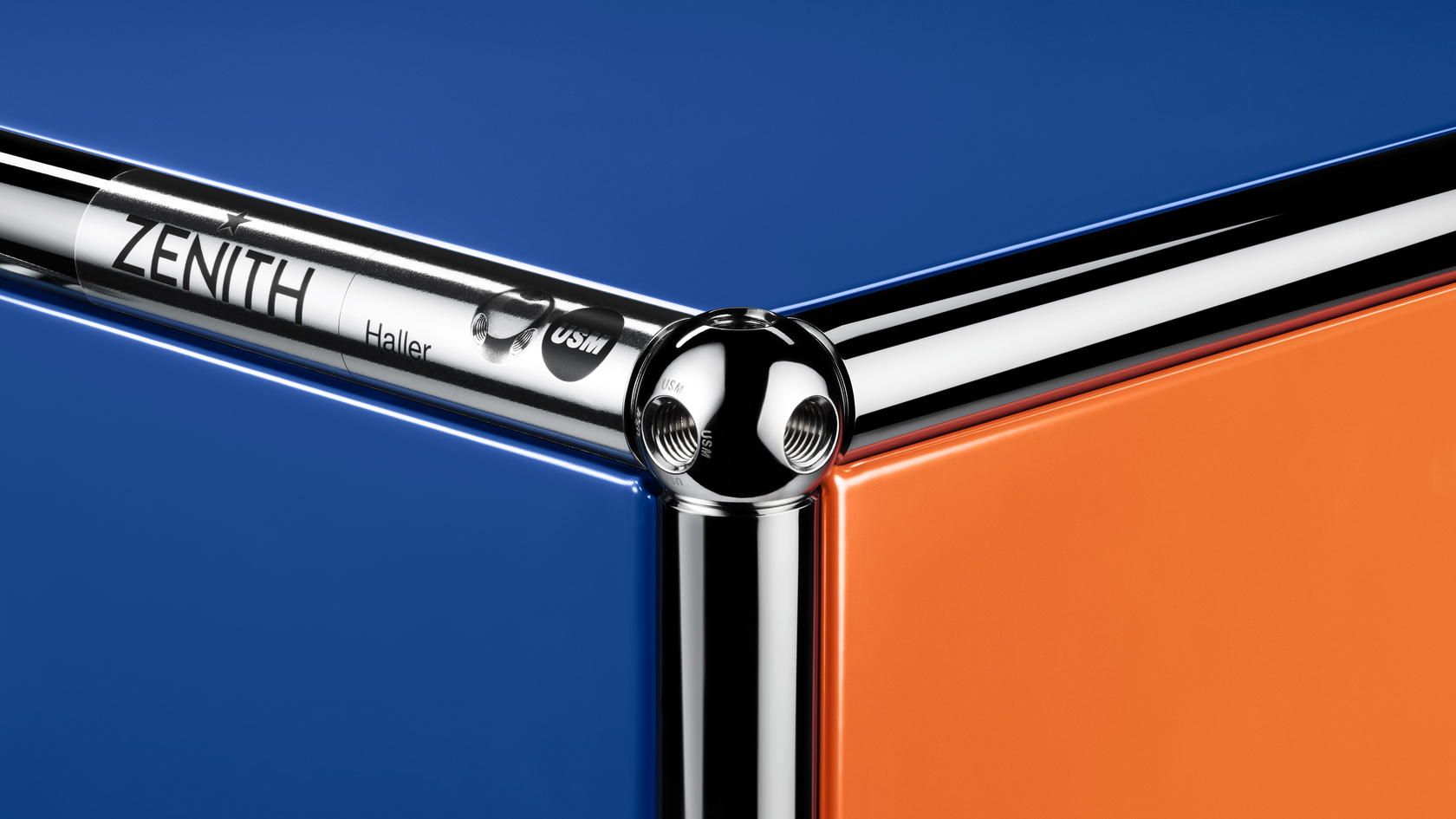
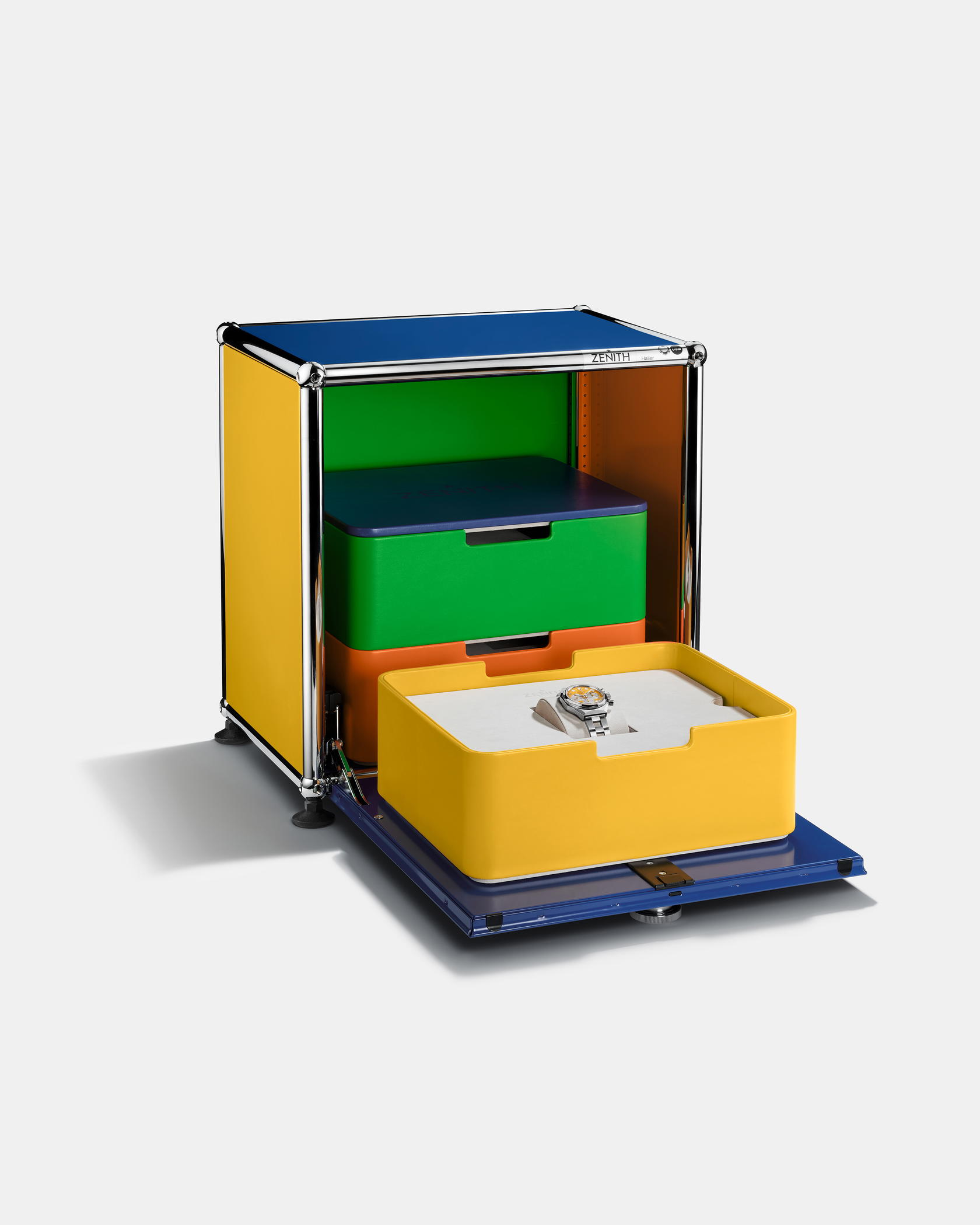
Each watch is priced at CHF 10,900 and available either individually or as part of a boxed set accompanied by exclusive USM modular furniture, including a custom-designed USM Haller chest created for the series.
For Zenith’s chief executive Benoit de Clerck, the partnership is a natural extension of the maison’s ethos: “The modular design of USM Haller, celebrated for its functional beauty, resonates with our own dedication to craftsmanship in watchmaking.” The collaboration is intended to appeal not only to watch collectors, but also to architects, designers, and those who regard design as a union of purpose and expression.