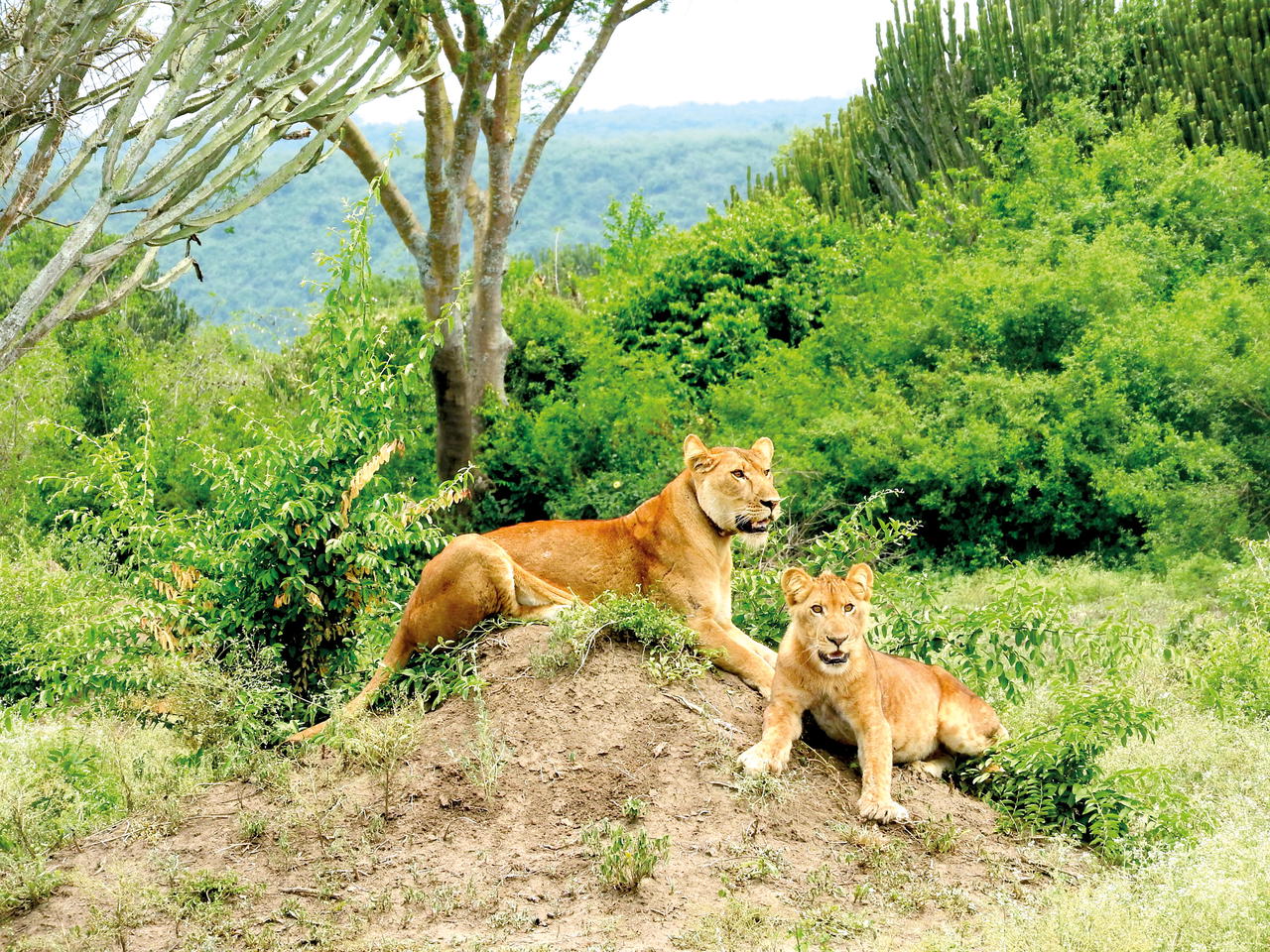
We have just turned off the main road into the mud track leading to Queen Elizabeth National Park in Southern Uganda when our driver brakes suddenly, jolting us out of our post-lunch somnolence. “Lion!” he declares, as everyone in the group stares at him in confusion. “Lion”, he repeats, pointing to a thorny acacia tree just off the trail.
Sure enough, there he is, a massive lion basking in the shade, lazily opening his eyes on hearing our voices. He shakes his magnificent mane and stares straight into my eyes for a moment, sending chills down my spine, before returning to his afternoon nap. We are reluctant to leave the lion, but we must move on; there’s a boat waiting to take us on a cruise to see more animals.
The primary purpose of this Uganda trip is to observe chimpanzees and gorillas. However, I come across lions, elephants, hippos, antelopes, baboons, and dozens of bird species as well. Uganda is always full of delightful surprises and secrets.
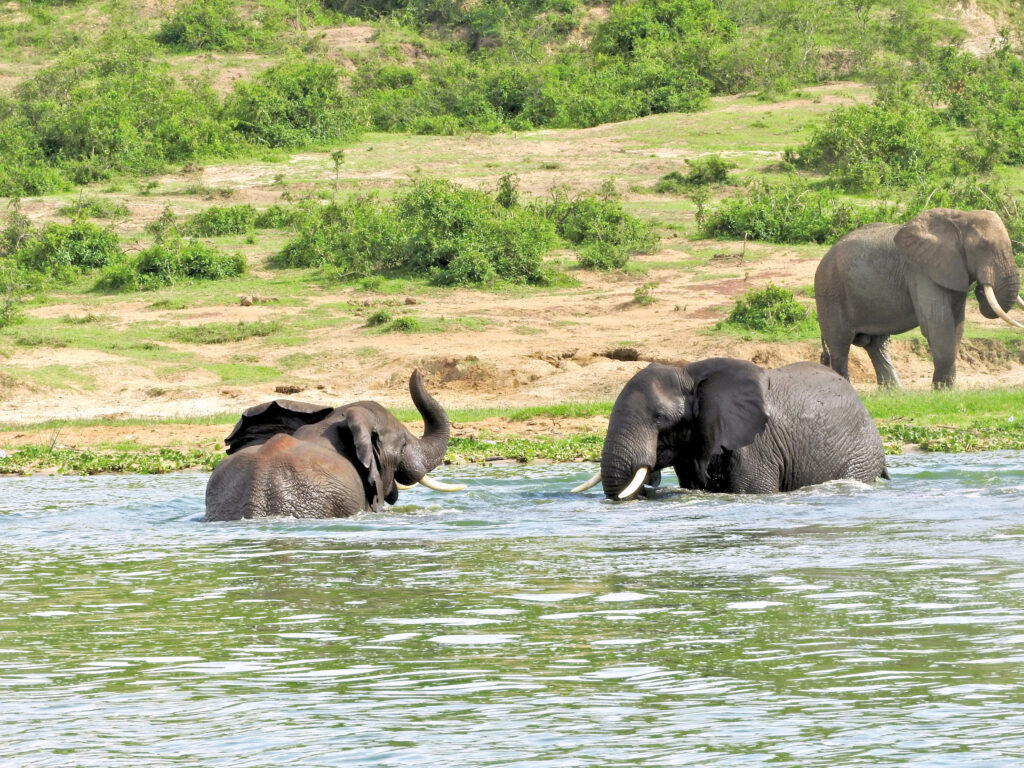
In this sunny afternoon, we’re heading out for a two-hour boat safari on the Kazinga Channel, a freshwater strait that links Lake Edward and Lake George, two of the most biodiverse wetlands in the country.
We see pied kingfishers, grey plovers, black-headed weavers, African skimmers, and a herd of elephants frolicking in the water, as well as a couple of hippos engaged in a loud, ferocious fight.
In Uganda, I am a guest of Volcanoes Safaris, an ecotourism company that pioneered great ape tourism in 1997 and now owns four wildlife lodges. On this trip, I visit a couple of them.
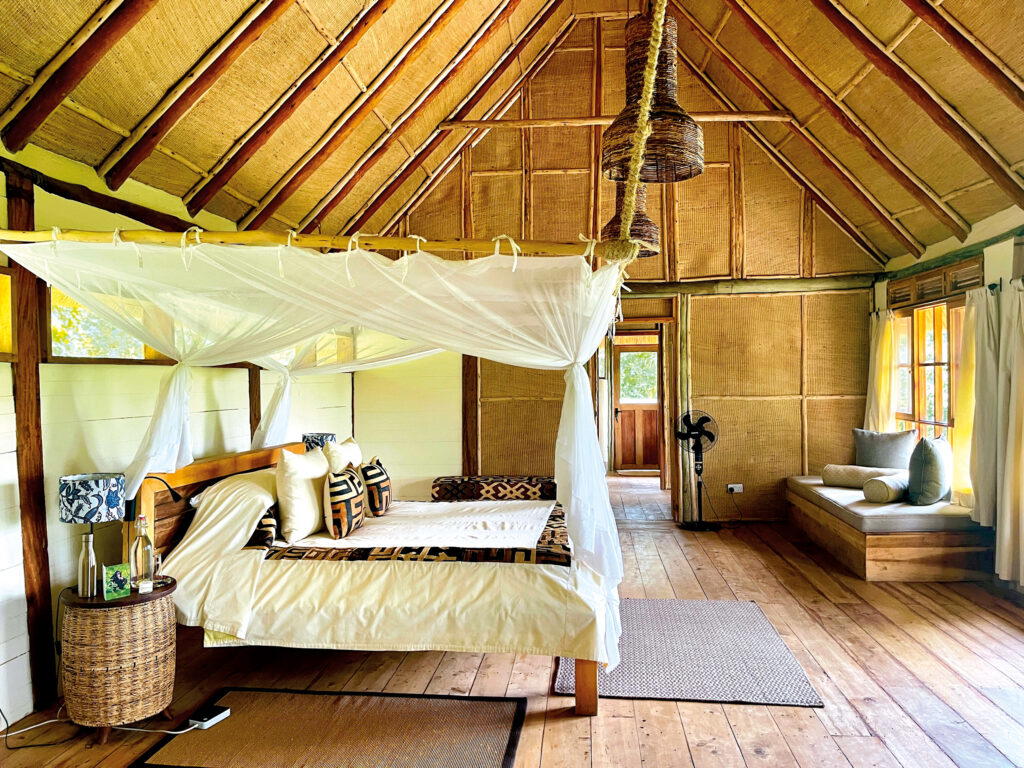
Located at the edge of the namesake gorge, Kyambura Gorge Lodge offers views of the blue Rwenzori mountains in the distance, making it the perfect base for exploring Queen (as locals refer to this national park). After the excitement of the boat safari, I fall into a deep and contented sleep in my spacious banda (cottage in Swahili), undisturbed by the myriad sounds of the forest.
Just after sunrise, we set off for the gorge, a sunken rainforest about 100m below the savannah plains, on a guided walk. Two experienced ranger guides from the Uganda Wildlife Authority are with us, both experts at tracking and locating chimpanzees living in isolation in this forest, completely cut off from the outside world. Following their lead, we descend into the rainforest along a steep mud track, keeping an eye out for chimps.
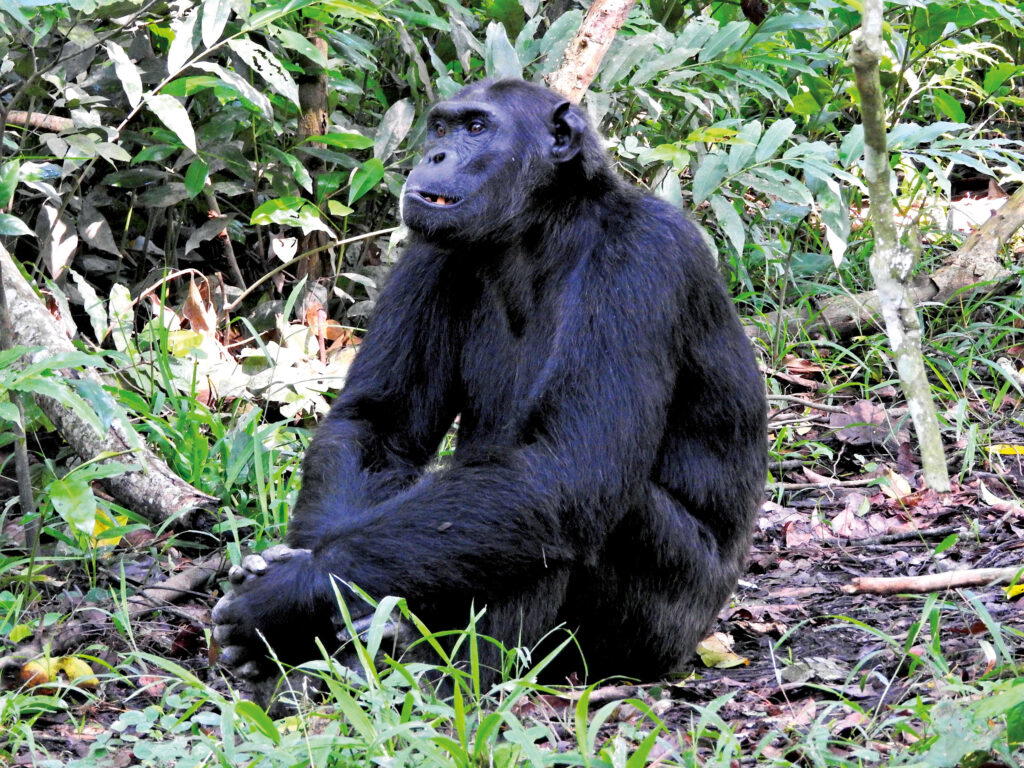
A series of hoots and shrieks puncture the dense silence of the rainforest within minutes. Half a dozen chimps surround us, some jumping nimbly from tree to tree, some swinging cheekily from the branches, and others scurrying purposefully along the forest floor.
Sitting high on a flat branch, Mweya, the alpha male, watches over his kingdom from high on a branch with a benevolent, watchful gaze. Watching and marvelling at their human-like social and familial dynamics, we spend an hour in their presence.
Tracking chimpanzees, our closest primate cousins as they share 98.8 percent of their DNA with humans, is one of the highlights of any trip to Uganda, and I am thrilled by this chance to see them at such close quarters in Kyambura Gorge.
As in Kyambura, researchers have worked patiently and persistently to ensure the chimpanzees of Kibale don’t run away at the sight of tourists. It turns out that these chimpanzees are also noisy and boisterous, scampering about looking for food in the forest. As well as the adults, a young one dangles from vines dangerously, ignoring his mother’s warning calls and testing the limits of her patience. Whether human or animal, kids will be kids.
My trip’s highlight is yet to come, and for that we drive south to Bwindi Impenetrable Forest, one of Uganda’s 10 national parks, near Rwanda. Uganda’s star attraction—the mountain gorilla—lives in this aptly named forest. There are less than 1,100 mountain gorillas left in the world, with half of them found in Uganda. The best place to observe them in their natural habitat is Bwindi.
INTO THE WOODS
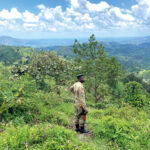
As I sit on the porch of Bwindi Lodge, I can see dense thickets of forest—clearly living up to its “impenetrable” label—and feel a mild anxiety attack about the hike ahead. However, this is what I have come here for, so I give myself a good mental shake and focus on what lies ahead at the end of this physical challenge.
The next morning, armed with walking sticks and steely determination, we meet at the reception hall at the national park headquarters. After a detailed briefing on the hike, we are divided into groups of eight and assigned a single gorilla family to track.
To ensure everyone shares the thrill of a lifetime, forest department trackers, who head into the forest ahead of us to look for these amazing creatures, stay regularly in contact with our ranger guides.
Porters from the local community help carry our backpacks and, although we don’t realize it then, also pull and push us through the most challenging parts of the trek.
Gloria Asasira, our leader, walks in front of us at a steady pace so that even the slowest of us can follow.
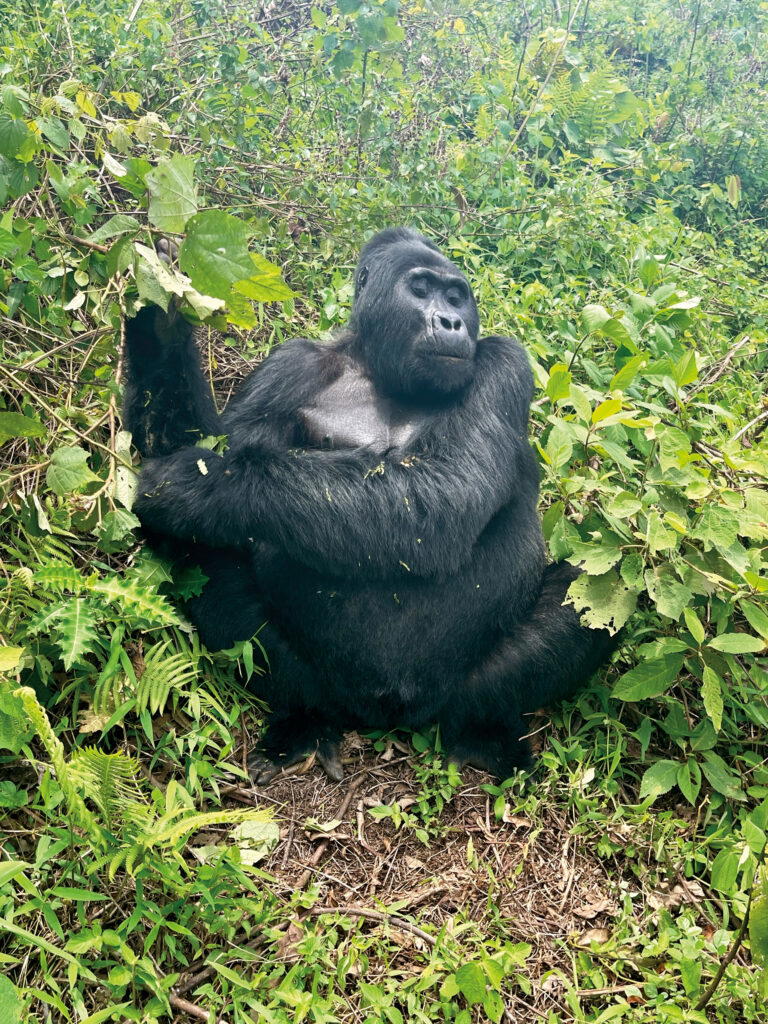
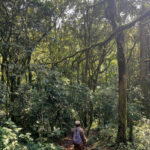
Off we go into the impenetrable forest, up and down through the deep woods, where Gloria often stops to clear a path for us, sometimes by hand, sometimes with a machete. It takes us two hours to reach the Kalembezi family of 17 gorillas. Among them are two silverbacks, several females, and a few babies.
As I sit on the porch of Bwindi Lodge, I can see the dense thickets of the forest—clearly living up to its “impenetrable” label—and feel a mild anxiety attack about the hike ahead.
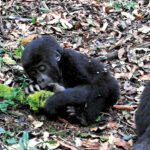
We spend an hour with these primates, the maximum allowed for visitors. Once again, I am fascinated by how closely their behavior mimics ours. This family is clearly led by the alpha male, who maintains a calm and dignified demeanor throughout their morning feeding ritual.
We follow them silently as they scramble through the thickets, only stopping to graze and pick up curious and naughty kids lagging behind. In the same way as the chimps, these young gorillas never fail to entertain us. As we return to our cars, we are all exhausted, but also exhilarated. It is, without a doubt, one of the most unique wildlife encounters I’ve ever had.
Visiting Uganda’s rich biodiversity up close is one of the benefits of travelling with Volcanoes Safaris, a responsible wildlife tourism company. The experience has also given me an opportunity to see how barefoot luxury can be provided in such remote settings while also supporting habitat conservation and community development.
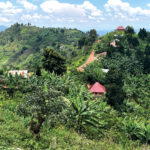
Beyond the safaris, I also get a glimpse of its work through VSPT (Volcanoes Safaris Partnership Trust), a not-for-profit arm that supports primary education for children and skills training for teenagers and women.
For many years, Uganda topped my travel bucket list, mostly because of the opportunity to see great apes in the wild. However, beyond that, I had no idea what to expect in terms of its people, culture, or even landscapes.
As I landed in Entebbe, the international airport near Kampala, my first impression of this East African country was of green lanes and friendly people. While travelling within the country, its welcoming geniality, combined with the cheeky smiles of kids, continues to warm my heart.
This undiscovered gem is safe and uncrowded, and its wildlife experiences are comparable to those enjoyed in Kenya and Tanzania, two of the most popular neighbouring countries.
Visiting the country and seeing such incredible wildlife sightings, both planned and unplanned, is an incredible opportunity Winston Churchill wrote in his 1908 book My African Journey after his safaris in Uganda, “For magnificence, for variety of form and colour, for profusion of brilliant life—birds, insects, reptiles, beasts—for vast scale, Uganda is truly the Pearl of Africa”. I wholeheartedly agree with him.