In Ulaanbaatar’s (or UB) rush hour melee, all manner of vehicles jostle for space and rub shoulders during the 11 km ride from the Jaguar Land Rover showroom to our hotel.
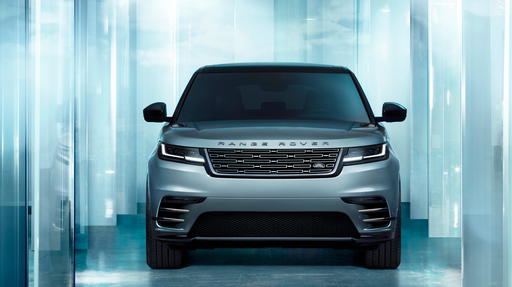
A chirpy marketing representative takes over from our airport transfer for this leg of the trip. Besides monitoring the skirmishes raging outside the Range Rover we are in, she educates us about Mongolia’s culture and history.
It’s my first visit to Mongolia and I’m here to experience the extraordinary all-terrain capabilities of the new Land Rover Defender in one of its harshest regions, the Gobi Desert.
A Wearnes-StarChase Mongolian customer experience like mine—an intense three-day, 1700-km overland expedition—is intended to take you off the beaten track and onto the roads less travelled. Of course, it is a walk in the park, thanks to the Defender’s legendary off-road capabilities.
As it brings like-minded enthusiasts together over a common passion, the spirit of community and camaraderie keeps the fires burning. The new Defender is, after all, a
4 x 4 that can go anywhere, anytime, and with anyone.
The itinerant group I am with includes owners from Singapore, Taiwan, and Mongolia—countries where Wearnes-StarChase operates JLR dealers. Many Land Rover enthusiasts consider the Defender the spiritual successor to the Discovery 4, rather than the Discovery 5, which is (overly) posh. The new Defender fuses the original’s rugged, rough-and-ready mores with a good level of cabin comfort and amenities that never slip into impractical luxuries.
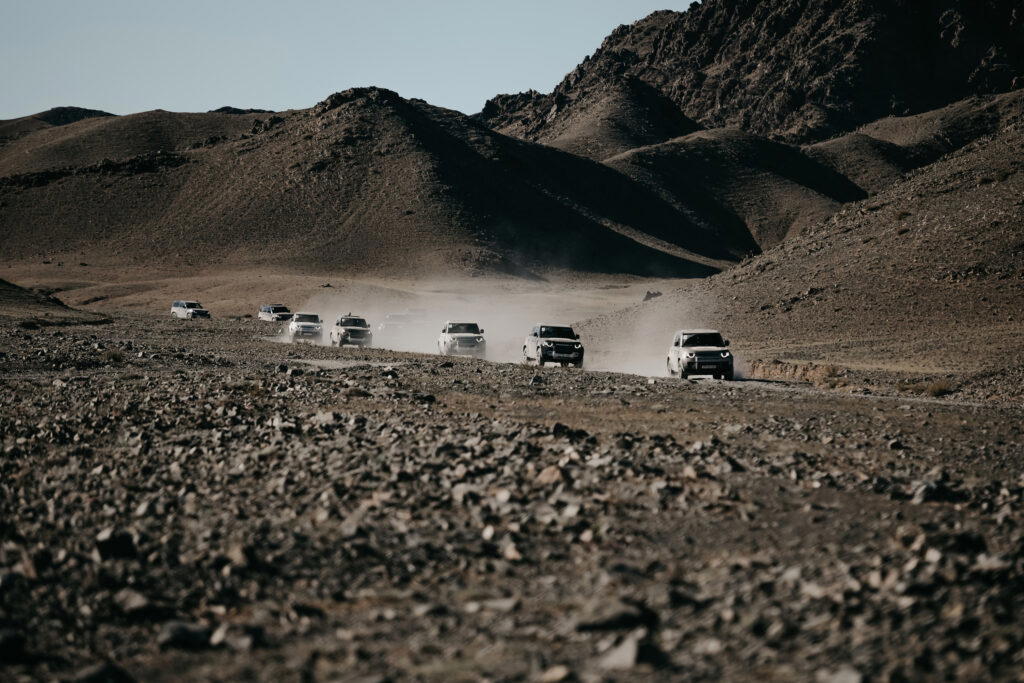
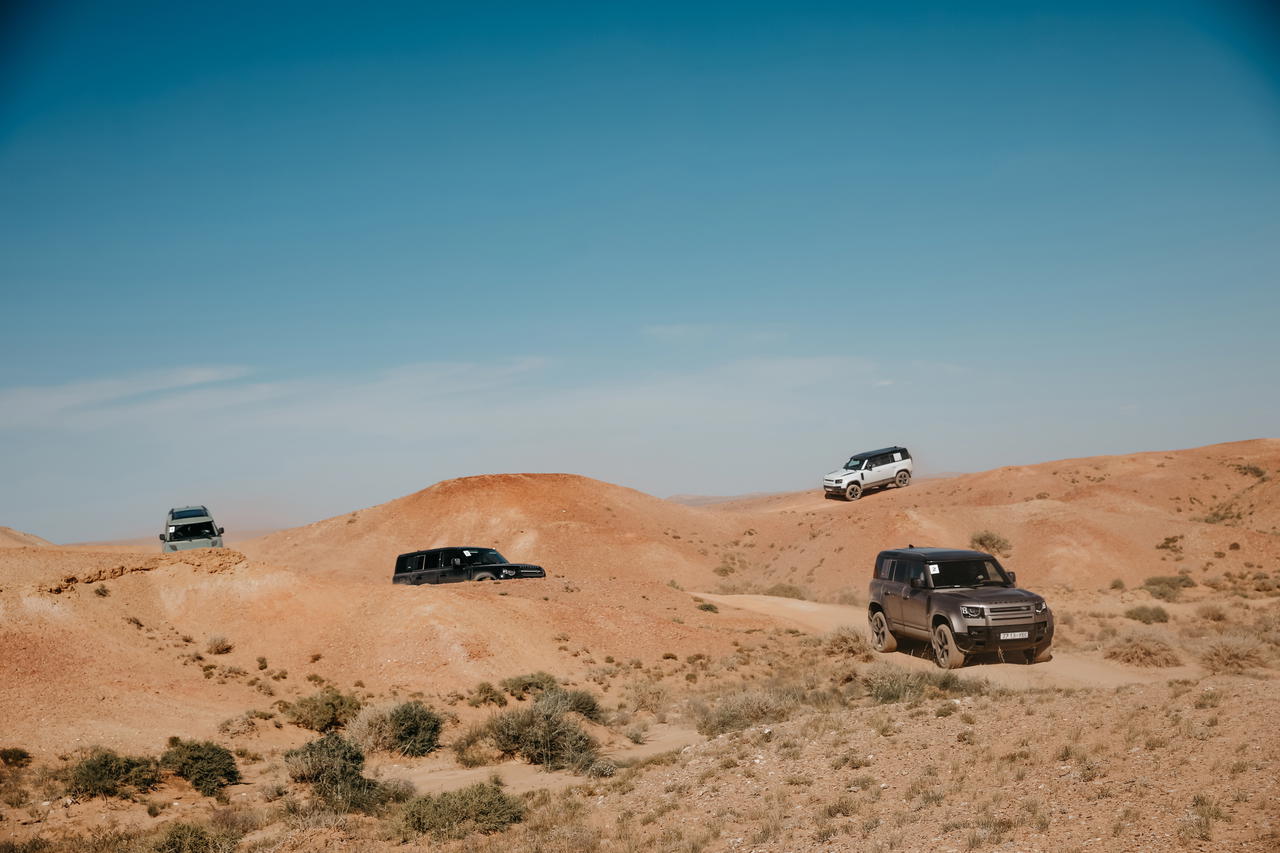
It rocks and rolls off-road over mud, ruts, and shifting sands as we traverse the vast and arid Ömnögovi and Dundgobi aimags, originally a Mongolian word meaning “tribes” that now stands for administrative subdivisions in Mongolia, Russia, and in the Inner Mongolia region of China.
As all this happens, the occupants remain cosy in the cabin with all the familiar mod-cons and a few unfamiliar features, like an Air Quality Sensor.
Once we’re out of the capital city of UB, the vast expanse of the plains is mind-boggling, especially to us city slickers. It’s hard to think of a harsher, more unforgiving environment better suited to the Land Rover Defender than Mongolia, especially since its brutalist aesthetics make for picture-perfect snapshots against the region’s stunning landscapes.
While there are paved roads (of sorts) leading into and out of the cities, we won’t need them where we’re going. Instead, we focus on where we need to be and head in that general direction.
Across the plains, the enormous cloud of sand kicked up as our cavalry of Defenders storms across what could have been mistaken for a horde of mounted ravagers.
We make more progress forging our own paths instead of playing follow-the-leader beacuse of the dust cloud wake created by its passage. In the Gobi, you don’t want to get stranded! Fortunately, there was enough room for 10 cars to drive abreast, while keeping the lead car visible at all times.
When following in the dust wake was inevitable, the Defender’s Air Quality Sensor and Cabin Air Ionisation with PM2.5 filter came into their own. The system monitors particulates while preserving the quality of your cabin air.
With a mega 525hp and 625Nm from the supercharged 5.0-litre engine, the Defender came, saw, and conquered—just as Chinggis Khan (better known as Genghis Khan) did and built the largest contiguous land empire in history some 800 years ago.
Both on- and off-road, the Defender has a huge amount of power to offer swift and
sure progress, while the Terrain Response system provides sure-footed assurance when things get tough.
Our lunch stop allows us to bask in the splendour of the White Stupa (or Tsagaan Suvarga), Mongolia’s mini Grand Canyon. I can’t believe this area was seafloor millions of years ago, which emphasises the impermanence of our time here and makes these walks on the wild side that much more satisfying.
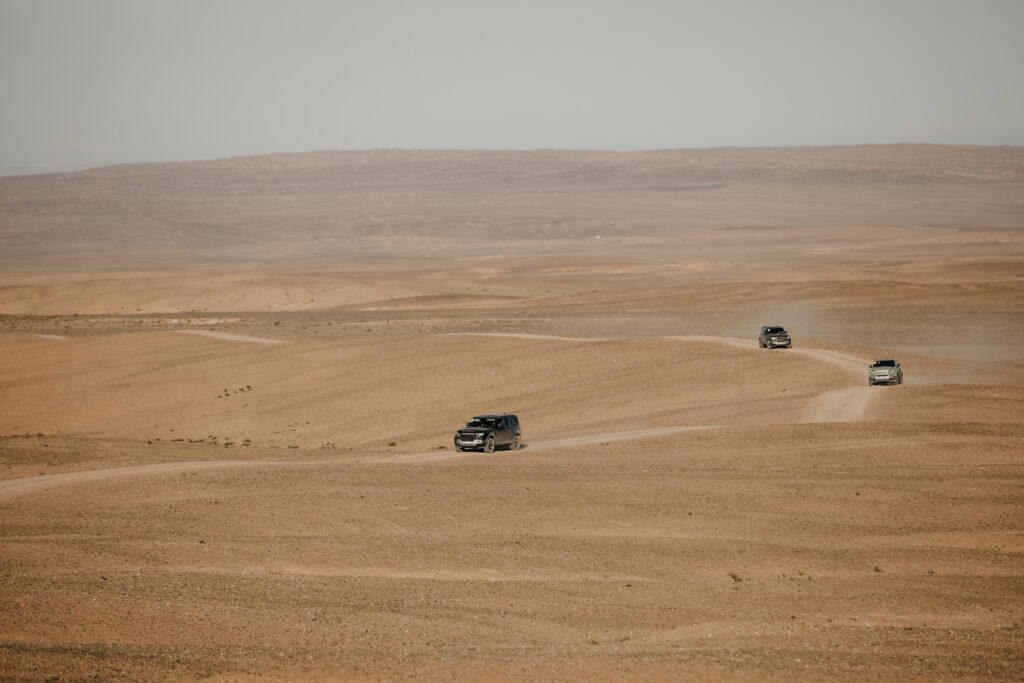
The Defender is a brilliant match for the nomadic lifestyle of the Mongolians. It is versatile, adapts fluidly to changing circumstances and environments, and can be displaced quickly without hesitation. Back in the city, it can confidently pull up to a favourite five-star hotel caked in mud and more, yet won’t mind being parked out front—mud-covered Defenders are the best!
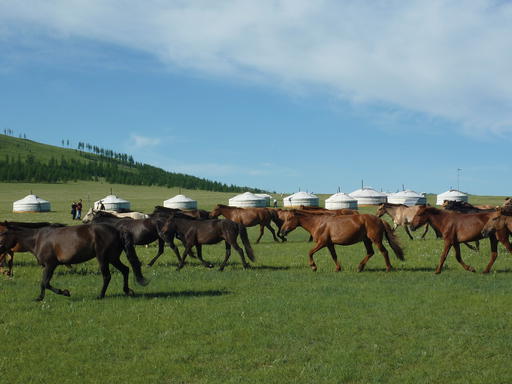
As the sun dips beyond the horizon and after driving over 700km, the searing heat of the day retreats as night falls, replaced with biting cold. Thankfully, we’ve arrived at the award-winning Three Camel Lodge, where we sleep in gers, traditional light, strong, and portable round structures that can be assembled and disassembled quickly.
Like the Defender, they appear functional on the outside but are cosy and comfortable within, providing much-welcomed warmth from the bracing cold of the mornings and nights.
The following day, a short hop, skip, and jump of just over 200km leads us to Khongoryn Els (also known as Duut Mankhan or ‘Singing Sands’), a sea of dunes extending across an area of 965 sq km in Gobi Gurvansaikhan National Park.
It is a highlight of this stop to hike up one of the tallest dune peaks, where you can see the sun’s rays bouncing off the peaks of the ‘Dune Sea’ during the sunset.
As our feet slip backwards with every step, we miss the confidence inspired by the Defender’s rock-steady composure. Aside from the destination and the cars, the real wonder lies in wandering on this journey of self-discovery, in fellowship among participants, and in the pace, which allows you to take time to stop and smell the proverbial flowers.