CHANEL
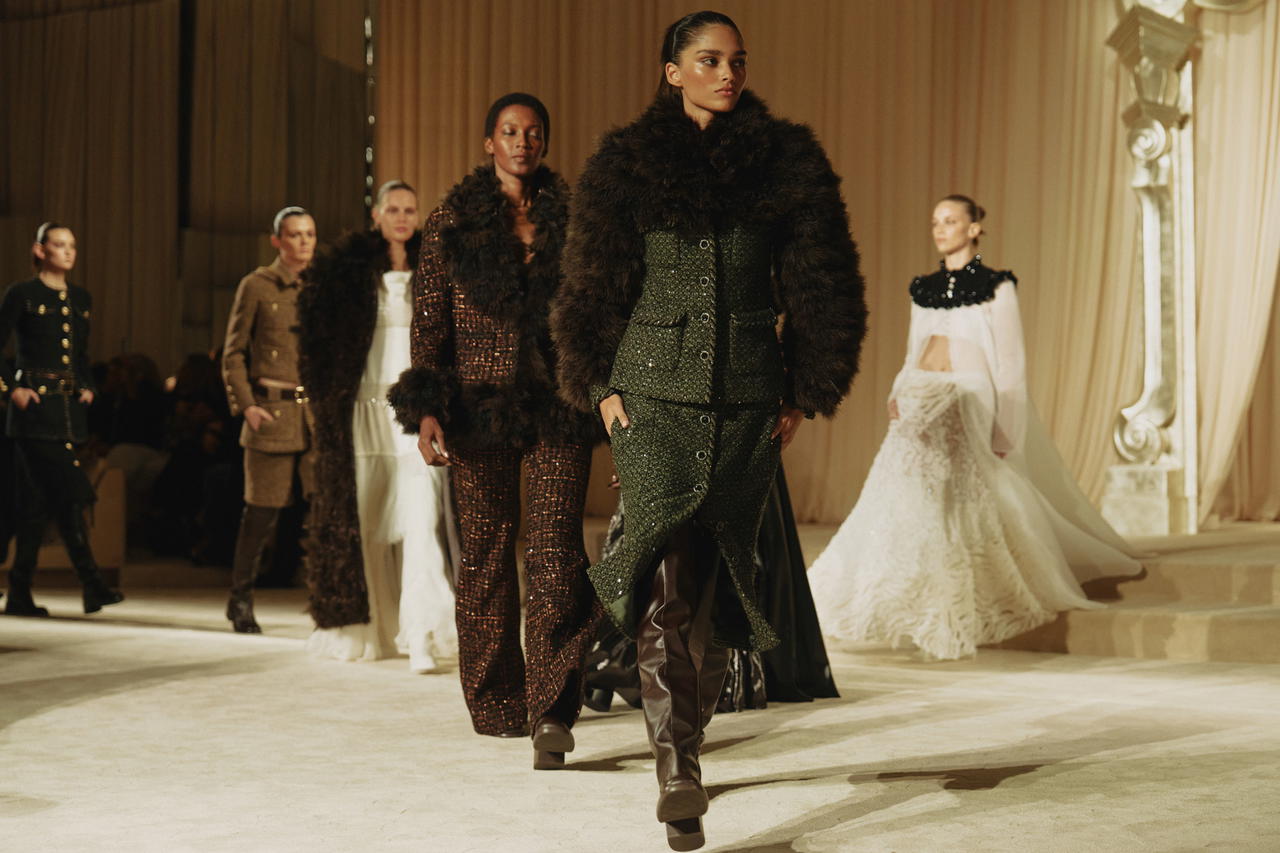
There are some couture shows that demand attention, but Chanel Fall/Winter 2025 drew us right in like a secret. Instead of the cavernous main hall of the Grand Palais, the house chose a more discreet setting above—an intimate salon that recalled 31 Rue Cambon, where clients have long slipped in quietly for fittings. More seance than spectacle, it was a hushed, intimate experience filled with whispers of silk and reflections in mirrored light.
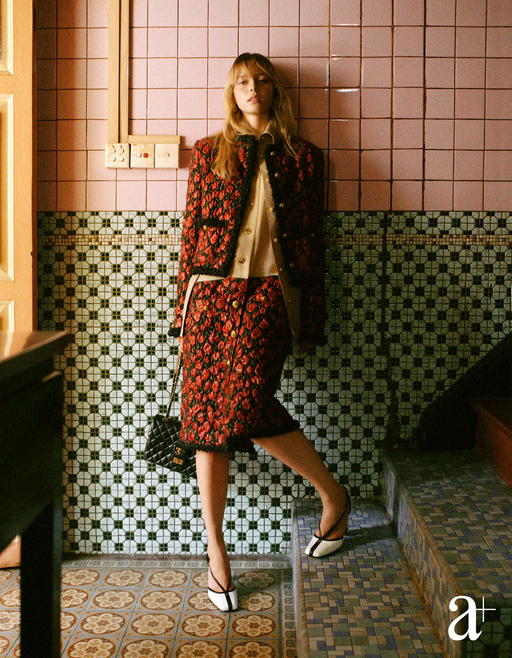
Wheat, Mademoiselle’s talisman of prosperity, was evident throughout: embroidered on jackets, beaded into lapels, and gathered in the arms of the finale bride like a sacred harvest. Tweeds softened into gentle silhouettes, silks floated beneath sheer tulles, and pearlescent buttons glinted like heirlooms—all moving with the quiet confidence of whispered house codes. There was a surprise at ground level, too. Sturdy highland boots anchored delicate dresses, giving a “heiress gone to the Highlands” vibe—a collision of rustic tradition and Parisian elegance.
This was also the Fashion Creation Studio’s final couture showcase before Matthieu Blazy’s debut in October. As much a bow as it was a finale, it acknowledged the steady hands that had carried the house between chapters, and the silence before its next voice could be heard.
BALENCIAGA
For his final haute couture outing at Balenciaga, Demna did something he rarely does: he took a bow. In the house’s couture salon, guests sat in solemn formation as models emerged silent and statuesque, resisting time. There was no runway spectacle or soundtrack—only the voices of collaborators reading their own names, culminating with Demna’s before Sade’s ‘No Ordinary Love’ swelled for the finale.
The opening was structurally severe. In black and Venetian red, the silhouettes were austere, their silk and lace sculpted into cathedral-like sleeves and stiffened hips. Isabelle Huppert donned an exaggerated funnel-necked jumper, and Kim Kardashian, dressed in a mink coat and diamonds once owned by Elizabeth Taylor, evoked the actress in Cat on a Hot Tin Roof.
Menswear, never a Balenciaga staple before Demna, featured sharply tailored suits inspired by Neapolitan craftsmanship. To prove that form is determined by the body, not the garment, they were first cut for a bodybuilder, then replicated across smaller frames.
From the bourgeoisie dress codes, Demna assembled his “ultimate wardrobe”—archetypal garments stripped of ballroom pretence and reimagined for life beyond the salon. That ethos carried over into the look book, in which couture-clad models weren’t posed in gilded halls but on the streets of Paris, a reminder that Balenciaga’s couture lives as much in daylight as it does under chandeliers.
DIOR
Maria Grazia Chiuri’s return to her hometown of Rome was nothing short of monumental. For Dior’s first full-scale runway show in the Eternal City, she staged a moonlit procession through the storied gardens of Villa Albani Torlonia, transforming it into a theatrical haven of classical elegance. Dubbed The Beautiful Confusion (bella confusione), the collection took inspiration from Federico Fellini’s 8½, referencing its original working title and evoking a dreamlike cinematic atmosphere.
Central to the show was the spirit of Mimi Pecci-Blunt, the legendary arts patroness whose famed all-white Bal Blanc masked balls resonate through Chiuri’s own Bal de l’Imagination. The collection’s opening white-themed procession mirrored that ritual, melding guest and model into a unified Roman tableau under the moonlit sky.
The silhouettes were theatrical yet grounded—tailcoats with ivory buttons, military jackets with dark trim, men’s waistcoats paired with sweeping silk and lace skirts. Many designs echoed ecclesiastical chasubles, while others, like the black and red velvet pieces, paid homage to the Fontana sisters. A finale gown in radiant golden velvet mirrored candlelight with painterly drama.
With her announced departure from Dior following this show, The Beautiful Confusion feels like a parting love letter—affirming that couture belongs as much to moonlit streets and timeless poetry as to gilded salons.
ARMANI PRIVÉ
Giorgio Armani has always spoken fluent black—not flat or lifeless but alive with a range of midnight shades. The Armani Privé collection expressed seduction, precision, and control through the name Noir Seduisant.
For the first time in two decades, the designer was not in Paris. Following doctor’s orders, a brief illness kept the 90-year-old in Milan. Even so, from the fittings to the sequencing, he directed all details via video, his exactitude evident in every seam and crystal flourish. It was perfect—or rather, perfectly Armani.
The show opened with flowing dresses traced in coloured embroidery, a prelude to the black parade, where slim tuxedos, close-cut tailcoats, and cropped jackets were worn against bare skin segued into elongated trousers that underscored sculptural tops with pagoda sleeves, peplums, and fluid asymmetries.
Then as velvet, metallic silks, and pave crystal linings caught the light like whispered secrets, military frogging, cummerbunds, and bowties kept the masculine–feminine dialogue alive. With Armani, black wasn’t just a fashion statement, it was a commanding presence in any space.
MAISON MARTIN MARGIELA
Rather than a polite inheritance, Glenn Martens’ first outing at Maison Margiela seemed like an invocation, a communion with the house’s unruly ghosts. In Le Centquatre’s paper-flaked basement, where Martin Margiela made his final bow in 2009, models emerged as though peeling from the walls, their faces obscured by plastic sheaths and metal lattices.
Martens coined the term “chapters” to describe the collection of self-contained vignettes ranging from the macabre to the miraculous. A Bruges native steeped in Gothic austerity, he infused each piece with a medieval, ecclesiastical gravity, making Margiela’s upcycling codes part of a ceremonial ritual. It seemed like vintage salon wallpaper florals had been salvaged; vintage biker jackets had been patched in paper; trench coats were made of transparent plastic; and jeans had been stiffened with oil paint, their belts frozen in mid-swing.
Then the mood shifted. Tulle feathers and lace blooms peeled from sheer dresses. Within veils of illusion tulle, 3D still-life birds fluttered. Depending on the angle, metallic duchess satin grew into statuesque drapes that might have belonged to martyrs or pop divas. In addition, corsets jutted from the hips, with their busks rising like tombstones, reminiscent of Galliano’s couture.
SCHIAPARELLI
In naming this collection Back to the Future, Daniel Roseberry paid homage to Elsa Schiaparelli’s surrealist legacy as well as made a statement about his readiness for fashion’s upcoming power shifts (read: Dior, Chanel, Balenciaga, and beyond).
The first headline landed before a single model appeared: Cardi B, poised at the gilded gates of the Petit Palais, draped in a heavily fringed black bustier dress and holding a live raven as casually as a clutch. Within minutes, the image went viral, foreshadowing the theatrics to come.
On the runway, Roseberry mined black-and-white photographs by Man Ray and Horst P. Horst that immortalised Elsa Schiaparelli’s interwar creations and translated them into a high contrast study in shadow and light—drained of colour yet steeped in surrealist tension.
The opening looks were precise and taut. Black tulle softened the authority of a dense Donegal tweed skirt suit, while a black polka-dot tailored suit revealed itself as semi-sheer under the lights, demonstrating Schiaparelli’s surrealism thrives when it’s tailored to confront.
In other looks, Roseberry straddled liquid elegance and unapologetic provocation. Bias-cut satin gowns draped like mercury gave way to silver biker jackets with gleaming matador epaulets. A crimson corset gown complemented by a dominatrix-style, black saddle-inspired bodice atop a bustier was anchored by a mechanically beating rhinestone heart.
GIAMBATTISTA VALLI
This season, Giambattista Valli staged a rare double bill that was one part cultural knighthood, two parts fashion spectacle. Hours before he unveiled his 29th couture collection, he was honoured with France’s Chevalier de l ’Ordre des Arts et des Lettres by Minister of Culture Rachida Dati in a ceremony. It was held at the Roman couturier’s Paris headquarters, where he was introduced by fashion critic Suzy Menkes.
In the upper salon, mannequins in his heavenly confections stood like nymphs in a pastel Parisian dreamscape. Apricot, periwinkle, and rose pale—shades drawn from the Rococo gardens of Jean-Honoré Fragonard and Jean-Antoine Watteau—unfurled in billows of silk mousseline and organza so sheer, they seemed woven from air. An array of towering bouquets were interspersed among the tableau, evoking a bucolic, sunlit garden in full bloom.
Valli’s Franco-Italian signatures emerged with the assurance of a master: sweeping ballgowns topped with portrait necklines; dramatic drapery that rivalled ornate embellishment equally; and intricate roses and buds spun from fabric and tucked into bosoms and sleeves as if freshly plucked moments before a ball. One enchanting tulle cape-back gown conjured a painterly image of parting clouds and a daydreamy blush as layers of tulle drifted past the shoulders.
IRIS VAN HERPEN
Under the vaulted glow of the Élysée Montmartre, Iris van Herpen invited her audience into a living, breathing oceanic reverie. At its heart was a “living dress” seeded with 125 million bioluminescent algae. Its surface sighed in soft cyan, like a quiet current glowing in the deep.
From there, the collection unfolded like a migration through unknown waters. Silhouettes drifted past in weightless “air fabric” from Japan, their lattice-like frameworks looking like the bones of creatures who had never been outside. Then, as resin-coated silk spiralled around torsos in frozen crests, fine metal mesh billowed into vast, tidal whorls that encircled models in architectural splendour.
There were even dresses that shimmered with the iridescent sheen of Spiber Inc. brewed protein, a biomaterial spun from fermented sugarcane that adhered to the body like the sleek skin of an imagined sea creature. Overall, it was unhurried, deliberate, and possessed a majesty that felt as rare in couture as it is in the wild.
VIKTOR & ROLF
Viktor & Rolf staged a couture study in duality under the grand arches of Salle Wagram, with 30 looks mirrored in pairs, each contrasting excess with restraint. Named Angry Birds, the collection took two different directions: one version was filled with faux feathers in riotous gradients, while the other was bare.
Their first foray into feathers, this avian fantasy was crafted in collaboration with milliner Stephen Jones, whose sculptural headpieces rose in kaleidoscopic towers. Thereafter, the runway was a riot of texture and silhouette—opera coats ballooned into feather-crusted clouds; gowns glinted with colour-changing plumes; and shoulders arched in theatrical defiance. The same cuts fell into stark elegance on their pared-back twins, the absence of ornament revealing a mastery of proportion and sharpness of line.
Additionally, neon green and purple accents suggested sci-fi eccentricity, while painterly gradients hinted at cabaret-style plumage gone punk. It was couture in two breaths: the first, a delirious exhalation of excess; the second, a cool inhalation of restraint—both unmistakably Viktor & Rolf.