
There are five of us at the fine dining lunch. Four of the service plates on the table are emerald green, but one is nut-brown. Noticing my scrutiny, the young server explains that the odd-coloured dish signifies ‘position one’. Orders are memorised in a clockwise direction from where it sits. “This allows us to know who’s having what without having to ask every course,” she says.
A faint line on the table cloth aligns with it. It’s a remaining marker for when the service plates are removed at some point during the multi-course meal.
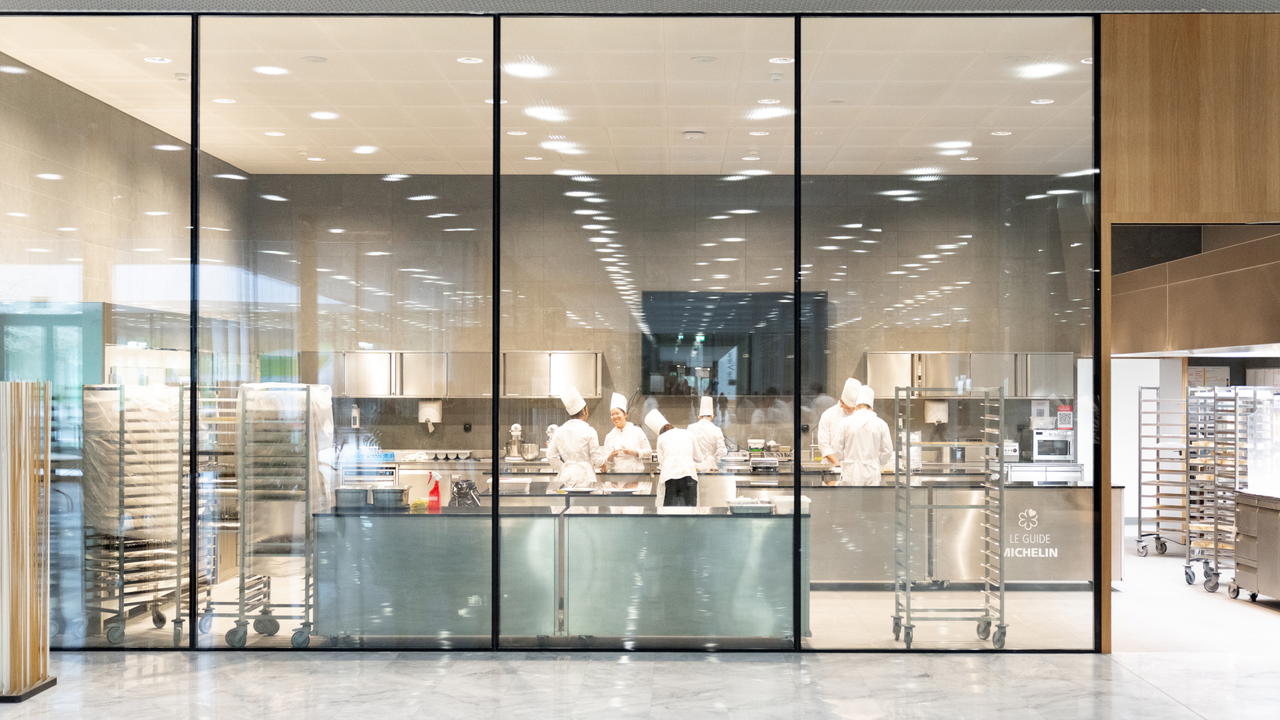
This is the standard upheld at the Michelin-starred restaurant Berceau des Sens. Situated in EHL Hospitality Business School, the pedagogical restaurant is run by students under the guidance of professionals. The students not only work in front of the house, but also in the kitchen.
Founded in 1893, EHL Hospitality Business School is the world’s first and oldest hospitality management school. While I’m at the flagship campus in Lausanne, Switzerland, the institution also has campuses in Passugg, also in Switzerland, and Singapore. Only one undergraduate degree is offered—a bachelor of science in international hospitality management—but a wider assortment is available for graduate degrees. Some 4,000 students from over 120 countries are currently enrolled.
Rigorous training is par for the course at EHL, and at Berceau des Sens, this, among other things, means students mastering a ‘perfect’ egg. The slow-cooking process entails an egg cooked at 63.5 degree Celcius for 45 minutes, which allows for the preservation of nutrients and optimal consistency. It also means the students are able to iterate the provenances, flavours and textures of the cheeses and wines available on cue. No wonder there is a two-month waiting list for a dinner reservation.
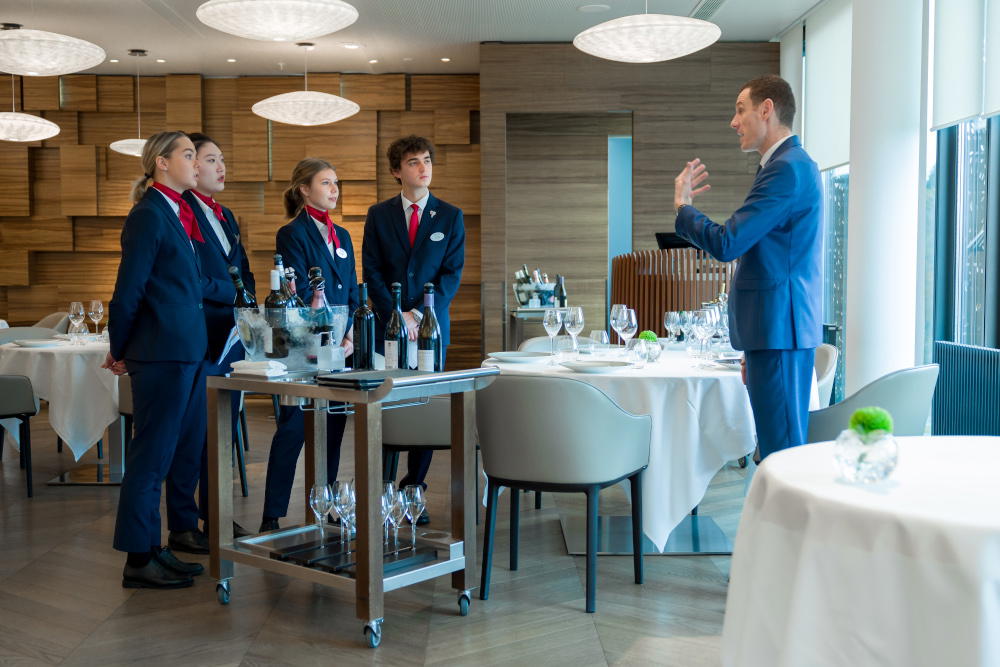
Expectedly, the food is exceptional, but it is the winsome personalities of the young servers that elevate the experience. Servers are preparatory year students and it is during this time that they pick up all operational skills like cooking, wine tasting, mixing drinks, housekeeping and managing a front office. That said, many of them have corporate ambitions and will spend the next three years studying business and hotel administration. It’s why they jostle for a spot at EHL, which has an acceptance rate of 46 percent.
Business is as big a part of the undergraduate curriculum. In fact, while 40 percent of graduates secure jobs in hospitality, 60 percent go on to work in neighbouring industries like luxury, real estate and finance. It’s why ‘hospitality business’ was incorporated into the brand name two years ago.
Rigorous training also means the students abide by a strict dress code on campus. Unless working in a uniformed environment such as a kitchen or restaurant, they are to be in business attire between the hours of 7am and 7pm. “You can be sent back if you don’t comply,” a student I chat with briefly tells me. The one doing the policing, I learn, is the school’s group values ambassador. He oversees the implementation and application of the school’s values. “We call him ‘the eagle’ because he’s always watching. Even if you think he isn’t, he is.”
As part of my tour, I sit in on a class for seniors. The CEO and COO of Fine Artisans Group, a local culinary concept outfit, are giving a guest lecture. Given their expertise, it’s a deep dive into the financial strategies of operating a business; they discuss investment analysis, financing methods, market analysis and operational rollout. Half the students earnestly ask questions after the presentation. They want to know more.
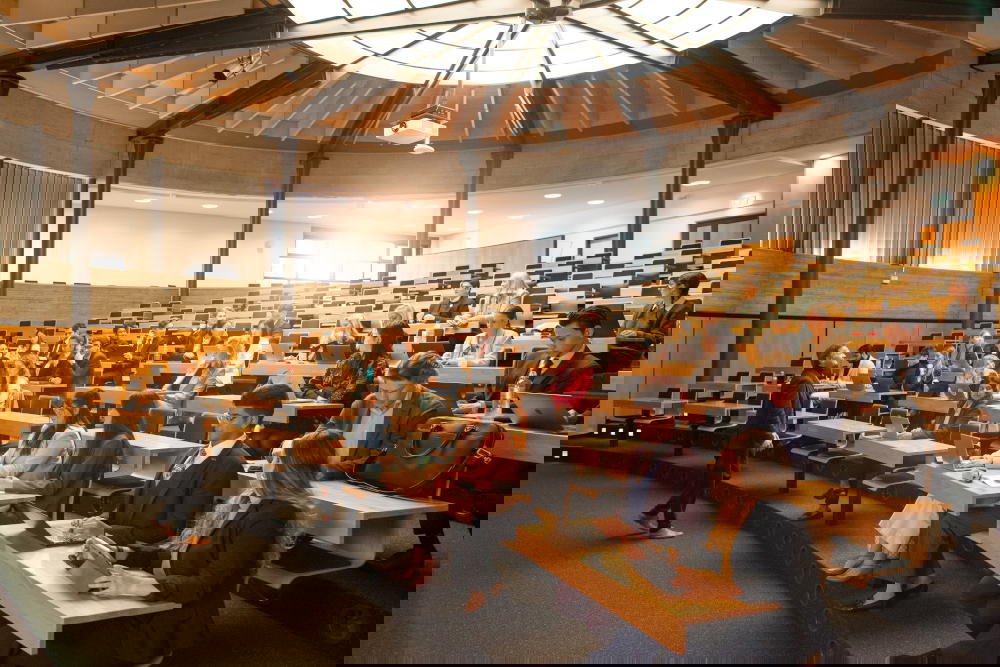
Erna Goana is a Singaporean third-year student. “It was always my dream to get into EHL. I bugged the recruiter for four years,” the 22-year-old tells me. “I feel like in other hospitality schools, the curriculum is slower paced—what we learn in two weeks, they learn in maybe two months. Here, things are drilled into us instantly and we’re constantly put in situations of high difficulty, which gives us an edge. We need to be able to think fast and think hard out there.”
Goana also believes that the school is setting her up for success in her intended area of specialisation. “I fell in love with finance here, when I started studying financial accounting. I’ve also covered financial analysis and managerial accounting,” she says. Her eventual plan is to get a corporate finance job in the hotel industry, work her way up, and one day throw open the doors to her own hotel. It’ll be the world’s first fully-accessible accommodation, she declares. “No matter what disabilities or mobility issues you have, you’ll be completely taken care of.”
If what she’s saying is anything to go by, students don’t only go to EHL because they aspire to be hospitality stalwarts—many of them want a shot at entrepreneurship and are confident the institution lays a firm foundation. And from what I’ve seen so far, the next generation is raring to make its mark.
But what does the future of hospitality look like? An increasing number of robots act as concierges and receptionists. Will there still be as many jobs? Will the need for humanness in hospitality diminish with extensive utilisation of technology in the industry?
Dr Ian Millar, a senior lecturer in the entrepreneurship and innovation department at EHL, doesn’t think so. He serves as an advisor to various hospitality technology companies and was a member of the Hotel Industry Expert Panel for the Singapore Tourism Board, advising hotels in the region on best practice technology usage.
In his opinion, there will always be demand for the human touch in hospitality—we just aren’t exercising it efficiently at the moment. “At this point, checking into a hotel through a person is pointless,” he says. He gestures towards his phone. “Can this be my check-in device? Sure. They have my credit card details. They have my passport details. All they’re doing is allocating me a room and giving me a key card, which is not an efficient use of the resource. It’s not really a customer experience.”
“Hotels should have self check-in kiosks and make them an option. Checking yourself in is not difficult, right? We do it all the time with just our names and booking references. There can just be someone going, ‘Hi, need some help? No? OK, I’ll leave you alone,’” he adds. “The hospitality part can come in when I go to the bar, they make me the greatest gin and tonic, and we chat for 10 minutes. That’s more hospitable.”
A device that he reckons every hotel room should come with is the tablet. It’s a lot more visual and can easily replace phone conversations, because unless it’s a luxury hotel, staff may not actually speak English. “Why does every hotel have a club sandwich on the menu? It’s because people know that when you can’t speak the language, you order a club sandwich—you know what you’re going to get.”
Yes, a surge in technological implementations might mean a cutback in jobs, he says, but jobs aren’t being taken from people if we can’t even find anyone to do them in the first place. He cites the manpower crunch in Singapore.
“About 52 percent of young people in Singapore have a bachelor’s degree. They want to work in a hotel, but they don’t want to be opening doors or serving drinks. They want to do revenue management or social media.”
Dr Ian Millar spells out the career aspirations of young Singaporeans
“You don’t have enough staff and the laws are now about how many foreign workers you can hire. Marina Bay Sands Singapore has 10,000 employees. Can it be reduced to 8,000? Sorry, it’s an economical factor when your case is law. We have to do the same or if not more, with less,” he adds.
But much as he is in support of making self check-in kiosks fixtures at more hotels, he doesn’t think that frontline staff should be replaced with robots. Not only are the prices exorbitant, they also break down often. “Robots as frontline staff is just an engineer managing things in the background. The problem will just be displaced.”
Where robots will be useful, he asserts, is in back-of-house processes. “Look at the housekeepers—they’re moving 50kg bags of laundry around. Get a robot on that. Or in banqueting, where tables and chairs have to be moved around. Also, peeling potatoes and carrots, which no one likes to do. A robot can do all of that,” he argues.
However, there is still a way to go in getting customers to embrace technology in hospitality. Hilton, he illustrates, spent some $25 million introducing mobile keys in all their properties. Yet, only four percent of guests are using them. “It’s a massive investment with zero return. Consumers aren’t used to it.”
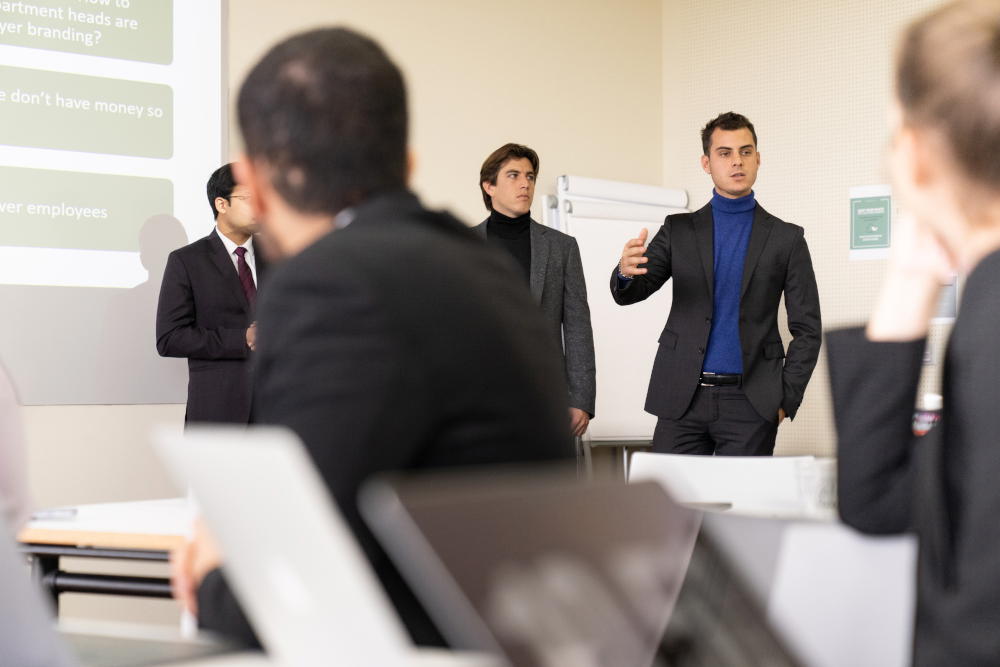
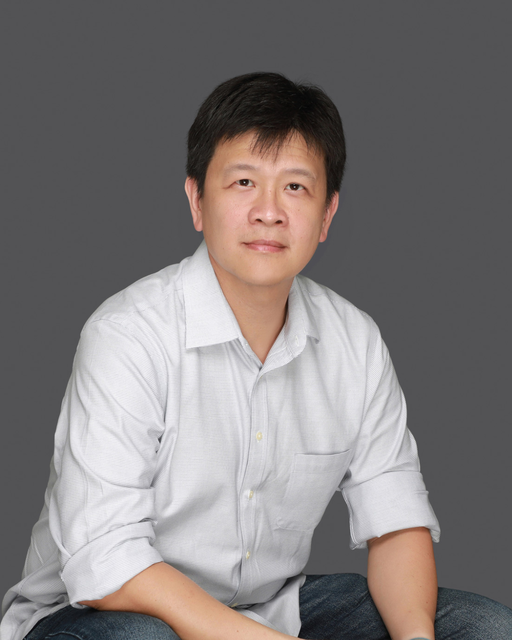
Dr Meng-Mei Maggie Chen, an assistant professor of marketing at EHL who teaches hotel distribution strategy, online consumer behaviour, marketing strategy and digital marketing courses, believes that the future of hospitality anchors on finding a new purpose.
“I was recently in Singapore. When we arrived, people started ordering their meals on Grab, which made me realise that this is a serious challenge for the hospitality industry. It’s a huge issue if service is no longer required,” she lets on. “But we have observed that this is the case with the younger generation, and the future of hospitality cannot go on like this.”
In her view, this new purpose will be found in meaningful interactions. “The Singapore government has said that devices are isolating not just the older generation, but also the younger generation. Loneliness is an epidemic all across the world,” she says. As part of her research, she regularly studies scientific literature on happiness. “All the authors agree on one thing. Good relationships continue to make people happy.”
Hospitality, she maintains, can be where these relationships are cultivated—though like Dr Millar, she cautions that young, educated talent won’t be looking to promote them through traditional service.
“We need to change the nature of their roles. For example, bar employees can undergo training and learn to explain wine pairings. This will give them a different social status. They will think, ‘I’m not just serving, but also teaching.’”
Dr Meng-Mei Maggie Chen makes plain the next step to take
If robots are relegated to doing repetitive tasks, more people will be able to take on the jobs that add value. “When we connect with others, we feel happy. We’re always looking for opportunities to mingle with other people. We’re wired to respond to social pleasure.”
In spite of the changes to come, EHL Group’s CEO Markus Venzin reckons that the future of the hospitality industry remains promising. “Hospitality is an evergreen industry that stays local. In other industries, say, the textile industry, production can be moved to other countries that are more competitive. But tourism doesn’t work like that,” he says. People visit other cities to learn, explore, and immerse themselves in the culture, and immersion is only possible through interactions with locals.
In his opinion, moving with the times, whether or not through artificial intelligence or robotics, boils down to an evolving business model. “Take for example, the shipping industry. It’s booming and there’s competition, but it can be hard to keep up with building ships. So, the bottleneck is: how many ships can you get?” he analogises. “Similarly, if, say, a hotel isn’t in an interesting location, it needs to decide if it wants to invest in infrastructure. Hospitality is like any other business. I don’t think it’s more dramatic than in other industries.”
He agrees with Dr Chen that meaningful interactions play a key role in hospitality—it is why EHL conducts psychology classes. If anything, he considers the school an institute on effective intelligence, which is defined as the ability of a person to deal with various complex situations using the available resource. “This teaches our students to ask themselves, ‘How good am I in understanding the emotions of others and how do I respond in an adequate way? This is what we do,” he explains.
If this standard is the benchmark, then EHL is ahead of the curve. I suppose the next question is: are arranging service plates and cooking the ‘perfect’ egg repetitive tasks?