

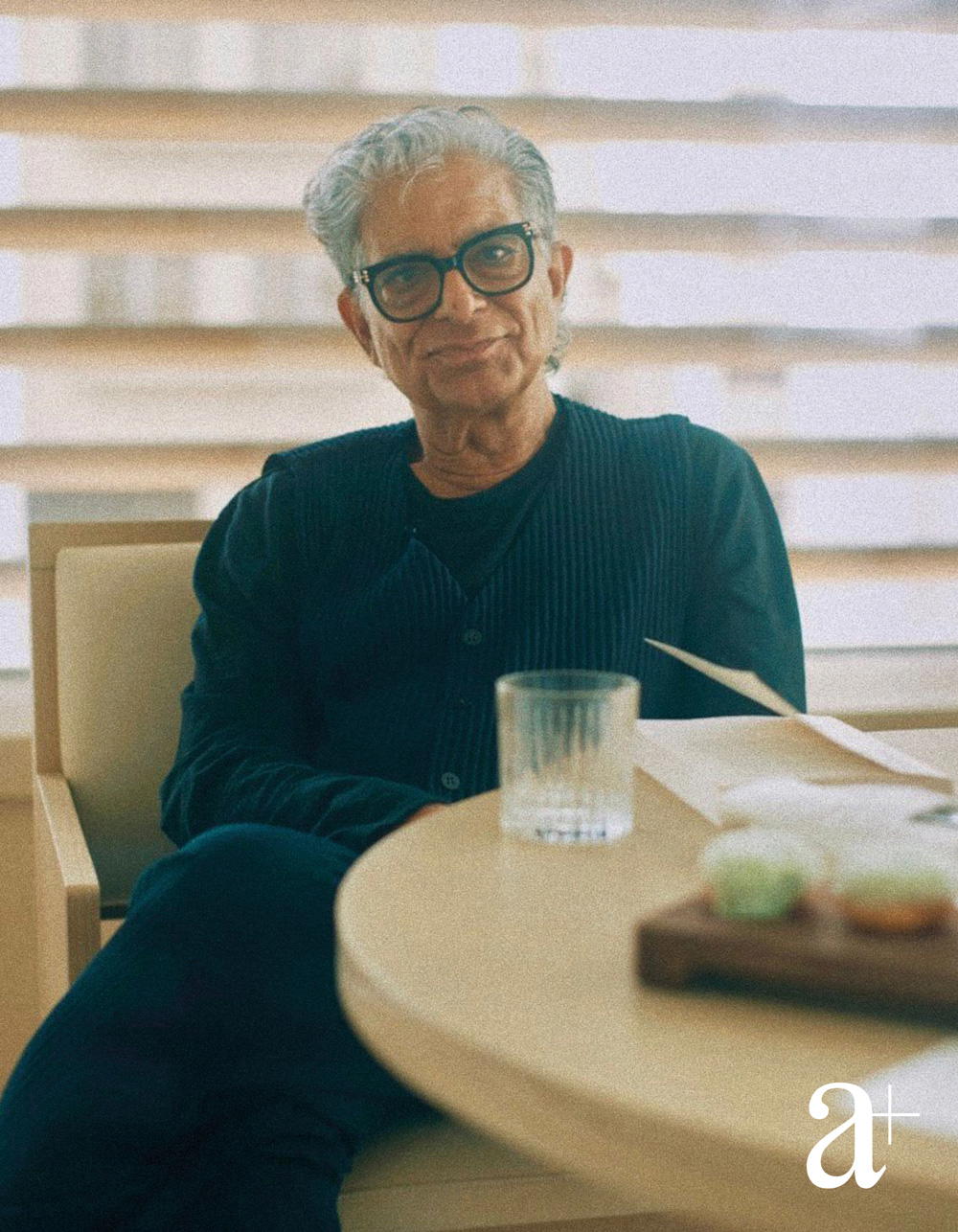
I knock and Deepak Chopra answers the door. It’s bewildering that he’s alone—there’s no hovering publicist or personal assistant, much less an entourage. This is a man whose books on alternative medicine have made him one of the most prominent and wealthy figures in the field. He was spiritual adviser to Michael Jackson, among other stars. But here he is in the hotel room, unchaperoned and unbothered.
Whatever your take on him, and there are some polarising views out there, two things are clear. One, he’s ready to hold his own. Two, he’s happy to be a regular guy. What was I expecting from someone who discusses metaphysics and the need to unleash our infinite potential?
The 77-year-old is in town to give the talk Sages & Scientists. He believes there are profound similarities between spirituality and science, like how our feelings and thoughts are similar to energetic fluctuations of the quantum field. “Even though it’s said that science explores the world objectively, it does so subjectively. Observations are made in consciousness,” he says. “Experiments are designed in consciousness. Theories are conceived in consciousness.”
Oof, we’re diving right into it. What he’s saying is: we think of physical reality as what objectively exists, independent of any observer—but does the universe exist if we aren’t there to observe it?
“How do we prove an observer-independent universe? Is there such a thing as an unseen colour? If so, what would it look like?” he asks rhetorically. This, he asserts, is why the “philosophy of science” is naive realism. Also known as common-sense realism, it is the tendency to assume that our view of the world is objective and accurate rather than subjective and biased.
What we perceive to be objective, he continues, is a species-specific perceptual activity that corresponds to the human brain. “So, I don’t believe there’s such a thing as objective reality. It’s only convenient to call the human experience ‘objective’ because that’s how we create science and technology.”
We’re only 10 minutes in and I already feel a little out of my depth. But I think I understand what he’s getting at. In his opinion, we live in a virtual reality.
“What does the human experience look like to an insect with 100 eyes? It’s a different virtual reality. It uses a different instrument and the user is its consciousness, which has no form.”
Deepak Chopra on his disbelief in objective reality
Because it has no form, he adds, it has no borders. And because it has no borders, it’s infinite and has no cause. “There’s no imagination without consciousness. There’s no comprehension. There’s no experience. Experience is dependent on something that is totally formless, which is the real you.”
I can almost hear my mind whirring. Is our existence as we know it one big video game?
“It’s not a bad analogy, but computers don’t have sexuality. They don’t feel hunger. They don’t have existential dilemmas. Human creativity is not algorithmic,” he offers. “This is why artificial intelligence can never be really creative or conscious. It’s an algorithm.”
Last year, Chopra released Quantum Body, which he co-authored with physicist Jack Tuszynski and endocrinologist Brian Fertig. The book is meant to “show how unlocking the secrets of quantum science can revolutionise how we live, age and eradicate disease”.
Its message: unlike our physical body, which is subject to ageing, injury, and decay, the quantum body “exists on a sub-atomic level and is the infinite, invisible source of everyday reality that affects your thoughts, feelings, sensations and biological responses”. The general take is that without the quantum body, there is no physical body.
It’s a convoluted summary. So, in simple terms, what is the quantum body?
“The quantum body is the spiritual body. It doesn’t have a form and can’t age—there’s no arrow of time,” he says. “Scientists don’t like the word ‘consciousness’ because it sounds spiritual.”
Am I addled or is he not calling a spade a spade? Still, how should one go about unlocking their quantum body?
The answer, apparently, lies in meditation. “Meditation bypasses thought. It’s being aware of your body, mind, emotions, nature of relationships, and what we call the universe—a human interpretation of, like I said, sensations, images, feelings and thoughts,” he sums up.
An understanding of quantum science, he adds, can help us lead healthier lives because 95 percent of chronic illnesses are epigenetic. “This means they are not determined by genes. Ninety-five percent of chronic illnesses stem from how we experience everyday reality,” he maintains, adding that the factors include sleep, movement, nutrition, and stress management.
“So, theoretically, 95 percent of these diseases are preventable. They stem from life experiences and most people experience life through suffering. Unlike other species, we have existential problems, old age, infirmity and the fear of death.”
Deepak Chopra on the root of our maladies
A quick Google search will support his statement. New research has shown that genetic factors are not the major causes of chronic diseases.
Once we no longer fear death, he continues, we won’t have any other fear because every fear is a fear of the unknown. “But the unknown is right here, in the form of formless space. This space is connected to intergalactic space.”
Chopra’s critics have long characterised his discussions on quantum healing as technobabble—nonsense that consists of buzzwords, esoteric language or technical jargon. Specifically, “incoherent babbling strewn with scientific terms”.
Given that he just linked death to intergalactic space, I have to ask: what are his thoughts on the criticism and is all of this… technobabble?
“When I was a practising doctor, everybody said, ‘The things you are saying are medical babble’. Nobody understood,” he offers. “If you talk to a physicist but you’re not familiar with the language, what they’re saying will come across as babble. We all have a little ecosystem where only the like-minded will understand.”
He looks me in the eye. “So, when people say I speak technobabble, they’re probably right. Supposedly, there’s a particular random quote generator that generates things that sound like stuff I’d say,” he chuckles.
That’s funny as heck. It’s not something I expect him to divulge. As I’m writing this story, I look it up. It’s called Wisdom of Chopra: Random Deepak Chopra Quote Generator. “It’s been said by some that the thoughts and tweets of Deepak Chopra are indistinguishable from a set of profound sounding words put together in a random order,” the website asserts.
I click on the generator. The first quote that comes up: “Our consciousness is the womb of innumerable phenomena”. I’m cackling.
Back to Chopra. “There’s a difference between science and scientism. Scientism is treating science as a religion,” he asserts. “Can science tell me why we feel love or compassion? Why we seek beauty? Why we have self-awareness or an existential dilemma? They say it boils down to the impulse to survive, but what is it that wants to survive? Are they saying a material object wants to survive, and that it has insight, intuition, creativity or vision? It’s nonsense,” he declares.
I’m not sure if this is meant to be ironic. Does he intend to simplify his jargon so that people may understand him better?
“Slowly. Over the years. Though by the time they do, I’ll be dead,” he says with a twinkle in his eye.
Can he start tomorrow then?
“I’ll try,” he replies with a laugh.
There’s something else to be said about Chopra. Babble or not, the man has a sense of humour. We engage in small talk before he walks me to the door and waves me goodbye. Hey, he’s happy to be a regular guy.