
Artificial Intelligence (AI) is increasingly guiding our daily decisions, from career opportunities to online shopping and even relationships.
As Budget 2026 positions Singapore as a potential AI hub in Southeast Asia, with a strategy that focuses on adopting, scaling, and strengthening capabilities—directed by a National AI Council helmed by Prime Minister Lawrence Wong—the real question isn’t what systems to build, but rather, who gets to build them?
That matters because AI is not neutral. Language models trained on data containing stereotypes, such as men being portrayed as scientists and women as nurses, can reinforce gender discrimination, and limit opportunities and affect decision-making in the workplace.
Little surprise then, women are significantly more vulnerable to AI disruption, according to a 2025 report by the United Nations’ (UN) International Labour Organization. With administrative and clerical tasks increasingly automated, nearly 10 percent of female‑dominated roles are up for transformation. The figure falls to about four percent for male-dominated positions. “In critical areas like healthcare,” Zinnya del Villar, Director of Technology, Data and Innovation at non-profit think-tank Data-Pop Alliance, warns, “AI may focus on male symptoms, leading to misdiagnoses or inadequate treatment for women.”
For Singapore, inclusion is more than a social good; it is integral to the AI future we seek to build. Singapore’s No 8 spot on the UN 2024 Gender Inequality Index—and top in Asia Pacific—gives us a credible foundation. Women here make up 28 percent of AI professionals, slightly higher than the global average of 26 percent. They are also more avid learners, according to a 2025 report by online learning platform Coursera: enrolment in GenAI courses surged by 253 percent in 2024, outpacing 168 percent among men.
While these numbers do not suggest parity has been achieved, they indicate that representation in AI is no longer marginal. And women here are already playing an important role—from shaping AI infrastructure, to building consumer platforms that influence everyday choices, and developing the next generation of tech talent.
LEADERSHIP & GOVERNANCE
The first area in which this matters is leadership. AI systems do not simply emerge from code; they are shaped by decisions around governance, deployment, oversight, and commercial priorities. Who sits at that level matters because diversity in leadership can influence which risks are identified early and which assumptions go unquestioned.
Among Singapore’s most outspoken advocates of diversity in tech is Dr Ayesha Khanna. As co founder and CEO of ADDO AI, she has worked with companies such as Visa, UOB, Pfizer, and Schneider Electric to develop data strategy and custom AI solutions. She frequently argues that technology’s value depends not only on technical sophistication, but on the quality of human judgement surrounding it.
“AI isn’t just learning language. It’s absorbing values,” Khanna has highlighted in a LinkedIn post this year. “And the uncomfortable question is this: whose worldview is getting baked into the system?”
To address the gender gap in the industry, she established 21st Century Girls (21C Girls), a charity that taught coding AI, Web3, robotics, and digital skills to girls and young women in 2014. After 21C Girls closed in 2024, she turned her attention to Amplify, an education and media platform that offers programmes in AI strategy, innovation and digital transformation, leadership insights, and scholarships to professionals and mid‑career women, enabling them to thrive in an AI-driven workforce.
“We as humans need to govern AI and to benefit ourselves and humanity. In this new world, you are the hero of this story, not AI,” she reiterates.
SHAPING EVERYDAY BEHAVIOUR
Representation also matters further downstream, in the platforms that shape everyday choices. AI is now embedded in search engines, rewards systems, payment experiences, and digital interfaces that guide how users spend, search, and decide. These systems are built on assumptions about behaviour, preference, and value. The question of who builds them therefore has implications not just for innovation, but for trust.
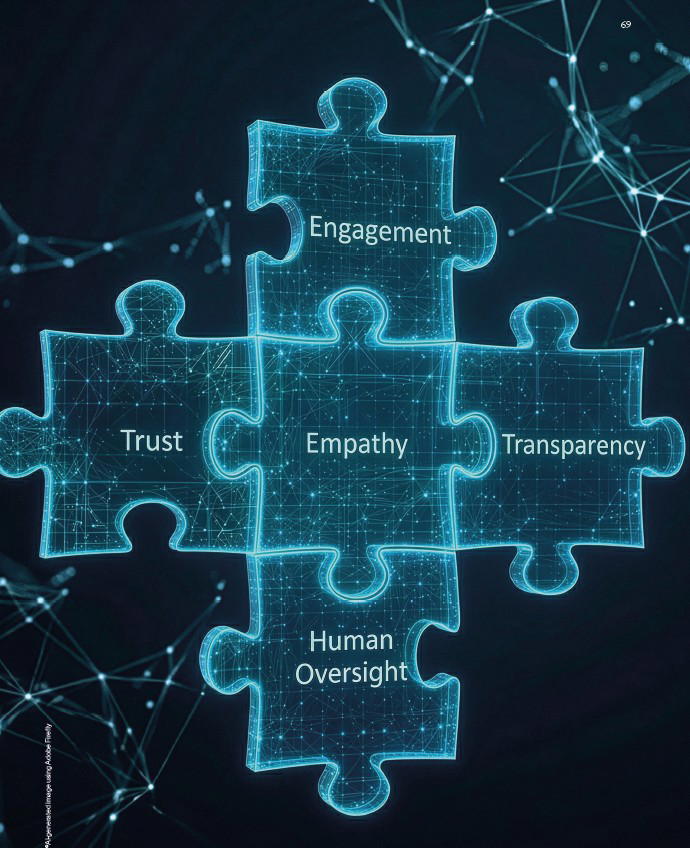
KPMG Singapore notes in its report, “Striking A Balance Between AI And Adoption In Customer Experience And The Need For The ‘Human Touch”, that businesses cannot rely on automation alone if they want to deepen trust and engagement. Transparency, empathy, and human oversight remain essential, particularly where customer experience is concerned.
That is especially relevant for a platform such as ShopBack, one of the region’s best-known rewards companies. Founded in Singapore in 2014, it serves over 50 million users across 13 markets, including the US and Germany, through partnerships with more than 20,000 global merchants across travel, fashion, and food. Last year, it drove nearly US$5.5 billion (S$6.95 billion) in sales for its merchant partners. Its growth offers a useful example of how AI in consumer ecosystems is not only about optimisation, but about understanding behavioural nuance across markets.
In 2025, ShopBack received a Major Payment Institution licence from the Monetary Authority of Singapore, a development that strengthened its ability to scale payments responsibly in a region where trust in digital finance can vary sharply. This matters because systems built for Singapore do not necessarily map neatly onto Indonesia or Thailand. Platforms operating at regional scale therefore need more than efficient algorithms; they need systems informed by responsible data interpretation and local sensitivity.
Seen this way, inclusion has practical consequences for how effectively platforms understand and serve the people using them. All this echoes co-founder Lai Shanru’s aim to forge close connections and mutual understanding through ShopBack, which she’s described as “a place where you forge strong friendships”, and whose values she feels are integral to “take us to the next stage”.

SUPPORTING TALENT POOL
If leadership and platform design determine how AI is governed and applied, then the talent pipeline determines who gets to participate. Even the most sophisticated systems will remain narrow in outlook if the pool of people building them remains narrow.
This is why initiatives focused on widening access matter. In Singapore, the Infocomm Media Development Authority’s SG Women in Tech initiative, launched in 2019 in partnership with the wider tech community, has reached more than 115,000 girls across primary and secondary schools as well as tertiary institutions. The aim is not simply to raise awareness, but to encourage more young women to see the sector as one they can enter and shape.
Community-led efforts such as TechLadies addresses the issue from another angle. Founded in Singapore in 2016 by Elisha Tan, it supports women pursuing tech careers through networking, training, and mentorship programmes. For the last, members are paired with industry practitioners for three months, allowing them to acquire real project experience and build a portfolio. Today, TechLadies has a community of more than 4,200 members across Asia.
The significance of such initiatives lies in perspective. A more representative talent pool changes what questions are asked, which problems are prioritised, and what assumptions are challenged during product development. Tan has noted publicly, gender diversity in tech is not just a women’s issue; it is an industry-wide challenge that requires collective responsibility.
Women alone do not hold the answer to a fairer AI, nor does representation automatically guarantee better outcomes. However, inclusion remains essential to the quality of the systems being built. It affects oversight, trust, relevance, and resilience. It determines which risks are noticed, which assumptions are questioned, and which users are fully seen.
As Budget 2026 demonstrates, Singapore is committed to spearheading AI transformation across the region, but the real value will be in how carefully and wisely we shape this future. Across infrastructure, digital platforms, and talent pipelines, women can certainly contribute to this.
Meanwhile, as we craft increasingly sophisticated prompts for tools like ChatGPT, one question we should continue to ask is: how can Singapore build the future we want to lead?
At a glance: SINGAPORE’S AI STRATEGY
National coordination Singapore’s AI plans will be overseen by the National AI Council, led by Prime Minister Lawrence Wong and his seven-member team , which includes Deputy Prime Minister Gan Kim Yong and Digital Development and Information Minister Josephine Teo. By coordinating policies across ministries, it will ensure resources and regulations match.
AI solutions in key sectors The National AI Missions will focus on sectors such as advanced manufacturing, connectivity, finance, and healthcare. Bringing AI projects from the pilot stage to real-world use and scaling what works are the goals.
Enterprise support & adoption The Enterprise Innovation Scheme will be enhanced for 2027–2028, with 400-percent tax deductions or a $50,000 limit on qualifying expenditure to encourage the adoption of artificial intelligence. Companies seeking to transform their operations and train their staff can take advantage of the new Champions of AI programme offering firsthand guidance. In addition, the Productivity Solutions Grant promotes productivity in businesses with its expanded range of AI-enabled tools.
Innovation infrastructure An AI Park at One-North will bring startups, researchers and companies together in a shared space for development, testing and collaboration.
Skills & workforce development The TechSkills Accelerator will train non-technical professionals in AI, beginning with accounting and law. Additionally, Singaporeans enrolled in selected MySkillsFuture AI courses will have access to premium AI tools for six months.
Building AI talent & learning pathways Higher education institutions will strengthen AI education, while training pathways are being updated to equip workers with practical AI skills.
For more inspiring stories in a+ all year round, gift yourself or loved ones a digital subscription.