Symbols carry power. Combine them into an amulet and that power takes on a more personal dimension. This is the idea behind Les Bijoux Talismans, the third chapter of Signes & Symboles, where Chanel turns its four emblems—the camellia, star, sun and lion—into talismanic jewellery. There are 25 pieces in the set.
Throughout the chapter, the amulet motif appears as a long, tablet-like shape, which Chanel turns into a necklace called a cartouche chain. The shape appears alone or repeated within larger designs, with openwork that adds lightness while preserving the symbols’ strength. A polished gold outline highlights each amulet in relief, framed at the top and bottom with diamonds set in closed settings.
Stars, engraved like lucky signatures, appear singly or in multiples across the amulets, while the four house emblems are either sculpted in relief or reinterpreted as precious charms. The result is a visual language built around repetition and variation. Some amulets are simply paved with diamonds; others are centred with a precious stone, allowing the same talismanic form to take on different identities.
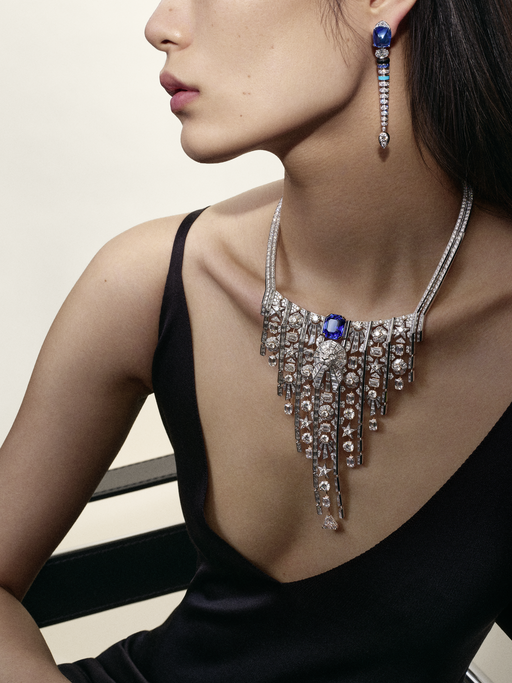
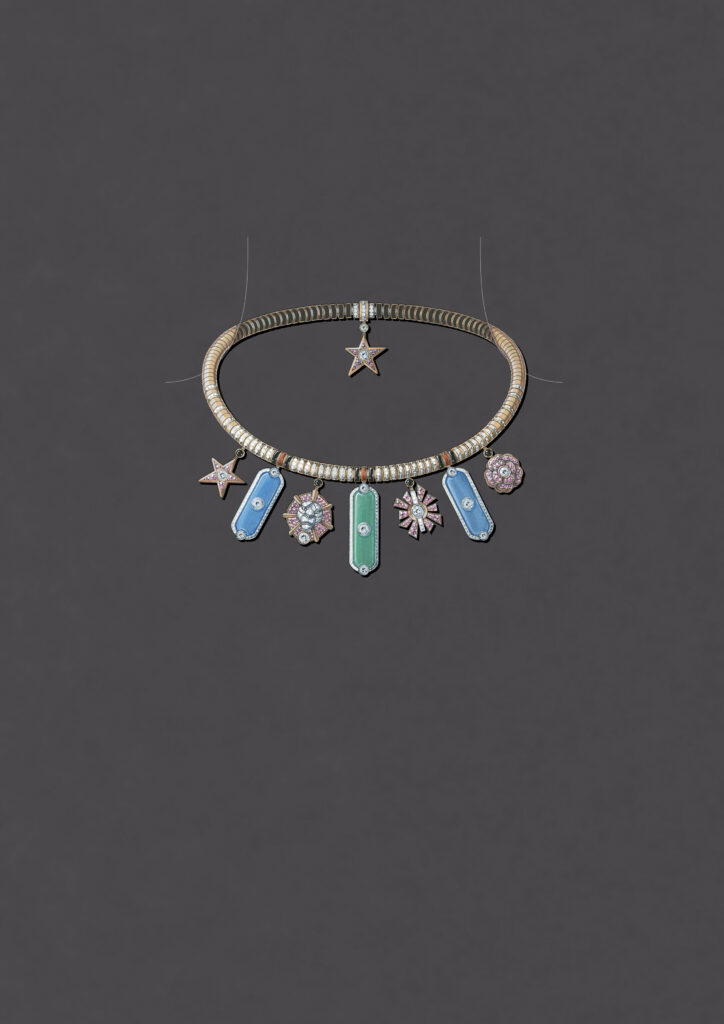
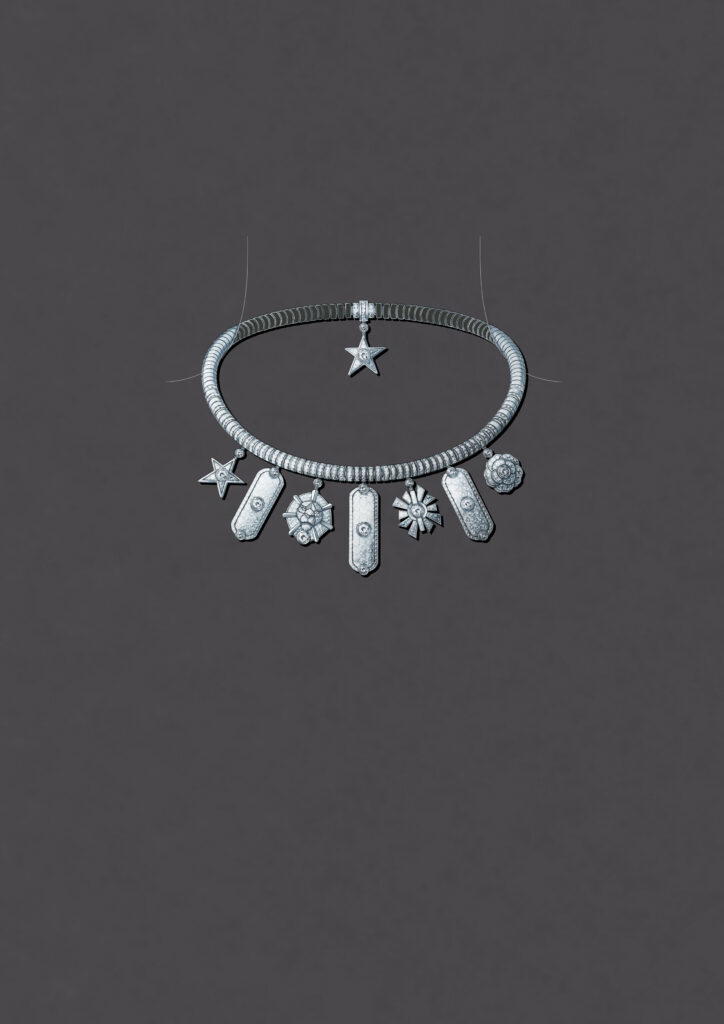
The Talismans de Symboles necklaces come in white gold with diamonds, or in a more colourful variant combining turquoise, chrysoprase, carnelian and onyx. All four emblems of the collection intersperse with the amulet— the elongated pendant shape that acts as this set’s signature and repeats radiating around the neck.
The amulets set the primary reading direction, radiating from the neck like sun rays, carrying the star, lion, sun and camellia within that spread. The contrast is deliberate: the amulets’ elongated shape plays against the rounder forms of the signature emblems. Warm carnelian and garnet meet cool turquoise and chrysoprase. Pink sapphires and diamonds sit against hardstones and white ceramic, reflecting Mademoiselle Chanel’s instinct for pairing the precious with the non-precious.
The tubular sports cord chain, with white ceramic elements that nod to Chanel’s ceramic work in watchmaking, was originally developed for the Haute Joaillerie Sport collection. Its build gives the necklace suppleness and real movement, rather than a fixed, static drape.
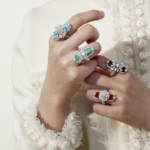
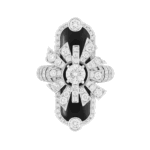
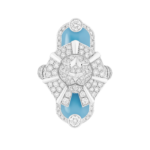
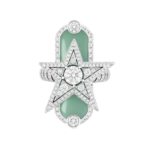
The Talisman Gabrielle rings extend the amulet motif into their own format: four rings, one for each emblem, each limited to an edition of five. That number is deliberate, as five was Mademoiselle’s own symbol of luck. Each design runs the full length of the first phalanx, with the amulet set below the emblem and a tubular chain encircling the finger.
The Star ring pairs diamonds with chrysoprase, its branches extending past the frame in a radiating line that breaks from the amulet’s elongated shape beneath it. The Camellia ring sets diamonds against carnelian, its petals splitting into a whirl: the upper four turn clockwise, the lower five counter-clockwise. The Sun ring follows the brand’s signature black-and-white palette, with diamonds set against onyx and the sun’s rays pushing outward past the ring’s frame. The Lion ring combines diamonds with turquoise, its mane radiating like the sun in solar diffusion. With only five of each ever made, the rings sit among the most sought-after pieces in the set.
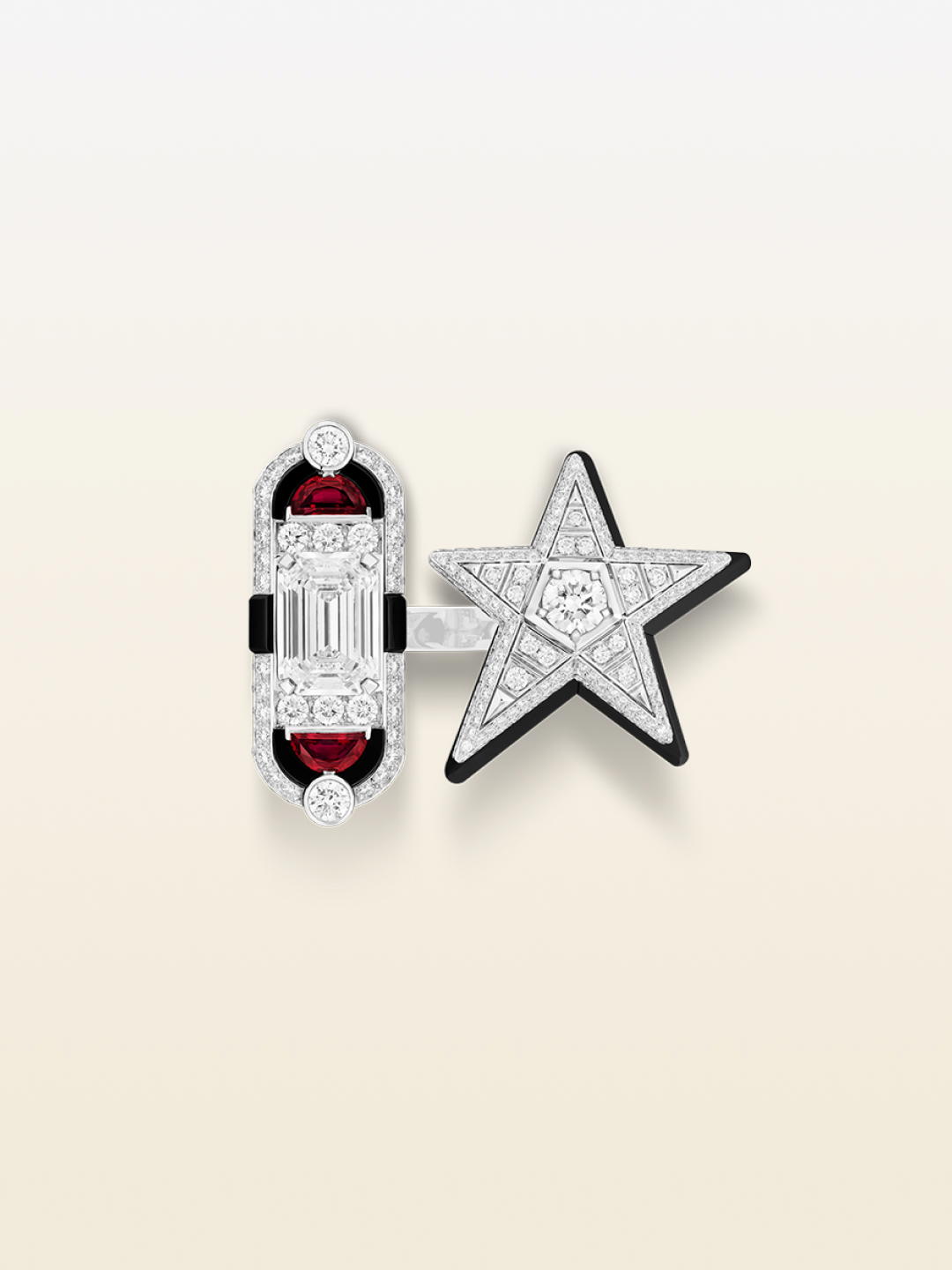
While the Talisman Gabrielle rings already push past convention, running the full length of the first phalanx, the Talisman Contraste ring goes further. In a toi et moi format spanning three fingers, it is anchored by a 5.13-ct emerald-cut D-FL Type IIa diamond.
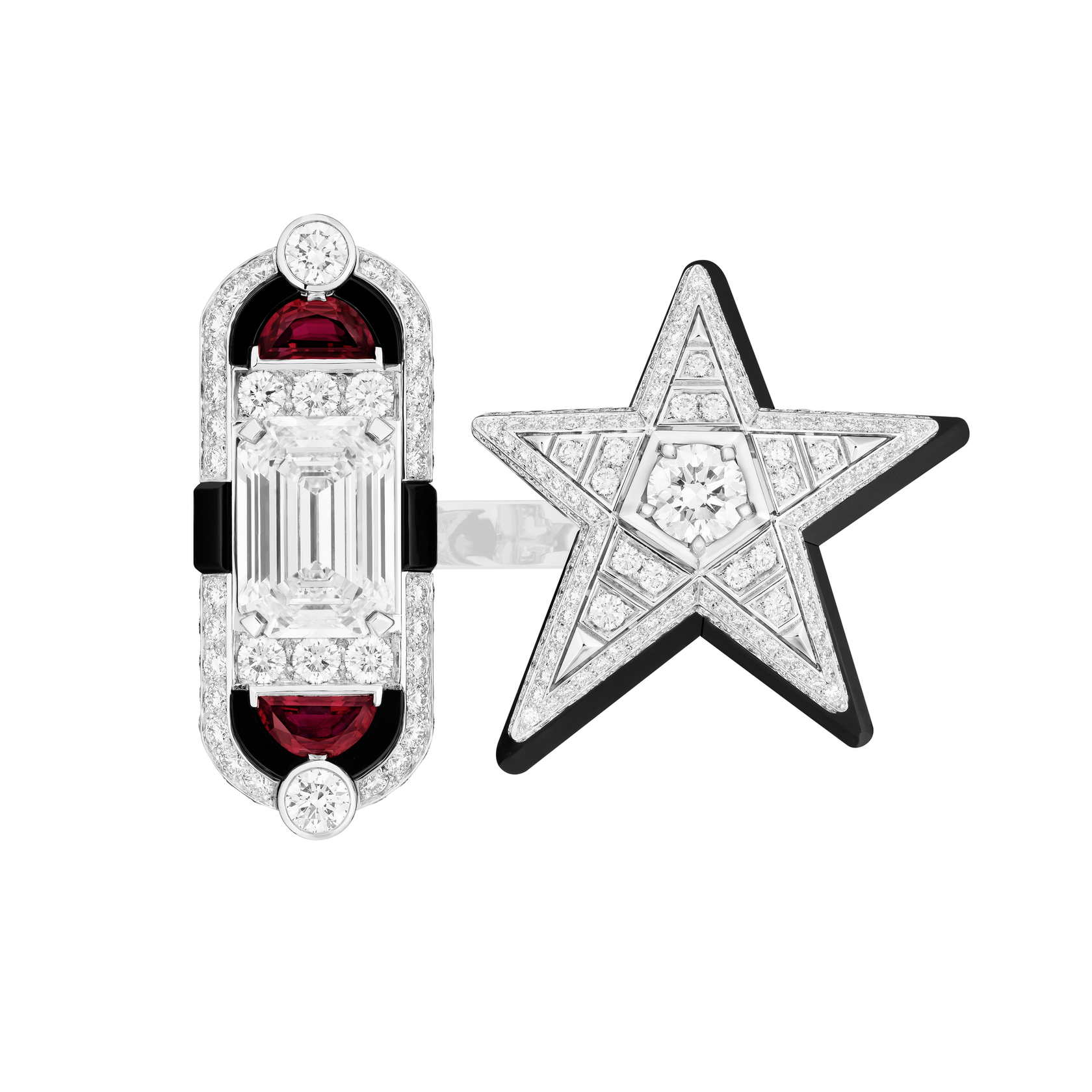
The comet and sun meet within the design. The comet’s familiar form is drawn from the 1932 Etoile brooch, while a border of onyx surrounds the star, creating a shadow effect and a sense of levitation seen throughout the set. The sun is depicted more subtly using half-moon rubies, evoking a Mediterranean sunset. Positioned between them is the amulet, highlighted with ruby and onyx, and centered by an emerald-cut diamond.
The diamond is not the only rarity here. The rubies are a matched pair, uniform in colour and cut into an unusual half-moon shape found on only two other pieces in the collection. Even the onyx accents required their own development: made to measure, each has a roof-shaped cut engineered to fit precisely into the points of the star.