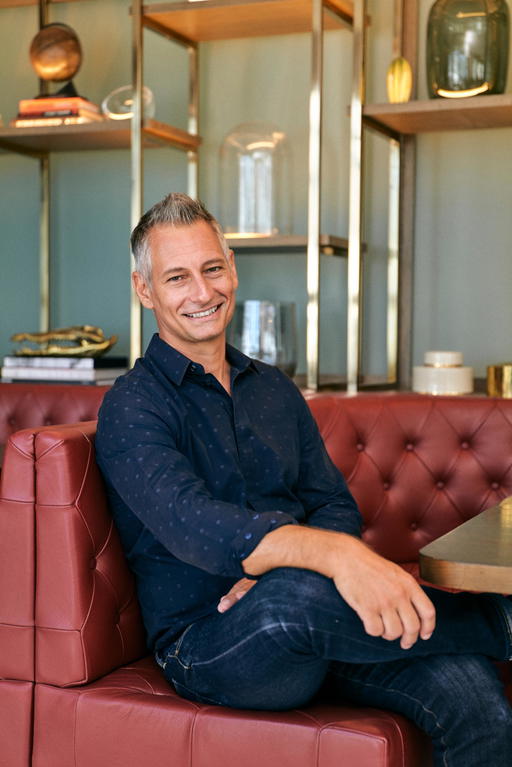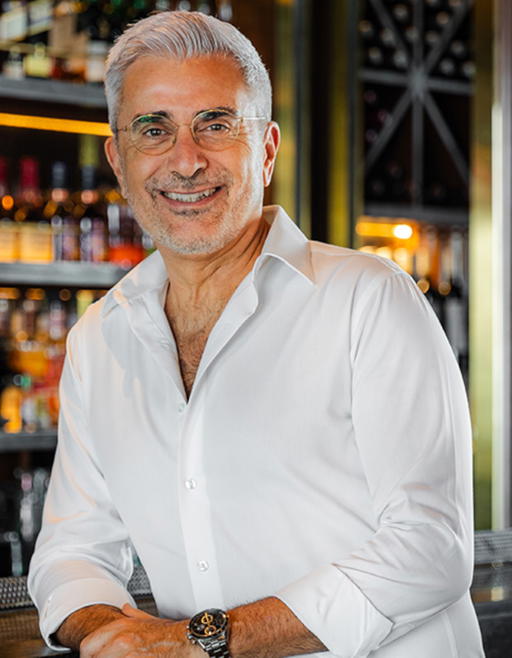

As with many company founding stories, the one behind Two Men Bagel House has a twist: it was supposed to be Three Men Bagel House. But the third partner got stuck up a gum tree, so two guys set up shop instead. A decade on, one-half of the founding duo has left the company, and Clement Fu has returned to join Jereborne Lam. They now run the bagelry chain together.
A cult-like following has seen the brand become synonymous with great bagels. Lam says its success is not just due to fine products and service, but also because it’s a homegrown brand that pushes the envelope in a way that makes local consumers proud. “The bagel is a foreign product, but we pay homage by keeping it as authentic as possible while injecting local elements,” he explains.
The marriage of Eastern and Western components applies not just to the food, but also the language and design. This convergence, he adds, allows customers to feel like they are a part of the brand. Traditional bagels consist of yeasted wheat dough rolled into a ring, boiled briefly in water, and then baked, not fried or baked immediately like doughnuts or standard bread. Typically served with cream cheese and lox or smoked salmon, red onion, tomato, capers, and fresh dill, they are savoury and crunchy on the outside but chewy inside.
But Two Men Bagel House has been raising the bar on what bagels can be since the outset, stuffing them with ingredients like peanut butter and spam when bagel shops in New York and Canada were still serving them the old-school way. Its bagels are hand-rolled, boiled in honey water, and baked in-house every morning.
“We respect the history and craft behind the bagel but saw its potential as a fun product. The way we took it apart and messed with it? It was pretty original. No one else was doing it back then in Singapore or elsewhere.”
Jereborne Lam on setting Two Men Bagel House apart
A business playbook with an emphasis on innovation explains why the menus vary somewhat across the company’s four outlets: approximately 30 percent of each outlet’s offerings are exclusive to the location. Much as the degree of variety involves extra work, it allows each store to capitalise on a unique identity. The Novena branch, for example, focuses on smoked meats, while Joo Chiat’s signature is wood-fired bagels.
Lam and Fu, however, learnt the hard way not to get carried away. Last year, they opened two non-bagel concepts—Two Men Rice Bar, and Butter The Grease Station by Two Men—but shuttered both earlier this year. “They were bad calls because we didn’t know the products and how to incubate them,” Lam says candidly. “The entire experience was a learning curve. The projects were short-lived, but they taught us a lot. That’s more important,” Fu underscores.
According to Fu, Two Men Bagel House’s biggest challenges lie in funding and leadership development; the company currently employs about 50 people. Even so, the partners credit three factors for the brand’s success in the cutthroat F&B industry. The first, fair compensation. “The trade is notorious for its long hours and low salaries, and I wanted to change that,” says Lam. “Our staff might not be paid the best in the market, but we treat them like family and make sure they have a work-life balance. When we care about our people, they will care about our customers.”


Second, autonomy. Employees are encouraged and empowered to propose ideas. Third, a value system both customers and staff can believe in. Fu says, “It’s not hard to start a F&B business. Anyone can do it with a five-figure sum. The challenge is to keep people engaged, whether with new menus or specials. Bagels, coffee, and humanity are our core values, with humanity being the most important. We not only expect that from our customers, but from ourselves as well.”
As a gesture of altruism, the duo recently lowered their prices by approximately 25 percent to make the products more accessible to those who enjoy them. While the bagels used to go for $15 to $24, they now range from $11 to $19. “We noticed many students coming into our stores, which made us realise that we should cater to everyone rather than just a specific demographic. We believe we’re here to feed the next generation,” Fu asserts. Despite the reduction in price, the bagels are the same size and the flour weight is unchanged, he adds.
Much as the brand has found a place in the sun, Lam believes it is only now ready to start the chapter on making headway. “Even though we have four outlets, I’ve always told my team that the past 10 years were spent ‘crawling’. We needed to learn how to ‘walk’ and we had to ‘fall’ again and again, but we’ve now gotten the basics right.”
Given that Two Men Bagel House has cornered the market here, the plan is to take the brand overseas. Lam and Fu have set their sights on expanding regionally and globally. Fu lets on that the goal is to establish a foothold in every country and eventually open a shop in New York, the birthplace of bagels. The company’s vision is to become the first internationally-recognised Asian-run bagel brand.
The support of a competent team, Lam says, means it is well-prepared for potential pitfalls. “There will be many mountains to climb in this next journey. However, if we move forward as a unit, we can leave a footprint.”
Art director: Ed Harland
Photographer: Mun Kong
Photographer’s assistant: Melvin Leong
Hair: Sarah Tan
Makeup: Keith Bryant Lee using Lancome