Khairina Sari
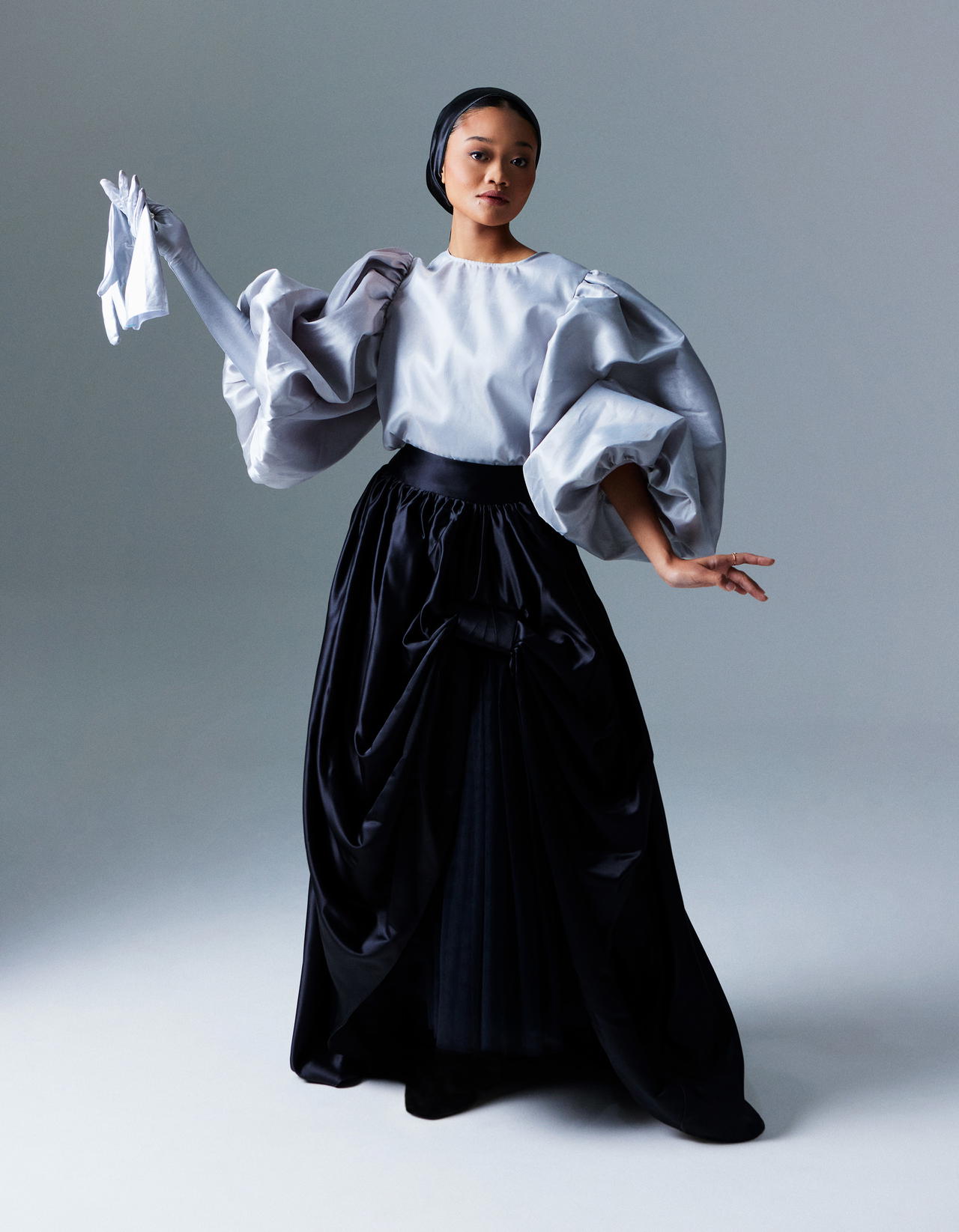
For 25-year-old Khairina Sari, fashion runs in the family. Growing up around seamstresses and designers, her decision to pursue the craft followed a generational legacy. Her grandmothers made clothes for their friends and family for special occasions like Hari Raya; and her uncle ran Surip, a label with a store at City Hall from the late 1990s to the early 2000s.
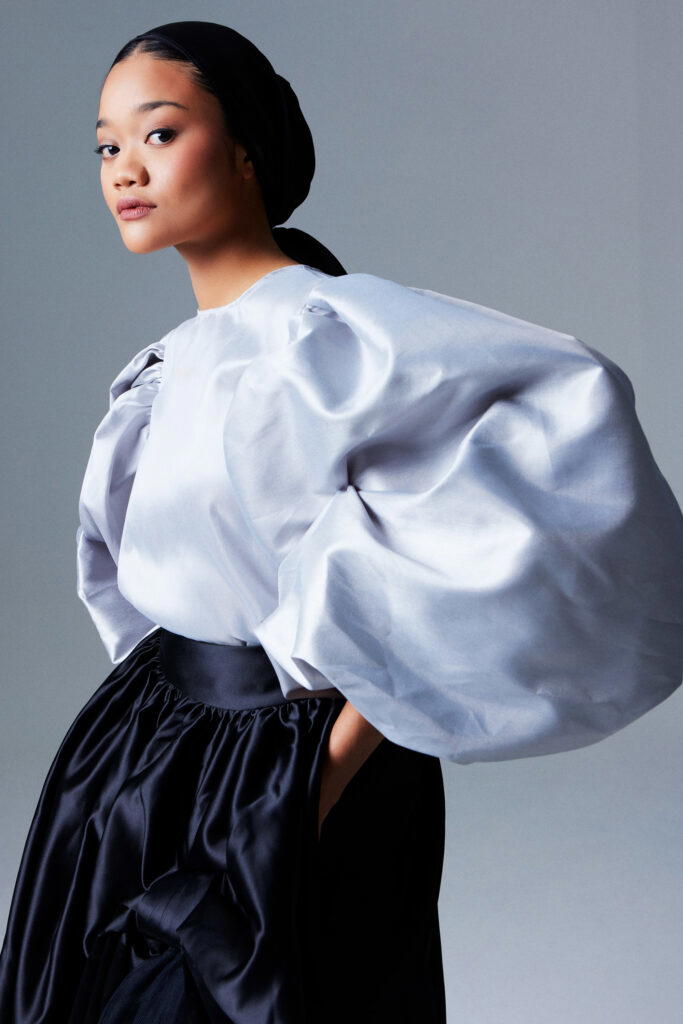
“Their passion and talent resonated with me from an early age,” Khairina shares. Last month, Khairina graduated from LaSalle College of the Arts with a collection that puts modesty at the forefront. Titled ‘Underneath the Veil’, the six-look collection is an experimental take on the various Islamic veils: the burqa, niqab, and hijab.
Khairina has long been interested in exploring modesty through her craft. Working on the collection has allowed her to unpack her relationship with modesty as a Muslim woman.
“Modesty, to me, goes beyond merely covering my body,” she says. “It allows me to present myself in a way that prioritises inner beauty, intellect, and character over mere external appearance.”
Fashion has consistently misrepresented modesty as sartorial oppression rather than as a personal choice. A key component of Khairina’s research was examining the complex intersections between faith and the law, and fashion and agency by exploring the stories of Singaporean Muslim women in various fields, including religious teachers and healthcare workers. Muslim nurses, for example, were not allowed to wear the tudung until 2021.
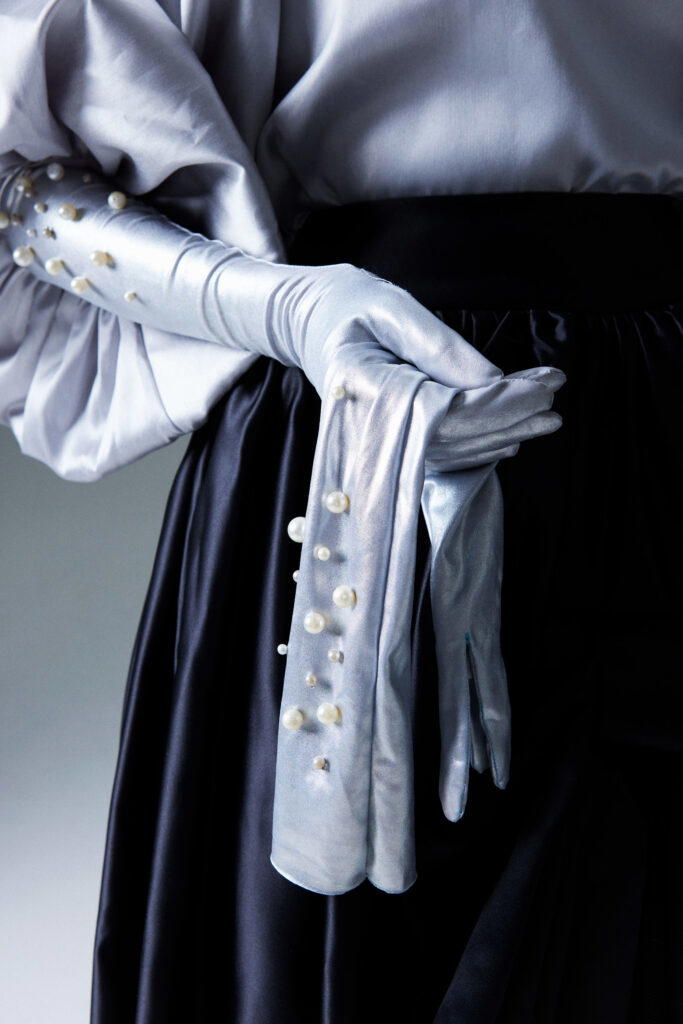
“With my collection, I want to tell stories that shed light on the prevalent challenges surrounding the hijab, while also revealing the inherent beauty that lies beneath the religious practice,” she says. By weaving in a diversity of workplace experiences in her collection, Khairina demonstrates how modest wear—like any other form of sartorial expression—is nuanced, personal, and multifaceted.
On the technical front, her process is decidedly referential. To better understand the worn experience of the burqa, Khairina draped a sheet of fabric over her body, proceeding to cut a slit that would slowly expose her face and body. An image of a white cotton burqa from 19th-century Afghanistan, for instance, served as the point of inspiration for her draping and ruching exercises. To replicate the silhouette and drape of a burqa, she experimented with toiles of calico, silk organdy, and lace to achieve the precise proportions of the veil.
The result? A collection that is delightfully lush and regal in its finishings, and complex in its references—a fitting direction for her plans. Khairina wants to foray into Muslim bridal wear by establishing her label to cater specifically to young Muslim women.
“I believe it is important to tell these tough stories. This experience has shown me the transformative power of storytelling and the immense impact it can have on individuals and communities.”
Liz Zhu
There is serendipity to Liz Zhu’s practice. From found clothes to found conversations, she bricolages fabric in the same way she pieces stories together. Trained as a fashion designer, Zhu moved to Singapore to pursue a master’s degree in arts and cultural entrepreneurship. She has been documenting the clothes she makes and wears on Instagram (@dow.d.p) since 2020—often two sides of the same coin.
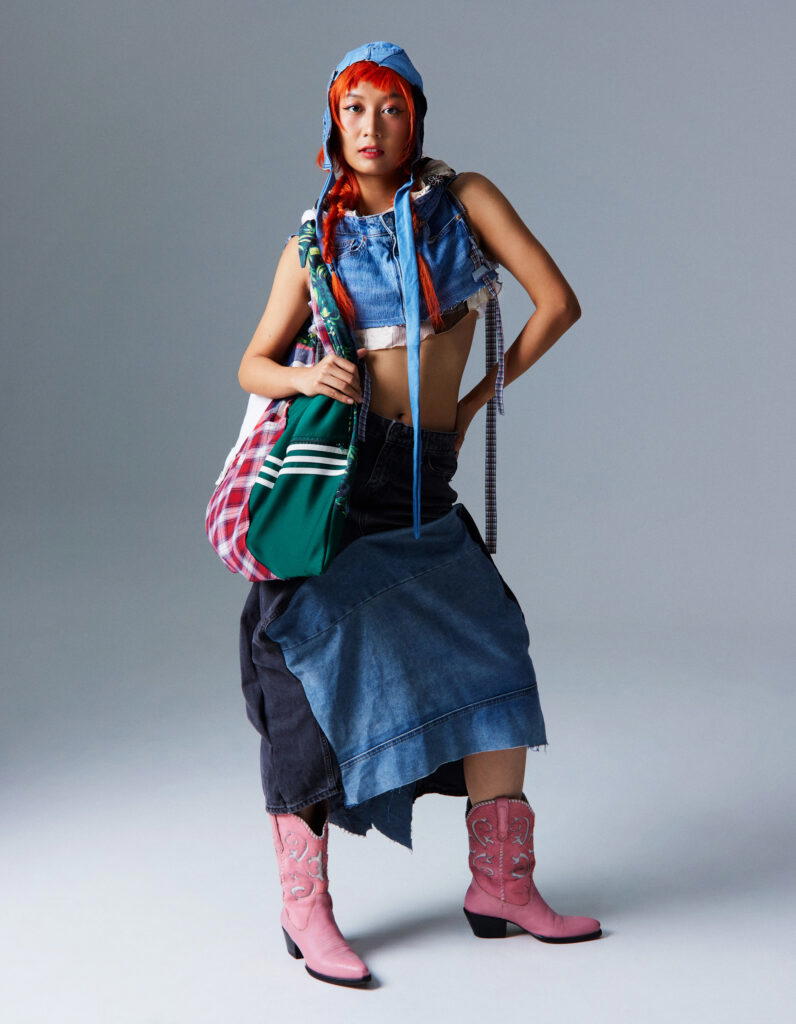
“My styling technique revolves around challenging traditional norms by taking pieces out of their original context and repositioning them,” says Zhu. “Using this approach is the key to achieving unique and daring looks, which has informed my designs with a similar sense of playfulness and subversion.” In her closet, sheet masks turn into boleros, tote bags become pinafores, and umbrellas become headpieces.
This freewheeling outlook doesn’t stop at what she wears. Her perspective on the fashion system imbues her work with an incisiveness rare in this industry. For a designer like Zhu, who sees through excess and overconsumption, upcycling makes sense. “The world is already filled with repeating clothes and items, and I see enough ‘raw’ materials for me to manipulate into unique pieces,” she says.
Currently, she is part of dblspace’s site-specific residency programme, where creative practitioners are given four weeks in a space in Peninsula Shopping Centre. In her time here, she has had conversations with communities at the veteran mall that have informed her upcycling practice.
Zhu has interviewed the senior community that spans punk musicians and dressmakers, who have generously shared personal items, memorabilia and stories with her.
“As I contemplated the validity of the fashion system, I gradually grew keen on the senior community to counteract the aggressive focus on youth and competition in the [fashion] industry.”
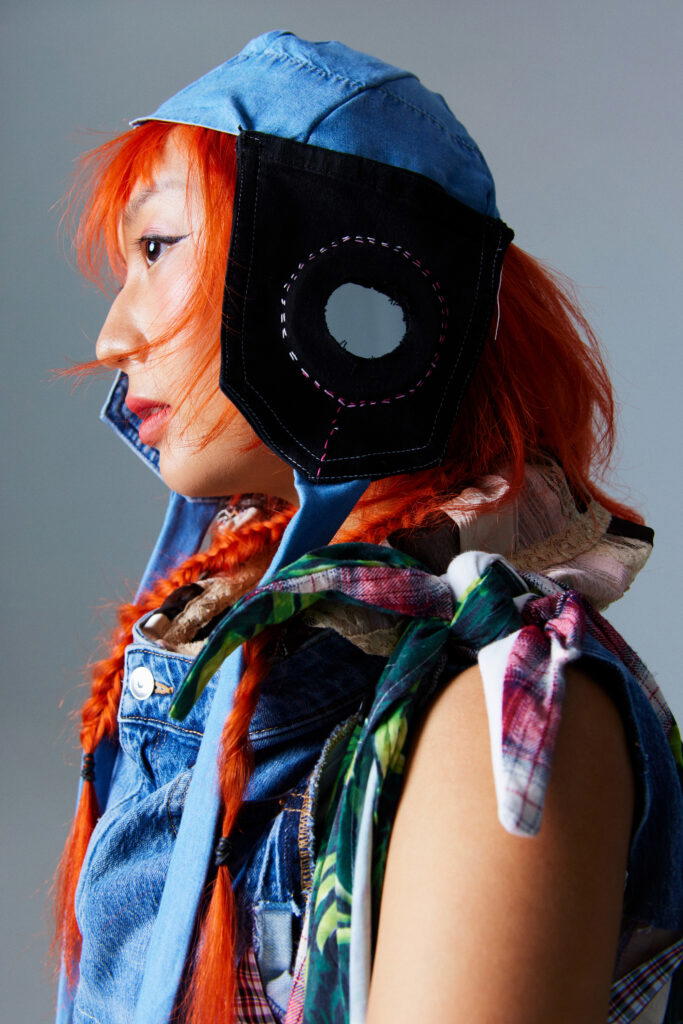
In collaboration with a photographer and a performer, she is currently remaking collars collected from a recycling station at Post Museum, a Singapore-based independent cultural space. Also in the works for Zhu is ‘KOVA’, an exhibition that will open this October at Jinjiang Hotel in Shanghai, where she will create a tote made from recycled and dead-stock textiles.
In her various creations, one might notice the influence of street dance—and this is because Zhu herself has been practicing street dance for the last eight years.
“As a choreographer and dancer, I often spontaneously reference functional construction and material used in streetwear and sportswear because of my frequent impressions of them, which also spark my versatile and transformative design style.”
For Zhu, her interest in fashion is rooted in the allure of creativity. “I was set free when I encountered art and design,” she shares. “You have so much more room to explore one’s capacity and subversive attempts as an individual, a collective, a community, or a society.”
Josh Tirados
Josh Tirados has a way of making spaces feel otherworldly. When I first encountered his work in 2022, it was in a semi-lit room in an industrial building in Tanah Merah. A performer was dancing butoh, an avant-garde form of Japanese dance theatre traditionally characterised by arrhythmic contortions of the body. The space was bare with white curtains that hung from a wooden structure—and there he was, Tirados performing while wearing his own pieces that resembled the curtains that housed his performance, titled ‘Breath’.
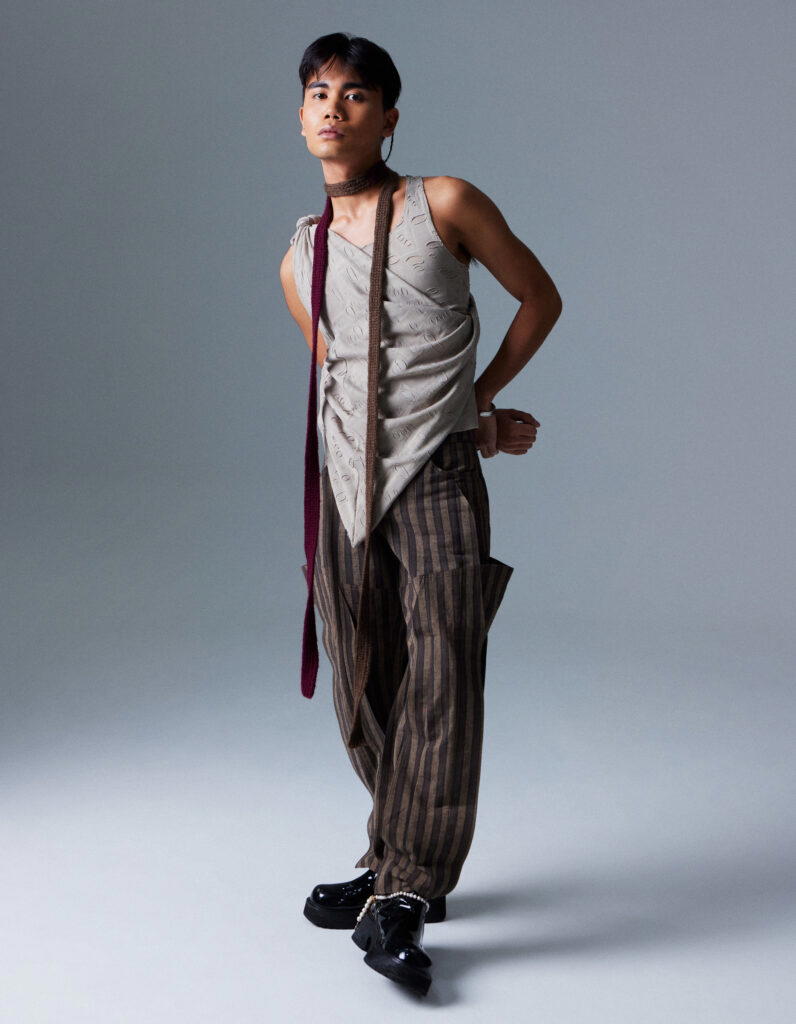
Performance is central to the Tirados experience. In May, he launched his eponymous label with a collection called Anino, which borrows its name from the Tagalog word for shadow and reflection. “I thought that to be very kind, that it could hold the weight of both,” he shares. “Shadow and reflection are traces of the existence of our being—not only to others but, quite beautifully, to ourselves.”
Anino was unveiled with a fashion show staged at Figment Embassy House, a refurbished shophouse in Geylang. The show was developed as part of a residency programme with An Asylum, a local conceptual label that provides funding and a furnished studio space to develop one’s practice.
“At this stage in my making, I have to make beautiful and wearable clothes,” says Tirados. “I wanted to dress myself, my friends, and my loved ones. What is something they would choose to wear?” The clothes in Anino reflect the intimacy of Tirados’ craft. Featuring handcrafted details such as clay amulets by artist Carmen Ceniga Prado, the 15-look collection is dedicated to his mother.
There is unspoken maturity to his designs. Anino featured gauzy knitwear, panelled waistcoats, vests, and trousers, and tiny sling bags that looked like they were fashioned from foraged fungi. His brand may be young, but Anino feels like the sort of collection that could only come from a designer who has located the confidence to be unwaveringly consistent in their vision.
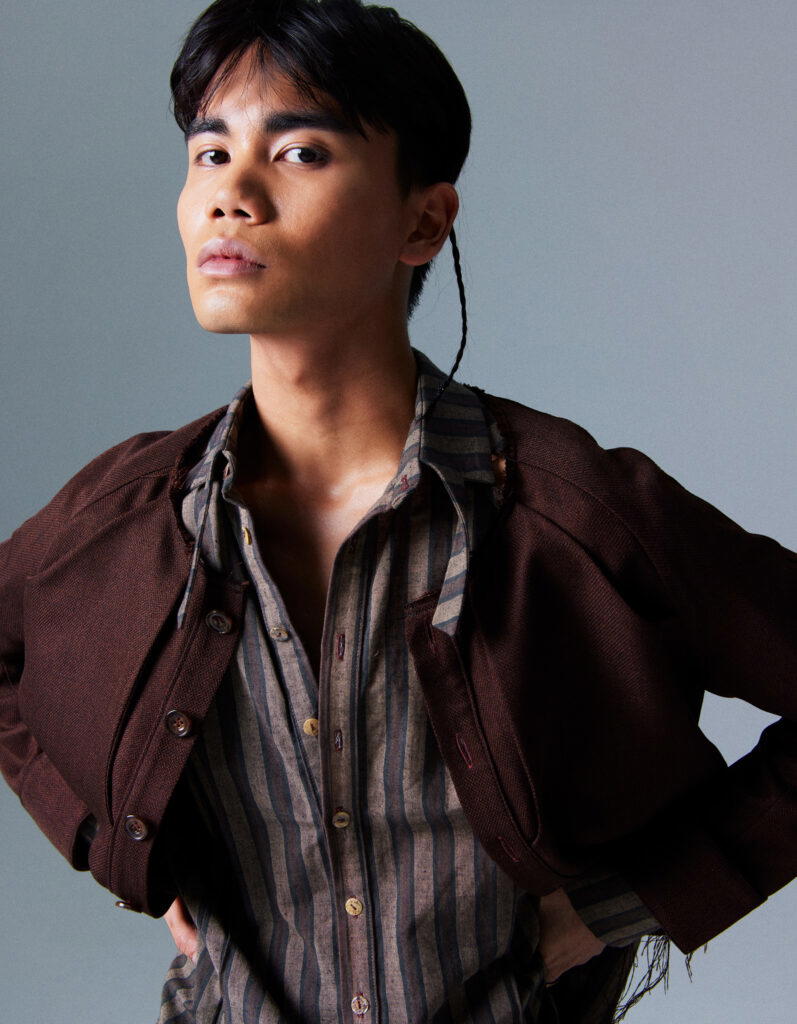
In July, Tirados staged another performance at Appetite, where he performed alongside performance artist Yuta Yang and musician Huang Ming Xiang. In this performance, audiences could notice the smallest of details—the twang of Huang’s pipa, the glide of Yang’s elbow against the sharpness of Tirados’ breath.
In each of Tirados’ shows so far, disciplines blur into one another. The sonic elements aren’t mere backdrops to the clothes; neither are the clothes simply costumes worn by performers. In these shows, collaboration is synaesthetic. “Sixty-one names, I counted,” Tirados mentions when sharing about the team effort that went into creating Anino. “This work is really not my own.”
On the heels of Anino, Tirados will release a new tank top design that will soon be available for sale. In the meantime, he has been pattern-cutting for An Asylum’s runway show, and helping to produce XYNNYX, an upcoming rave.
“In performance, I feel like I can tap into the grotesque, salacious, and joyous parts of the mind in a more extreme, visceral way,” he adds. “Holding space for people in a country where it is so precious feels only right.”
Art Direction Chia Wei Choong
Hair for Zhu & Tirados Sean Ang, using Goldwell
Makeup Keith Bryant Lee, using Gucci Beauty