There is an entire department dedicated to sound in the Ferrari engineering division. Internal and external engine acoustics; pitch and cadence at different revs; even the tubes required to pipe the engine grunts to the driver. “You buy a Ferrari because of the sound. If the sound is good, you can drive the car for hours,” the engineer tells me.
I am nursing a glass of wine at the rooftop bar of the five-storey Executive Spa Hotel in Fiorano Modenese. The Ferrari Museum and Factory is a five-minute drive away. Next to me, seven Ferrari employees dive into the technical and engineering intricacies of the Prancing Horse’s latest — 296 GTS.
You can feel the passion these engineers have for their automotive creation. In response to a simple question about downforce generation, one of them delivers a 10-minute spiel while gesticulating to illustrate his point about wind and force.
Ferrari generates that kind of fervour. In 2019 and 2020, consultancy Brand Finance ranked the Italian marque as the world’s strongest brand, valuing it at US$9.1 billion (S$12.8 billion). Even Disney couldn’t match it.
But can it elicit the same enthusiasm without sound? A Ferrari wouldn’t be a Ferrari without its iconic harmonics, right?
Similarly to its hardtop sibling, the 296 GTB, the 296 GTS has a plug-in hybrid powertrain that pumps out 315Nm of torque and offers about 25km of electric driving. The battery takes three hours to fully charge, despite the regeneration system charging it every time you brake — and you’ll be braking a lot. However, imagine a Ferrari cruising silently along the Italian roads at 120kph.
In the beginning, it was disconcerting. When I first powered up the 296 GTS, I had to call the Ferrari representative over to ask if I was doing something wrong as the discernible roar that usually accompanies the supercar’s start was missing. He laughed and said, “Si, it’s on. You are now in hybrid mode.”
It was harder to work on the transition merger actuator (TMA), which switches the 296 GTS instantly between full electric, hybrid and petrol. The engineers didn’t want any lag because it wouldn’t be “very Ferrari”. In this respect, the team has done a fantastic job.
My 296 GTS for the day seamlessly switched between all three modes, with the only noticeable difference being the sudden high-pitched whine of the 2.9-litre twin-turbo V6 coming to life.
A New Era
That petrol engine was another engineering feat. This is the first-ever hybrid V6 on a Ferrari berlinetta (Italian for little saloon) and convertible.
Automotive purists might consider it blasphemous, but with internal combustion engines being phased out in many developed countries — the European Union is banning the sale of fossil fuel cars by 2035 — Ferrari had to head in the electric direction.
This year, it announced that by 2026, 60 percent of its automotive sales will be hybrid or fully electric.
The team adopted a new layout for the V6, placing the cylinders at a 120-degree angle for performance reasons. Incidentally, this architecture also made the engineers christen the engine “piccolo V12” or the little V12 because of its aural similarities to the Ferraris of yore at higher revs.
While not a replica, the sounds are delightful and do encourage you to push the car harder and even faster.
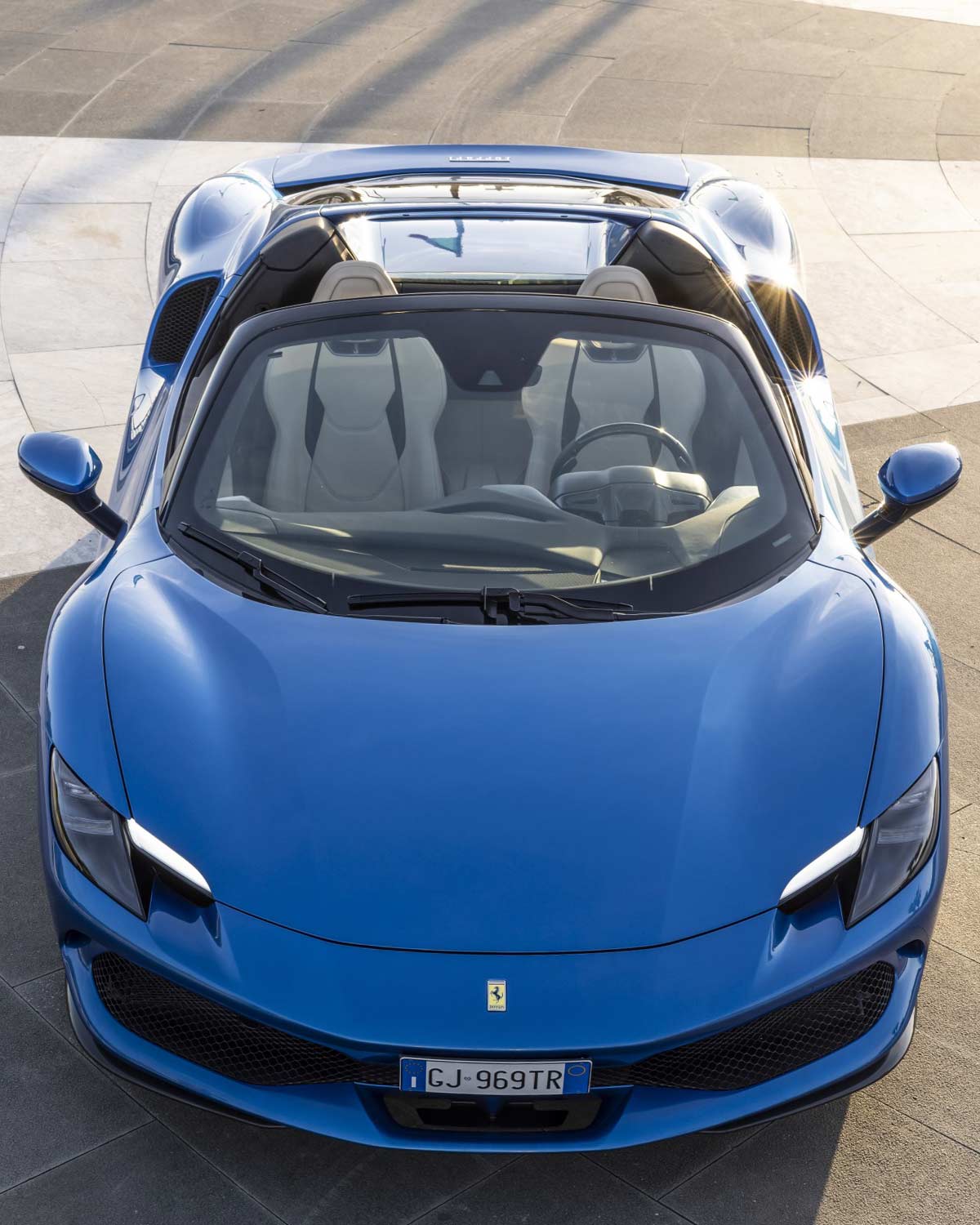
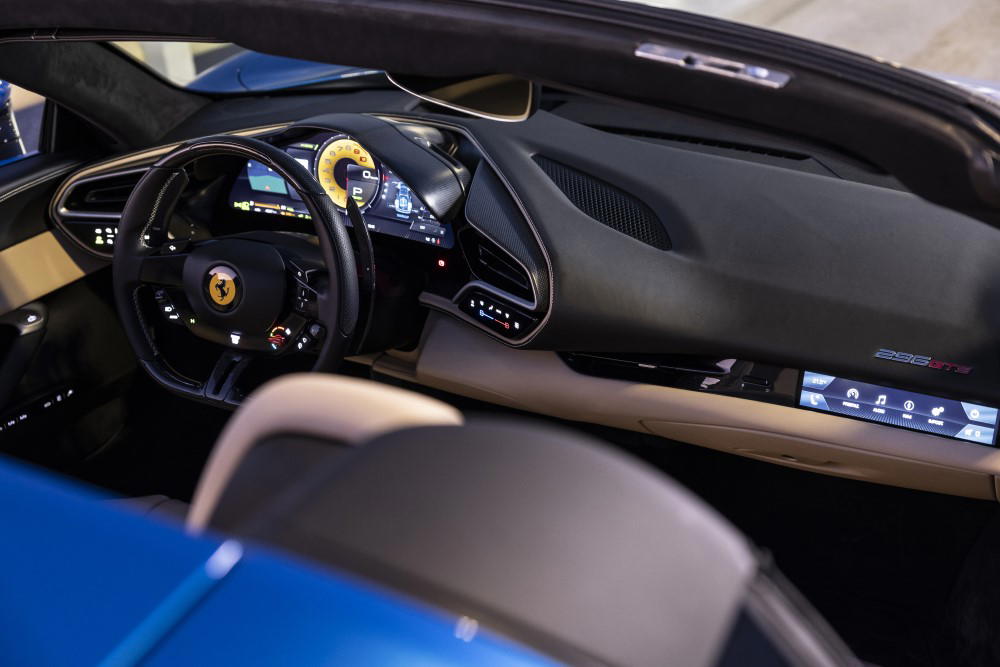
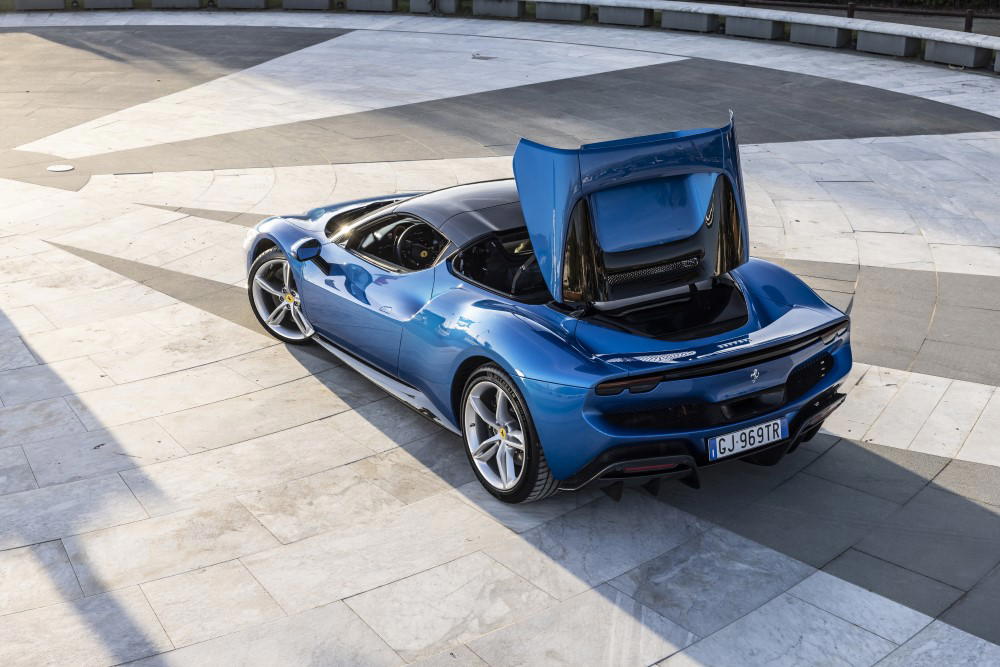
The team even redesigned the “hot tube” — a literal pipe that funnels the engine’s natural sound into the cabin for the 296 GTS. When the retractable hardtop (pictured, below), which takes 14 seconds to complete a cycle, is closed, the tube goes to work.
Additionally, while the 296 GTS is 70kg heavier than the 296 GTB, its engineers have retained a similar driving performance without compromising design or engineering.
A quick glance down the side reveals that the wheelbase (2,600mm) is shorter than other Ferraris — the Roma is 2,670mm, and the 812 GTS is a whopping 2,720mm. The team faced an enormous challenge here as they had to maintain the sublime Ferrari driving experience in a smaller package. They have succeeded, as I can attest.
The “flying bridge” — the small rear window — at the rear is a nice touch. Inspired by Ferrari 250 Le Mans, a 1960s race car designed especially for the famed endurance race, it complements the dual flying buttresses at the rear engine bay. Masten Gregory, Ed Hugus and Jochen Rindt piloted the 1965 version to victory. Ferrari has not won the endurance race since then. But that is a story for another time.
The 296 GTS designers also used a two-layer concept to minimise weight. While the body is constructed from high-strength, lightweight aluminium, the underbody, visible when you squat and peer closely, is made from carbon fibre. This move helped the team shave about 5kg.
In light of Ferrari’s shift towards an electric future, the 296 GTS waiting list has already reached three years, and it will likely get longer. Petrol-powered cars will soon become collectors’ items.
Old Ferraris are already hammering for tens of millions of dollars at auctions. As a result, I expect this trend to continue and prices to rise. Ferrari doesn’t build cars; it creates la passione.