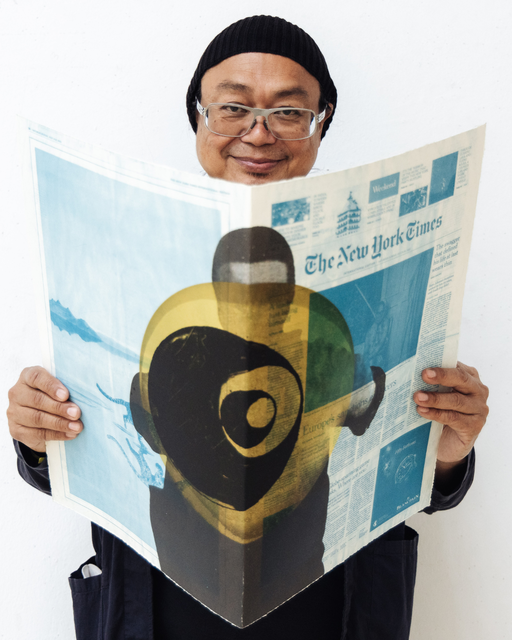

I arrive at STPI on a Friday afternoon for my interview with Eko Nugroho. As I approach the gallery, the first curious figures peer askance from behind dark baubles, safe from the fermenting heat outside. Perhaps with instinctual guilt, I put aside my phone to return the gaze briefly.
Nugroho, based in Yogyakarta, is known for his keen observations of politics and urban environments, fostered during the late 1990s when Suharto’s regime gave way to the Reformasi. While refreshed allegories of contemporary life have emerged since, his masked figure remains a consistent motif through his two-decades-long artistic career.
His current exhibition, “Strange Monster View”, running from 22 August to 10 October, is a wry commentary on our digitally saturated lifestyles and our identities, dissonant and afflicted by mutant forms.

In parallel to his works that spill out of the canvas and onto the walls and ceiling of STPI, Nugroho’s affability gushes with generosity. It is the sort of demeanour that demands reciprocated presence and intentionality. As we speak about his works, his penchant for forming relationships makes itself apparent. I begin my interview where it all starts: his practice.
YOUR PAST WORK MERGES STREET ART, GRAFFITI, COMICS, WAYANG KULIT, EMBROIDERY, AND BATIK. HOW DOES PRINT FACTOR INTO YOUR PRACTICE?
Something I believe is that the artist does not belong to his medium. Instead, he belongs to his ideas. Despite having trained in painting, I have since increased the number of materials I worked with based on my growing interactions with craft communities.
For example, I have encountered embroidery and batik artisans whose work is slowly disappearing as more people opt for cheaper, mass-produced textiles. So I try to learn from these artisans to promote appreciation of these art forms to wider audiences, while finding new ways to express various concepts.
The same applies to my artworks at STPI. I want to showcase the collaborative process, techniques, and materials that I have developed with the team. Between the mural and print works, I want to display a contrast in different art forms as well. This tells people that art is borderless, and can exist in collectible forms as well as impermanent forms.

YOU HAD TWO RESIDENCIES AT STPI, IN 2012 AND JUST LAST YEAR. HOW DID THESE EXPERIENCES SHAPE “STRANGE MONSTER VIEW”?
At the time of my first residency, I explored the city in depth to acquaint myself with its architecture, sounds, tastes, feelings, information, and my relationships with Singaporean friends. All this information fed into my sculptural works presented in “We Are What We Mask”, exhibited in STPI in 2013.
I kept in touch with the STPI team, and we became close friends. When I returned for my second residency last year, the gallery had become more like home to me. In conversation with the team, whose mastery of print I wanted to highlight, I decided to focus on experimenting with new printing techniques for this exhibition. I began by creating lots of drawings and paintings in my studio. From there, the team proposed various unique approaches to print I could try out.
So in my first exhibition here, I used more conventional techniques such as relief printing. In this one, you can see that I have tried out new methods, which include etching, flocking, pulping, embossing, and mokulito.

YOU INCORPORATE LOCAL MOTIFS SUCH AS THE QUInTESSENTIAL CHILLI CRAB IN CHILI CRAB MASK (2026).
I was lucky enough to experience the National Day celebrations in Singapore twice, in 2025 and this year. From observing the crowds and various events, I sensed that Singapore’s National Day carries a strong sense of community for everyone. It is in the way people gather, occupy space, and relax on this occasion.
I wanted to capture these symbols of nationalism, relationships I have forged here, as well as architectural points in the city from my point of view as someone who both belongs and does not belong here. These markers were turned into the masks through which I see my own “strange monster view”.
"Eko Nugroho: Strange Monster View"


YOUR WORKS ARE A HUMOROUS COMMENTARY ON OUR SMARTPHONE-DRIVEN CULTURE. HOW DID THIS THEME COME ABOUT?
What my work wants to question is: what if one day all our technologies ceased to work? Would we still feel human? In Singapore, as well as plenty of modern societies, our lives have moved into the small cage of the phone. We have become less aware of our surroundings even if we are able to discover more information to help us get smarter.
But the most important thing is to make good friends and communicate with the people around you. I do not think it is possible to stop using our phones completely, but we need to listen to each other more and to be physically present to each other. This will help us build support systems through the joys and sadness of life. The works remind both myself and others to connect with each other more.

WHAT DOES BEING A “STRANGE MONSTER” MEAN TO YOU?
It means watching, learning, judging, criticising, and expressing in a way that does not conform to others’ expectations. That is why I think it is necessary to talk to others, to bond through our “strange monsters”.
WHAT DO PEOPLE OFTEN MISREAD ABOUT YOUR WORKS?
Rather than misreading, I see it as different people bringing their own interpretations. I do not want to guide people towards understanding my works a certain way, as their perspectives enrich my practice. Their varied backgrounds, influences and worldviews form the basis of discussion that my works entail, as well as inspiration for my future practice.
SO YOU ARE ENCOURAGING AUDIENCES TO HAVE THEIR OWN STRANGE MONSTER VIEW OF THINGS?
Yes, exactly!
“Eko Nugroho: Strange Monster View” exhibition also offers public programmes led by an artist talk with Nugroho and curator John Tung, and activities such as mokulito, screenprinting and embossing. Free guided tours on selected days are also available. More details here.