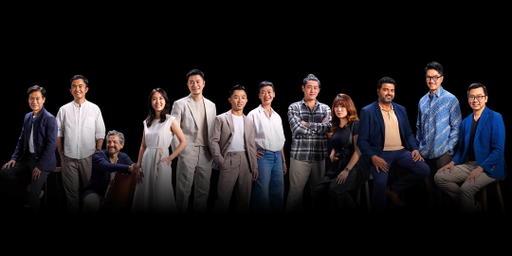
Calvin Soh moots newfangled concepts like he is delivering a TED Talk, complete with measured pauses and rhetorical debate.
His latest adopted trope is tech analyst Azeem Azhar’s Exponential Age — the idea that unprecedented technological advancement is overhauling global economies, politics and societies.
“I’ve worked with clients like Nokia, which was valued at US$100 billion (S$138.9 billion) and had a 40 per cent market share. Five years later, Microsoft bought it for US$10 billion. How do I prepare my family if businesses are being disrupted like that?” muses the business consultant, who works with brands such as homegrown furniture maker Castlery.
An advertising veteran and former chief creative officer at Publicis, Soh is in the business of pitching bankable ideas. Only in this case, he’s presenting his family as a proof of concept. His 16-year-old daughter, Ava, illustrated a wearable NFT worn by Ukranian President Volodymyr Zelenskyy at the Shangri-La Dialogue, while 20-year-old son Dylan’s modular hydroponic planter system won the Design Business Chamber Singapore’s Design for Good competition in 2021.
The proud father claims some credit for their entrepreneurial bent. “If the assumption is that jobs will always be disrupted, then the question we asked was, can we teach our kids to find problems to solve? As long as there are problems to solve, you’ll always have a career. If it is a social problem, then you’ll have both purpose and profit.”
In that line of reasoning, Soh’s notion of the family as a startup is hardly iconoclastic. What parent hasn’t made projections to gird their child to an ambiguous future?
Like many modern households, they’re partial to a collaborative approach to parenting — complete with mutual performance reviews and annual general meetings.
“Our kids can disagree with us. Just don’t be an ass about it. We can try things your way. If it works, great, we will admit we were wrong; if not, then you try our way,” he describes.
Pottering about One Kind House – his mother’s 2,000 sq foot Telok Kurau house reimagined into a cooking school, urban farm and social cause incubator – he leads me through edible gardens bombinating with life, and his kids’ 3D printer-equipped studio.
Initially seeded as an active ageing avenue for his septuagenarian mother, it has sprouted into a platform for showcasing sustainable, innovative living — albeit through pin-sharp marketing.
The Singapore Tourism Board’s video of an effusive Pinkett-Smith family crowing over the Sohs’ cooking and dining session, a highly rated Airbnb experience, is ample proof of the virtues of self-promotion.
Soh’s mother Helen, the family’s matriarch, tells me they’ve hosted corporate events for companies like Google. Hearing her son beat the drum for circular ecosystems, I have to ask: what is it with former ad men and farming? Soh counts Edible Garden City’s Bjorn Low as a contemporary and friend.
“When you live this stressful corporate life and have friends who’ve had heart attacks and serious health scares in their early 40s, how do you react? When it came down to it, I was part of an industry that sells things you probably don’t need and can live without. So can I use my skill sets to sell things we need and are good for the earth?” intones Soh.
The quippy creative argues that he’s “too cynical to change the world”, but wants to show Singaporeans a way of functioning beyond the myopic pursuit of material success. AI may be insidiously supplanting us, but the future isn’t necessarily dystopian.
“Right now, our education systems are all about competing with AI, but you can’t out-memorise a machine. A machine cannot be compassionate, creative or empathetic; that’s our advantage.”
Videography: Belle Chew
Photography: Mun Kong
Producer: Cara Yap
Styling: Chia Wei Choong
Hair & Makeup: Rick Yang/Artistry, Rick Yang/Artistry, assisted by Nikki Loh, using Shiseido and Keune