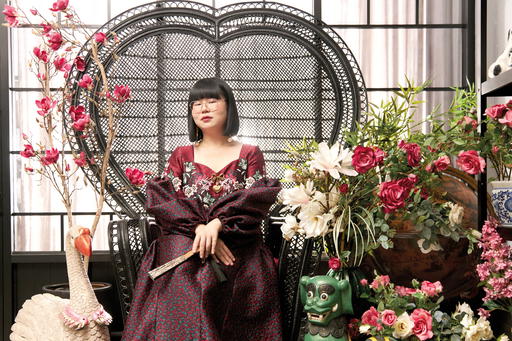
At five, Jarupatcha Achavasmit slotted her Hello Kitty handkerchief under the microscope in her mother’s lab. What she saw changed everything: threads crossing threads, colours bleeding into fibre, a hidden architecture she had never imagined existed. “I saw the structure of the weave so close, a hundred times closer,” she recalls. “It was like another world. I never looked at materials the same way again.”
Her mother—a soya bean scientist educated at Imperial College London—spent her days studying leaves and insects at Kew Gardens. Her grandmother, a seamstress teacher, taught Achavasmit to use a sewing machine before her feet could even reach the pedals. From these two women, a sensibility was formed: disciplined observation fused with patient craft.
Decades later, that same vision defines Achavasmit’s practice as a textile artist. She is renowned for working with metal not as a sculptor chisels stone, but as a weaver works thread. She believes it is intrinsically tied to human life, spanning from ancient tools and threaded needles to modern aircraft parts and medical implants.
“Metal is so versatile,” she says. At 52, she has hammered large copper sheets into form, drawn stainless steel wire down to a mere six microns, and guided it through sewing machines and handlooms, producing something closer to silk than steel.

I first encountered Achavasmit’s work at Singapore Art Week 2026, as part of OH! Moonstone, an art walk, organised by OH! Open House and curated by John Tung. Her monumental, ethereal installation ‘Light Metal Gossamer Bloom’ was displayed on the ceiling of Daily Diecast, a hobby shop on Moonstone Lane. She created it by hand-weaving discarded aluminium toiletry bottles stripped into fine strands during her residency at Peninsula Bangkok in 2023.
In “Living in an Elastic Time”, a recent group show at the Jim Thompson Art Centre in Bangkok, Achavasmit contributed ‘Sound of Era’—made during a residency in Udon Thani, on a former US military base from the Vietnam War. The sculpture confronts the legacy of Agent Orange, the chemical defoliant that scarred the Vietnamese landscape and its people for generations. A copper plate, beaten until it buckled and rusted, bears witness to those histories.”This is how humans hurt other human beings,” she says quietly.
“They hurt nature, the trees, the environment, and it echoes across many generations. History always repeats itself. Now we have the war in Iran. War is always with us.”
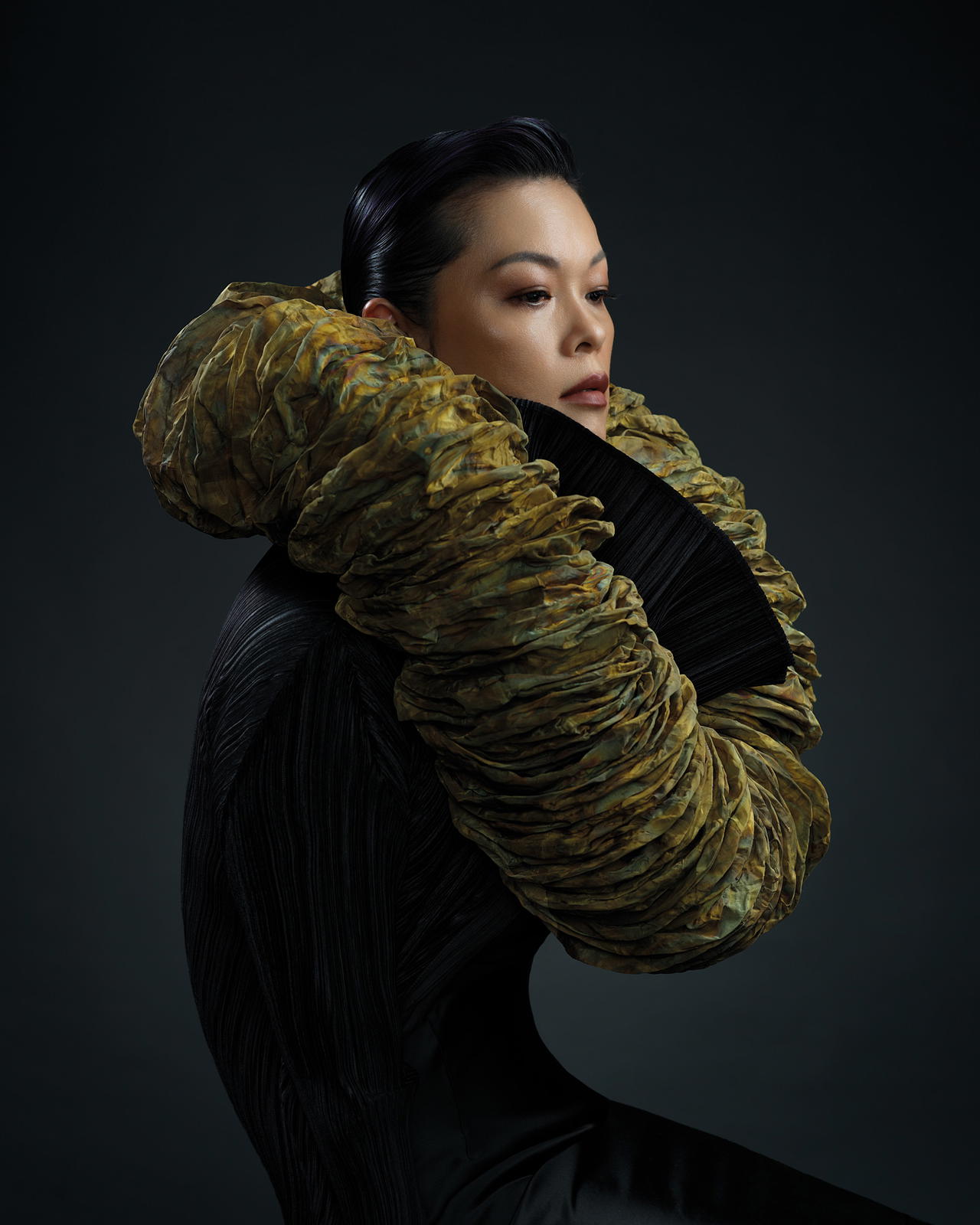
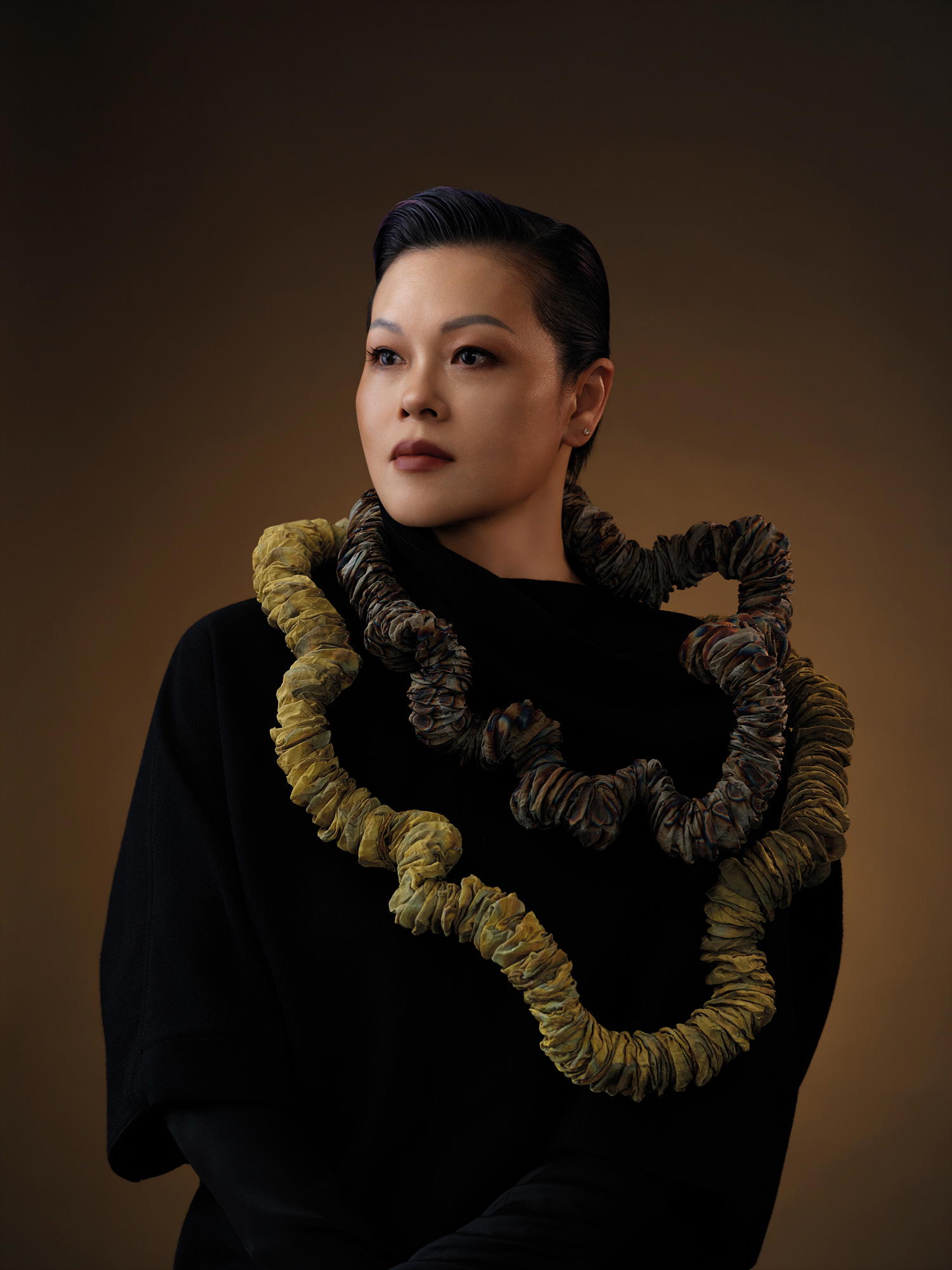
Her newest work is more intimate. After three years in the making, the ‘Malai’ series—her first wearable collection—takes its name from the Thai garland, those intricate flower strings given to loved ones at celebrations and funerals, only to be discarded. She aims to make that gesture permanent.
Achavasmit drew inspiration from Ida Ng, the CEO and co-founder of Helutrans Artmove, whom she met over dinner in Singapore. In her view, Ng embodies a rare balance of strength and femininity, a pairing she found deeply resonant. Woven in stainless steel, copper, silver, and brass, her pieces span statement sculptures to compact, travel-ready accessories weighing between 200g and 900g. “For me, weight is very important,” she says. “It provides a certain reassurance.”
Next, she aims to bring her work even closer to the body, experimenting with metal as wearable sculpture to explore how the material communicates differently.
It is a striking body of work. Trained in textiles at King Mongkut’s Institute of Technology Ladkrabang (KMITL), then at the University of Michigan Ann Arbor and Central Saint Martins, Achavasmit spent three decades teaching at KMITL and co-founded Ausara, a Bangkok atelier specialising in bespoke woven surfaces for hospitality and luxury clients. Her art has been shown at Warin Lab Contemporary, Milan design events, and Art Central Hong Kong.
The pandemic reshaped her approach, teaching stillness and prompting her to resign from her faculty position in 2024 and move to Chiang Mai. There, she built a new studio and home with her painter and activist partner Mit Jai Inn, a leading figure in contemporary Thai art.
In August, her work will be featured in the Textile Futures section, Gallery 8, as part of the inaugural exhibition at the new Merdeka Textile Museum in Kuala Lumpur. Achavasmit has also launched the Patra Artist in Residence Programme in Chiang Mai to support early-career women artists with studio space, production costs, and exhibition opportunities in Chiang Mai and Bangkok. “We lose a lot of female artists if they don’t make it right at the beginning,” she says. “If you want to help them, you don’t wait.
“It’s never too late,” she adds. “I started my company at 40, became a full-time artist in my 50s, proving you can begin at any age.”
There is a beautiful thread weaving from the five-year-old at the microscope to the studio she’s now building in the mountains. As a designer, she explains, everything had limits—the client, budget, installation, environment. Art, on the other hand, has given Achavasmit something else entirely: a way to send her messages more clearly, and to create without limits. “I want to jump into the water and swim freely.”