
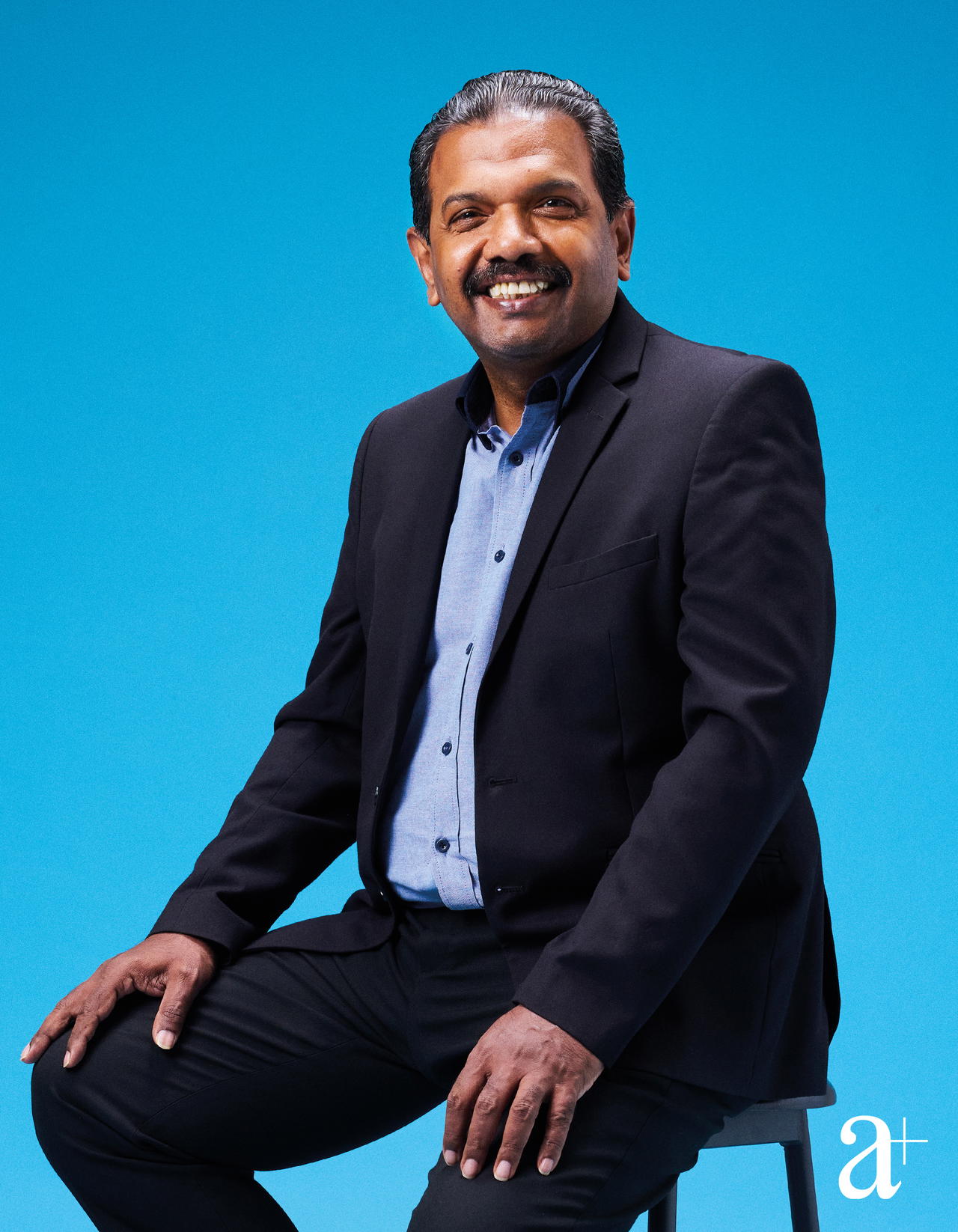
Two young people can have similar potential yet vastly different outcomes depending on who they know, the opportunities they encounter, and how confident they are to pursue them. Inequality today is less about financial support and more about access to opportunities, networks, technology, and exposure, says Anbarasu Rajendran. Since 2018, he has been CEO of the Singapore Indian Development Association (Sinda), a registered charity dedicated to uplifting the Singapore Indian community.
Anbarasu speaks from hard-won experience. Growing up in a modest, resource- restrained family meant he thrived with the support of his kampong. “Those early experiences taught me a powerful truth: no one succeeds alone. Behind every individual’s achievement is a community that lifts you with support and opportunities.”
Before Sinda, Anbarasu was an educator and later took on leadership positions at the Ministry of Education. Realising that helping individuals requires looking beyond the classroom eventually drew him to community service and social development.
Sinda’s work spans education, youth development, family strengthening, social support, and community engagement. Its flagship programmes, such as the Indian Business Leaders’ Roundtable Corporate Mentoring Programme, and the Let Her Shine! Career Clinic Series, link young aspirants with transformative connections. This opens up possibilities they may never have imagined for themselves.
Its family service centre adopts a preventive, developmental, and remedial approach to ensure families get the right support at the right time. This is because it is far more effective to build family resilience early than to intervene only when challenges become critical, Anbarasu explains. Initiatives such as the Early Learners Series engage parents and children during the formative years, helping to strengthen child development, parenting practices, and family bonds from the outset.
Sinda supported some 30,000 individuals and families last year, but Anbarasu believes impact isn’t measured by reach alone.
“The real question is whether interventions help people become more self-reliant, resilient, and ready to seize opportunities.”
Anbarasu Rajendran on creating change that lasts
“The real question is whether interventions help people become more self-reliant, resilient, and ready to seize opportunities.”
He views the obstacles he faces in his work as strategic imperatives shaped by the vicissitudes of a rapidly evolving social landscape. The first priority is keeping Sinda relevant as new skills, technologies, family dynamics, and aspirations reshape what people need to thrive. He places significant emphasis on staying grounded by engaging stakeholders and using data and insights to develop programmes rather than relying on historical assumptions.
The second is reaching those who need help but don’t actively seek it. Sinda tackles this with proactive outreach—Door Knocking Exercises and partnerships with schools, community organisations, volunteers and grassroots networks. “We work intentionally to identify needs early and connect families to support before challenges become more entrenched,” he says.
Anbarasu believes no single organisation can solve complex social issues alone, so conversations with potential partners focus on what all stakeholders can achieve together for the community. Strong partnerships, he says, are built on a shared belief that investing in people is not just a social responsibility but a collective investment in Singapore’s future too.
The future-ready social service model should be proactive rather than reactive, collaborative rather than fragmented, and empower rather than rely on dependency. By leveraging data, technology, and AI, organisations will be able to anticipate emerging needs, tailor support, and deploy resources more efficiently.
That said, social services remain fundamentally human. “Trust, empathy, and meaningful relationships cannot be automated. A social worker, mentor, volunteer, or community partner must inspire confidence and hope to drive lasting change.”
Photography Mun Kong
Art direction Annalisa Espino Lim
Grooming Sarah Tan using Charlotte Tilbury and Goldwell
Photography assistant Artemii Chumak